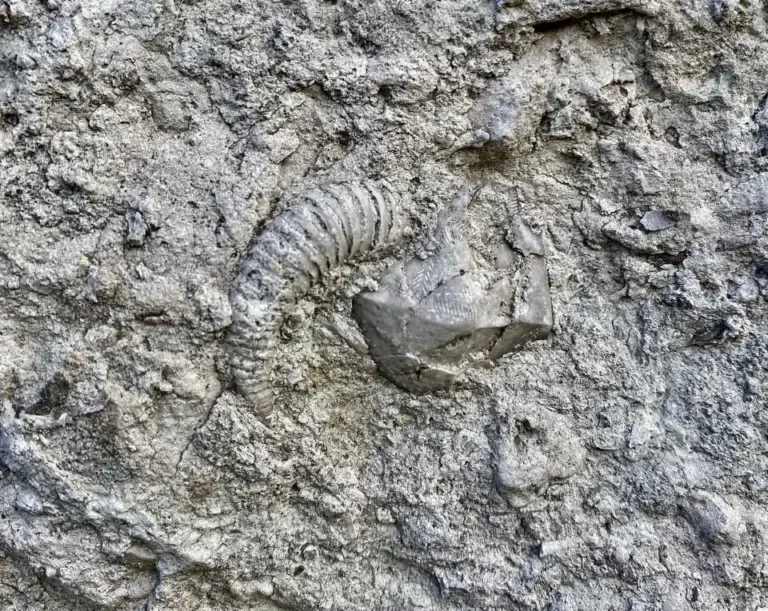
On Vasilyevsky Island in St. Petersburg, a rare fossil was found in the stone cladding of an ordinary residential building. Palaiologists identified it as an ancient sea creature that lived here hundreds of millions of years ago, when there was a prehistoric sea on the site of the city.
A unique find was noticed in the decoration of the basement of a building on Morskaya Embankment. Attention specialists attracted by the well-preserved calyx of an extinct echinoderm –
Cheirocrinus. Since the house is located near the Karpinsky Institute, scientists were able to immediately study the sample. They explained that the limestone used for the cladding was formed approximately 460 million years ago. Imprints of ancient life are often found in such rocks, but this find is special.
The discovered creature belongs to the rhombifers, which are also called cystoids or “sea bladders”. These extinct organisms were distant relatives of crinoids. During the Ordovician period, they inhabited the ancient seas in abundance. Of the entire variety of stalked echinoderms, only sea lilies have survived to this day.
We see part of the calyx, which consisted of large calcite plates, and the beginning of its long stem,” comments Nikolai Semyonov, a freelance employee of the Geological Exploration Museum of the Karpinsky Institute. “Thin feeding appendages extended from the upper part, which helped catch plankton, but they were not preserved on this specimen.
It is difficult to determine the exact species of the organism, since many cheirocrinids from this territory have not yet been sufficiently studied. The origin of the limestone only allows us to assume that the fossil could have been mined in the Middle or Upper Ordovician deposits of the Leningrad region, which are actively being mined for construction needs.
This amazing find right in the center of the metropolis reminds us of the deep geological past of the region. We can only hope that the ancient fossil will not repeat the sad fate of another famous artifact – the trilobite from the Makarov embankment, which disappeared without a trace – and will become a new point of attraction for everyone interested in history and paleontology.
The material was prepared with the support of the Russian Ministry of Education and Science as part of the Decade of Science and Technology.
Source: @menteetmalleo