Scientists at Perm Polytechnic University have developed an innovative method for controlling robots that allows them to effectively diagnose pipelines with bends and turns. This invention has already received patent and can significantly improve monitoring of the condition of oil and gas pipelines.
Modern pipelines require regular monitoring to prevent accidents and leaks. To achieve this, autonomous robots are increasingly being used that can detect damage such as corrosion, wear and cracks. However, existing robot models often encounter difficulties when passing curved sections of pipes, which reduces their efficiency.
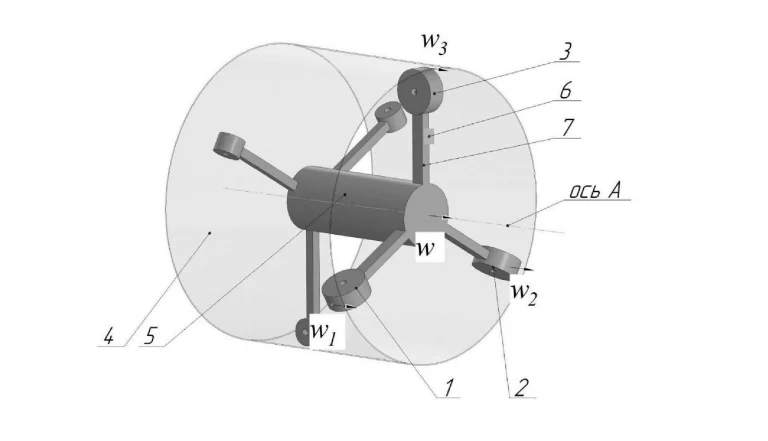
Scientists from Perm Polytechnic University have proposed a solution to this problem. They developed a way to control the robot, which ensures its stable orientation and maneuverability even in difficult sections of the pipeline. The method is based on the use of a robot with three drive wheels, each of which is equipped with an independent motor. When going around bends, two wheels rotate at the same speed, and the third one rotates at an increased speed. This allows the device to accurately determine the radius of curvature and adapt its speed for optimal movement.
“Our method allows the robot to quickly navigate in space and overcome difficult areas without losing control,” explains Dmitry Kuchev, assistant at the Department of Equipment and Automation of Chemical Production at PNIPU.
A new development by Perm Polytechnic scientists opens up prospects for better and faster monitoring of industrial pipelines. This is especially important for preventing accidents and reducing environmental risks. The invention can be used in oil and gas pipelines and heating networks, which makes it a universal tool for diagnosing pipeline systems.
Source: naked-science
Photo: Design of an in-pipe robot. 1 – first drive wheel; 2 – second drive wheel; 3 – third drive wheel; 4 – pipeline; 5 – in-pipe robot; 6 – gyroscope / © Mikhail Grigoriev, Getty images