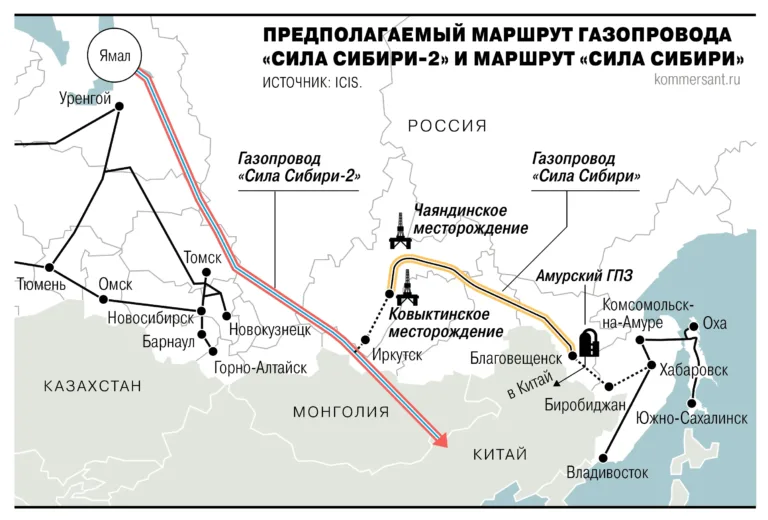
At the 5th Eurasian Economic Forum in Astana, Kazakhstan’s Minister of Energy, Erlan Akkenzhenov, unveiled details of a major project to construct a transit gas pipeline from Russia to China through Kazakhstan. The planned capacity of the new route toward China will reach 35 billion cubic meters of natural gas annually. An additional 10 billion cubic meters could be allocated to Kazakhstan’s domestic market, helping to expand gasification in regions that still face energy shortages.
The pipeline is tentatively scheduled to begin operations in 2029, with gradual ramp-up to full capacity by 2034. Total investment in the project is expected to exceed 5 trillion tenge (more than $11 billion). For Kazakhstan, the project represents a critical step toward establishing itself as a continental gas hub. For Russia, it offers an alternative—or complementary—export route to the Asia-Pacific region alongside the Power of Siberia 2 pipeline planned through Mongolia.
At the same time, the two countries are close to signing an agreement to increase the transit of Russian oil to China via Kazakhstan by an additional 2.5 million tonnes annually. During the Russian president’s state visit to Astana, the energy ministers of both countries confirmed that the heads of state had already given their preliminary approval to the project.
Meanwhile, Kazakhstan’s gas industry recorded a downturn in the first quarter of 2026. Marketable gas production fell by 16.4% to 6.1 billion cubic meters, while domestic consumption increased by 8.6% to 8.8 billion cubic meters. As a result, the country’s own export potential has become significantly constrained. Consequently, the Ministry of Energy and the national gas operator QazaqGaz are increasingly focusing on the transit of Russian and Central Asian gas supplies.
The new pipeline through Kazakhstan is expected to address several strategic objectives simultaneously. It will diversify Russia’s gas export corridors, support Kazakhstan’s domestic gasification efforts, and strengthen the country’s position as a major regional transit hub.
Source: CDU TEK
Image: Kommersant