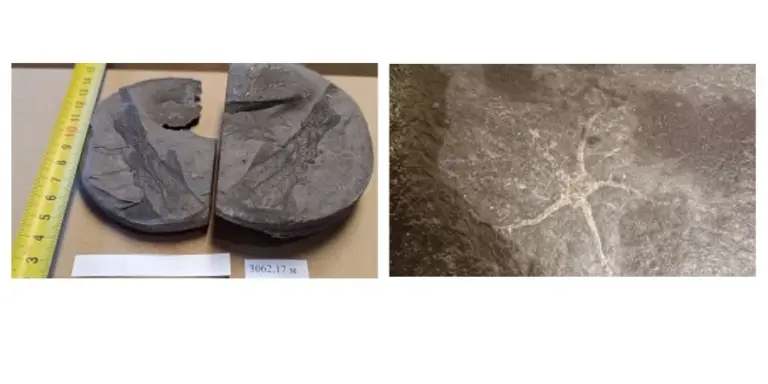
Specialists from the Rosneft Scientific Institute in Tomsk made a rare discovery – in rock samples they found perfectly preserved traces of marine inhabitants of the Jurassic period. Among the finds are prints of a ray-finned fish, fragments of a sea lily and the skeleton of a brittle star, a relative of the starfish.
Typically, cores—rock samples that are examined for oil—contain only small fragments of ancient organisms. However, this time scientists found large remains, including parts of the skeleton and even skin. Imprints of fish with distinct fins were found in samples from a well in the Surgut region of the Khanty-Mansiysk Autonomous Okrug.
According to Rosneft experts and paleontologists at Tomsk State University, the find belongs to the extinct family of peipiaosteids, the ancestors of modern sturgeons. The age of the surrounding rocks is estimated at 154–158 million years.
Such discoveries allow scientists to:
- more accurately determine the conditions in which oil deposits were formed;
- study ancient ecosystems and their connection with the formation of hydrocarbons;
- improve reconnaissance methods deposits.
The Tomsk Rosneft Institute has a huge core collection – more than 160 km of samples from thousands of wells throughout Russia. For their analysis, advanced equipment is used, including micro- and mesotomographs, which create digital 3D models of the rock structure.
The company actively implements innovative research methods:
- In 2022, a unique software package for digital core analysis was launched, which has no analogues in the world.
- A microtomograph with a resolution of up to 3 microns has been developed for modeling processes in oil-bearing formations.
- In 2024, a mesotomograph was put into operation, which digitizes up to 4 meters of core per hour – 4 times faster than analogues.
These technologies help more accurately predict oil reserves and choose the best methods for its production. The discovery of the remains of the Jurassic period is another step towards understanding the processes of formation of oil deposits.
The discovery of Tomsk scientists is not just a paleontological sensation. It is of practical importance for the oil industry, helping to more accurately identify promising areas for production. The introduction of digital technologies makes this research even more effective, which ultimately contributes to the development of the Russian fuel and energy complex.
The material was prepared with the support of the Russian Ministry of Education and Science as part of the Decade of Science and Technology
Source: neftegaz.ru