Specialists of the Far Eastern Federal university (FEFU), the National Research Center “Kurchatov Institute” and the National Academy of Sciences of Belarus presented an innovative technology for processing and long-term disposal of radioactive waste. It provides a high degree of environmental protection from radioactive contamination and can be used in the operation of future nuclear facilities in the Far East.
The method is based on a two-stage waste treatment scheme. At the first stage, radioactive solutions are purified using synthetic NaY zeolite, which selectively binds strontium ions, one of the most dangerous radionuclides. The saturated zeolite is then sintered using Spark Plasma Sintering technology, resulting in an ultra-dense ceramic with a stable crystal structure.
According to researchers, such ceramics remain stable even under extreme influences and are capable of retaining radionuclides. The structure of the resulting material is similar to natural minerals, which makes it especially durable and safe for the isolation of high-level waste.
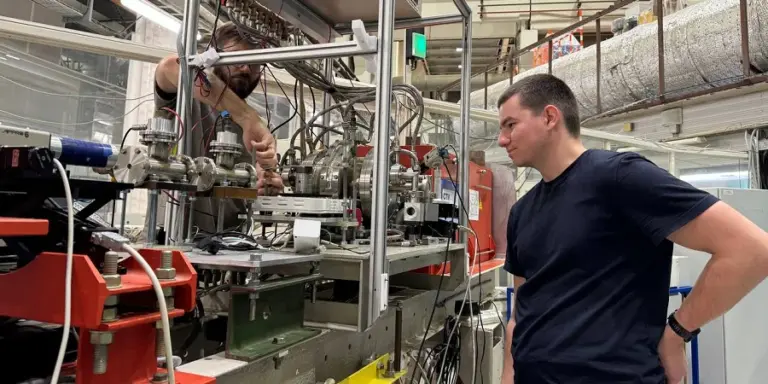
To study the properties of the material, synchrotron radiation was used at the KISS-Kurchatov complex. The use of X-ray spectroscopy made it possible to determine the binding mechanisms of radionuclides and confirm the effectiveness of the technology.
Professor Igor Tananaev, academician of the Russian Academy of Sciences and project leader, noted that the technology combines scientific novelty and practical effectiveness. According to him, the uniqueness of the method is that the same material performs two functions at once – first it serves as a sorbent, and then it becomes a matrix for the final storage of waste. This approach reduces technological costs and makes the recycling process more economical.
FEFU is also building scientific and technical human resources for further research in the field of nuclear technologies and is preparing to launch the new RIF synchrotron, which will become a center of attraction for world-class materials science projects.
The created development will improve the level of environmental safety and will be an important step towards creating future technologies for nuclear energy and environmental protection.
The material was prepared with the support of the Russian Ministry of Education and Science as part of the Decade of Science and Technology.
Source: neftegaz.ru