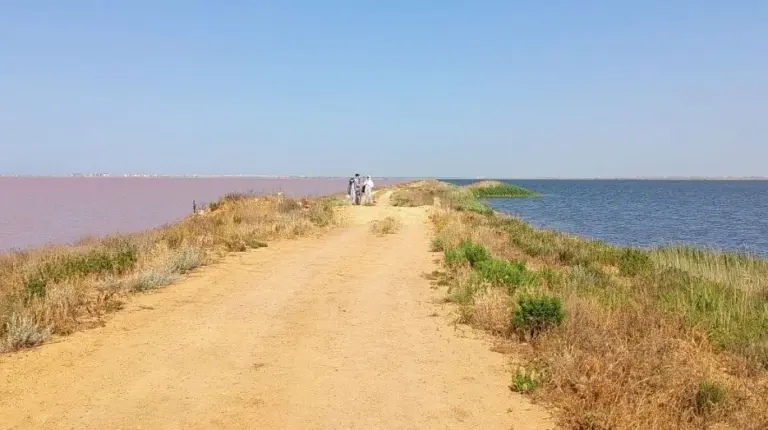
A group of scientists from St. Petersburg State University (SPbSU) conducted a large-scale study of the salt lakes of Western Crimea. Experts took samples of water and bottom sediments in 23 reservoirs to study their modern geochemical state. The work was supported by a grant from the Russian Science Foundation.
Crimean salt lakes are an important natural resource. Many of them, for example Lake Saki, are famous for their healing mud used in sanatoriums. Others, such as Sasyk-Sivash, are of industrial importance – salt, bromine and soda are mined here.
According to Marina Charykova, head of the Department of Geochemistry at St. Petersburg State University, the last fundamental studies of lakes were carried out in the middle of the 20th century. During this time, their condition changed due to climate change and human activity. For example, the closure of the North Crimean Canal led to the desalination of some reservoirs.
“Modern analysis methods make it possible to accurately determine the composition of water and mud, including trace elements – bromine, boron and others. This is important for the development of the resort potential of Crimea,” explained Elena Kayukova, associate professor of the Department of Hydrogeology at St. Petersburg State University.
The selected samples will be studied in the laboratories of St. Petersburg State University using high-precision equipment. Scientists will determine the chemical and mineral composition, which will help assess the suitability of the lakes for medicinal and industrial purposes.
Research is also important for tourism – many salt lakes of Crimea attract travelers with their unique nature. New data will help preserve these reservoirs and effectively use their resources.
The work of St. Petersburg State University scientists opens up new prospects for the development of resorts and industry in Crimea. The research results will improve the use of therapeutic mud and protect lake ecosystems from negative changes.
The material was prepared with the support of the Russian Ministry of Education and Science as part of the Decade of Science and Technology
Source: minobrnauki.gov.ru