Perm Polytechnic scientists have developed an innovative approach that increases the accuracy of 3D modeling of complex oil reservoirs by 10%. This method makes it possible to better predict the movement of oil and gas in reservoirs, which significantly improves production planning.
Creating an accurate 3D model of an oil field is a key step for efficient mining. Such a model helps to understand how resources are distributed in the rock, predict their movement and develop an optimal extraction strategy. However, modeling complex reservoirs, especially carbonate ones, remains a challenge due to their heterogeneous structure with many fractures and voids.
Scientists from Perm Polytechnic University have proposed a solution to this problem. They have improved a tracing method that allows them to track the movement of fluid in formations. During the research process, a special indicator is pumped into the wells – a chemical compound, dye or radioactive isotope. Sensors record how quickly and where the substance moves, which provides information about actual filtration flows.
“Our approach allows us to take into account tracer research data when building a hydrodynamic model. This increases its accuracy and predictive abilities,” explains Inna Ponomareva, professor at the Department of Oil and Gas Technologies at PNRPU.
During the experiment, scientists selected a complex oil reservoir with a heterogeneous structure. They first built a standard model and then conducted tracer studies. The indicator was pumped into five injection wells and its appearance was monitored in 17 production wells. The data obtained made it possible to refine the model, which improved the convergence of calculated and actual production indicators by 10%.
The new method of Perm scientists opens up prospects for more accurate modeling of complex oil fields. This not only increases production efficiency, but also helps optimize reservoir development processes. The results of the study were published in the journal Petroleum Engineer and carried out within the framework of the Priority 2030 program.
Source: naked-science.ru
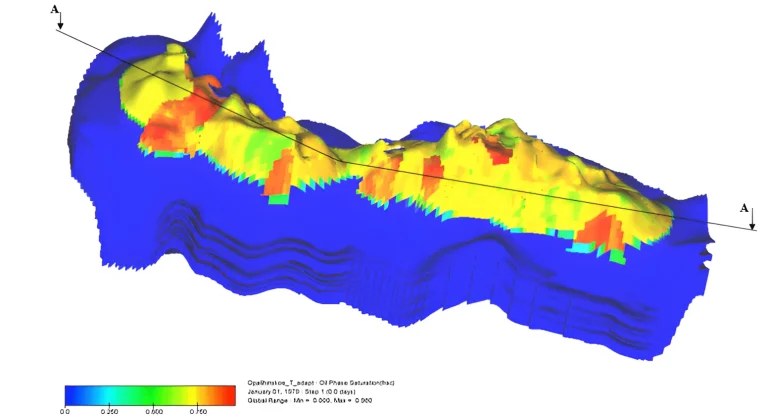
Photo: Appearance of a 3D model of a reservoir using the example of the initial oil saturation distribution field / © Inna Ponomareva, Petroleum Engineer magazine