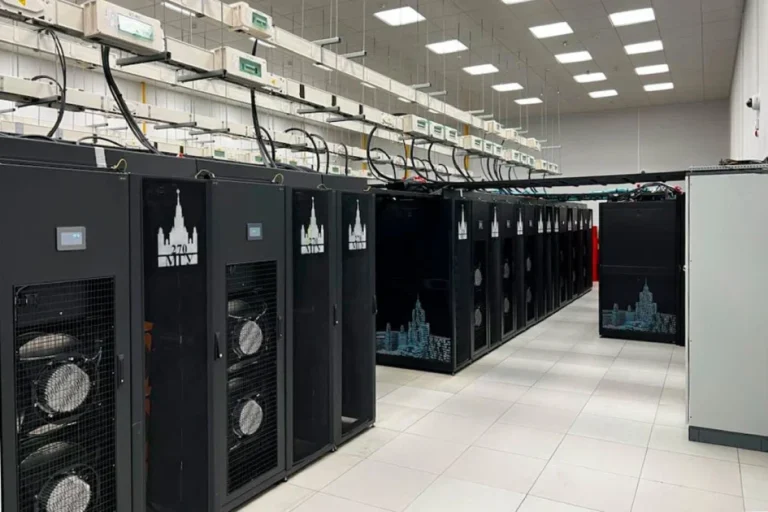
MSU scientists conducted full-wave seismic modeling for a typical geological model of Western Siberia, using the power of the MGU-270 supercomputer. The results of the study will help improve the accuracy of studying hard-to-recover oil and gas reserves.
Employees of the mechanics, mathematics and geology departments of Moscow State University performed large-scale seismic modeling that takes into account all types of waves: longitudinal, transverse, surface, exchange and diffracted. This became possible thanks to the computing resources of the MGU-270 supercomputer.
The research was conducted under the guidance of professors Vladimir Levin and Yuri Ampilov. Scientists have developed geological and mathematical models of the field based on real data from the Arctic region. The modeled section included oil and gas bearing complexes, screening layers and permafrost rocks.
For numerical modeling, the spectral element method was used, which required about 15 billion degrees of freedom. To speed up calculations, a special module was developed that uses graphics processors. This made it possible to complete the calculations in two months.
Research results published in the journal “Geology and Geophysics” and will be included in a 16-volume series of monographs on computational mechanics. The technology can be used to create reference models of oil and gas regions, process seismic data and model 4D seismicity.
Source: msu.ru