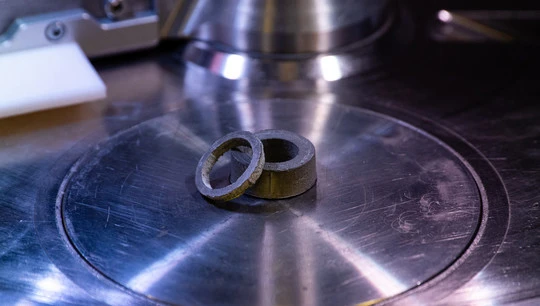
Physicists from the Ural Federal University, together with the Institute of Metal Physics of the Ural Branch of the Russian Academy of Sciences, have created a unique technology for the additive production of permanent magnets from rare earth elements. The development opens up new opportunities for the electric vehicle industry, aviation and space industries.
Over the course of many years of research, Russian specialists have developed a method for 3D printing highly efficient magnets based on neodymium, iron, samarium and cobalt. The work was carried out by order of the Science and Innovation institution (part of Rosatom) as part of the implementation of the Unified Industry Thematic Plan.
A special feature of the new magnets is their resistance to extreme temperatures – up to 200°C for neodymium and 550°C for samarium-cobalt compositions. This makes them promising for use in critical components of aviation and space technology.
“The development of technologies for the production of rare earth magnets is an important element of the country’s technological sovereignty. Our competencies cover the entire chain – from the extraction of raw materials to the production of final products,” said Alexey Dub, First Deputy Director of Science and Innovation.
Currently, scientists have managed to create samples of magnets measuring 10x10x3 mm, but the technology allows the dimensions to be varied within a wide range. For comparison, mobile devices use magnets that are about 1 mm in diameter, while electric vehicles use magnets up to 50 mm in diameter.
“Samarium-cobalt magnets demonstrate exceptional reliability in extreme conditions. Their use in electric motors makes it possible to increase efficiency by 10-15% while simultaneously reducing weight and dimensions,” explained Alexey Volegov, head of the research group.
The developed technology not only corresponds to the best world analogues, but also surpasses them in a number of key parameters. This creates the basis for import substitution in strategically important industries.
Source: urfu.ru