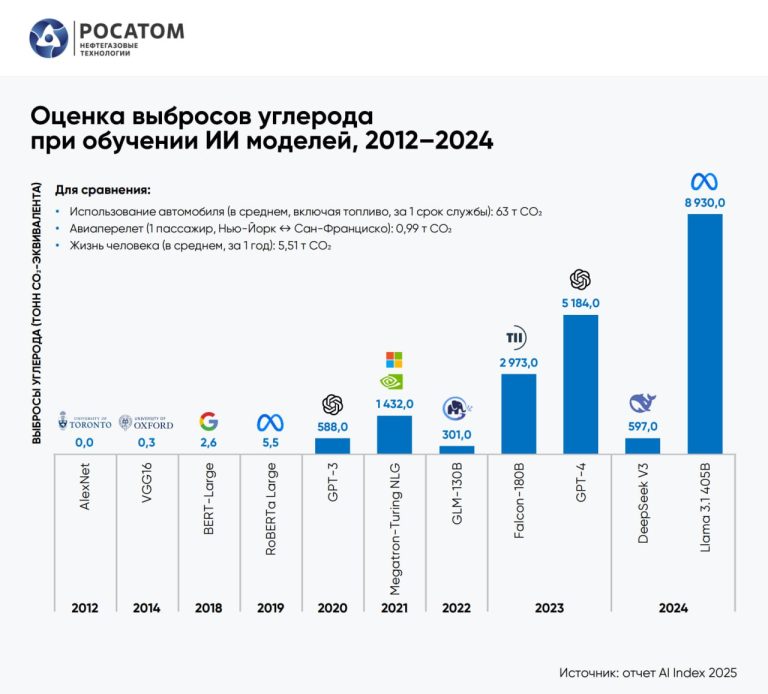
Диаграмма сравнивает углеродный след от обучения ИИ-моделей с 2012 по 2024 год: от нулевых выбросов у AlexNet до рекордных 8 930 тонн CO₂ у Llama 3.1

AI is catching up with oil and gas: the carbon footprint of large models is equal to industrial emissions

15.05.2025
Reading time: 2 min
0

Carbon footprint of modern AI models growing catastrophically fast. According to the AI ​​Index 2025 report, emissions from training neural networks are already comparable to industrial ones, such as oil refineries. 

The oil and gas industry has long been under the scrutiny of environmentalists. Companies are introducing carbon capture technologies, switching to renewable energy and optimizing production to reduce harmful emissions. However, pressure on the industry continues unabated: giants face millions in fines, carbon taxes and strict public scrutiny. 

But now the area of ​​environmental debate is also at the center of artificial intelligence. New data shows that the carbon footprint of large AI models is rapidly increasing. 

The AI ​​Index 2025 report contains shocking numbers: 

  • Llama 3.1 405B became the leader in terms of emissions – 8,930 tons of CO₂. This is equivalent to the annual impact of 1,940 cars. 
  • Training GPT-3 resulted in emissions of 588 tons of carbon dioxide – the same amount produced by 127 cars per year. 
  • GPT-4 turned out to be even dirtier: 5,184 tons of CO₂, which is comparable to the annual emissions of an entire oil refinery. 

AI technologies, which are supposed to help humanity, are now themselves becoming a serious environmental problem. Without implementing green solutions, the industry’s carbon footprint will continue to grow, approaching that of traditional industries. 

Source: @rosatomogt

Prepared by —
Author avatar
Lyubov Cherkasova
Did you like this news? Share with friends
RELATED

Leave your comment


Editor-in-Chief
Maria Kostina
Maria Kostina
Geophysicist, founder of the project and editor-in-chief GeoConversation. Salt of the Earth
GO TO THE EDITOR'S COLUMN

GeoConversation. Salt of the Earth is a media platform where top mining-industry specialists share their experience, helping professionals communicate and collaborate more effectively.

Learn more about the project
TOP PROFESSIONALS
Дмитрий Макаров

Dmitry Makarov

Highland Gold
Lead Analyst
Тарас Паникоровский — эксперт в minералогии и кристаллографии, лауреат премии «Хрустальный компас». Исследует природоподобные технологии и техносферную безопасность Арктики.

Taras Panikorovsky

Murmansk Arctic University, Murmansk
Head of Laboratory
Глеб Загорский

Gleb Zagorsky

State Scientific Center of the Russian Federation, Arctic and Antarctic Research Institute
Geophysics Engineer
VIEW ALL EXPERTS
CATEGORIES
SUBSCRIBE
If you would like to receive a monthly selection of fresh articles by email
LIKE THE PROJECT? SUPPORT US
Friends, developing the project takes a lot of effort and financial resources. If you like what we do, you can support us in two ways.
MORAL SUPPORT
Show our website to your friends. Just click on the social media icons below and share our website on your pages.
FINANCIAL SUPPORT
Even a small fee will help us pay for the transcription (audio to text) of an expert interview or the design of drawings, diagrams, and tables.
Send a donation
Got an article idea? Suggest it.
Cool! You have an idea for us. We love that, because only the experience and knowledge of an expert makes our articles useful for the reader. Please answer 5 questions to let us know a little more about you and the article
answer questions