Create a video or picture, ask GPT chat to write a text or answer any question – now these tasks have become simple and everyday thanks to artificial intelligence (AI). And when they say that AI will take over the world, then this is, in principle, not a fantasy, but a reality. How can this technology help a geologist?
Maria Kostina, editor-in-chief of GeoConversation, talked about the difference between artificial intelligence and machine learning and how AI tools are being implemented into work processes with experts – 1st category geophysicist at the Karpinsky Institute Andrei Karamyshev and head of DeepCore product development at Digital Petroleum, geologist Evgeniy Baraboshkin.
Partner of the article: PetroTrace Services LLC is an expert in processing and complex interpretation of seismic and GIS data. It specializes in desktop work, 3D geological modeling, seismic exploration quality control, development of the Alpha software system for geological exploration and sales of GeoEast geophysical software (CNPC).
Reliable solutions for your company! Read More…
Artificial intelligence, machine learning and neural networks. What is this?
If you search the Internet, you can find dozens of definitions of artificial intelligence technologies, machine learning and neural networks. Expert Evgeny Baraboshkin explained how these concepts are usually visualized in the form of Euler circles. Conventionally, if you draw a large circle, it will be artificial intelligence, and a smaller circle inside it will be machine learning. And the third circle, even closer to the center, is deep learning neural networks. Based on these technologies, it is possible to create those very chatbots that, as some assume, can think for themselves, although this is not the case. A separate branch is the development of General AI, general artificial intelligence, which can independently make decisions and perform certain tasks.
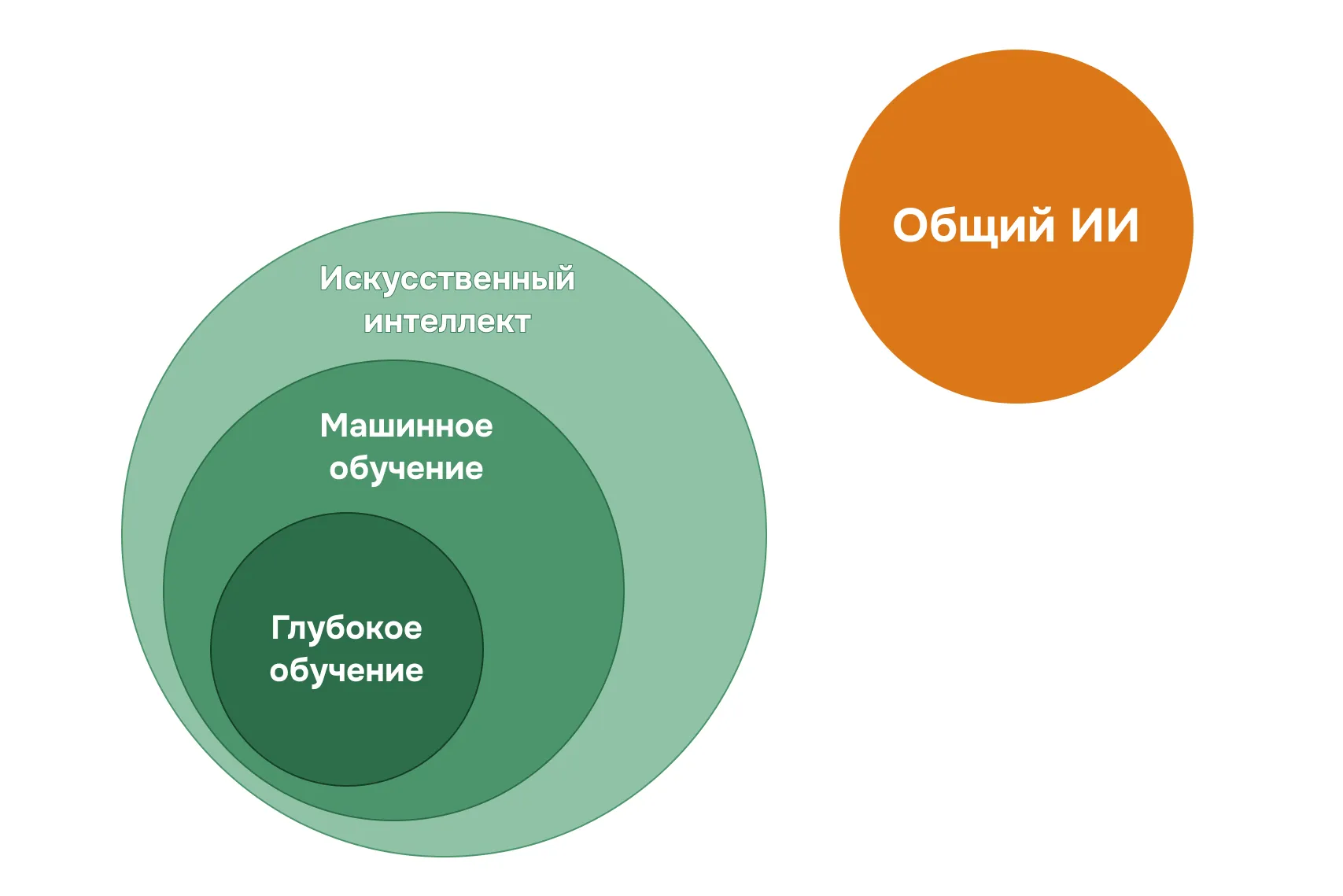
It turns out that any technology that simulates decision-making using certain algorithms can be called AI, but not every technology can be called machine learning or a neural network. At the same time, it is machine learning and neural networks that are used in geology. Let’s figure out together what it is and how to train a machine so that it is useful for exploration and mining.
Where did the artificial neuron come from?
The first formal model of neural networks was McCulloch–Pitts model. It seemed to be trying to explain how a real biological neuron works, but it was not yet a full-fledged neural network. The first neural network architectures, such as the Rosenblatt perceptron, appeared later, in 1957.
Recall that a biological neuron (or nerve cell) can be thought of as a device with several inputs and one output. From one neuron, an electrochemical impulse is transmitted to subsequent neurons, and together they form the central nervous system. It is not yet fully understood how human nerve cells work – in the brain, the total neural network consists of approximately 90 billion neurons, which are connected to each other by trillions of connections. However, it was the complex nervous system that became the prototype for the artificial neuron.
The development of AI resembled a roller coaster – there were periods full of discoveries, and there were moments of some decline in interest in the technology. But modern chatbots came about thanks to discoveries that happened already in our century.
“Scientist Geoffrey Hinton in 1986 expanded the backpropagation algorithm by which neural networks learn. Subsequently, in 2012, Alex Krizhevsky and Ilya Sutskever (who actively collaborated with Geoffrey Hinton) proposed the AlexNet model for image recognition. This was the first model that surpassed humans in the quality and speed of pattern recognition. After this discovery and the development of computer vision technologies, there was a real boom in neural networks, which later led to the popularity of generative AI.”
Andrey Karamyshev

Today we are witnessing the third wave of AI development – the world is increasingly talking about Agent-Based Artificial Intelligence (AI), which goes beyond generative AI and is capable of autonomously solving complex problems.
What types of neural networks are there?
Geophysicist Andrey Karamyshev explained that there are many classifications of neural networks, but we mainly operate with two types: networks of fully connected layers and deep convolutional neural networks (CNN). They have one common feature – the first layer of neurons, whose task is to receive and distribute input signals to other neurons. But the structure of fully connected networks and CNNs differs.
Fully connected layer networks
Fully connected multilayer networks are the oldest in origin and the easiest to understand. Such networks consist of layers with neurons: an input layer, where neurons receive signals from outside into the network, hidden layers (there may be as many of them as you like or none at all), where the signals are processed, and an output layer, where neurons transmit the result of processing to the network. Also, in such a network, each neuron is connected to all neurons of the previous layer.
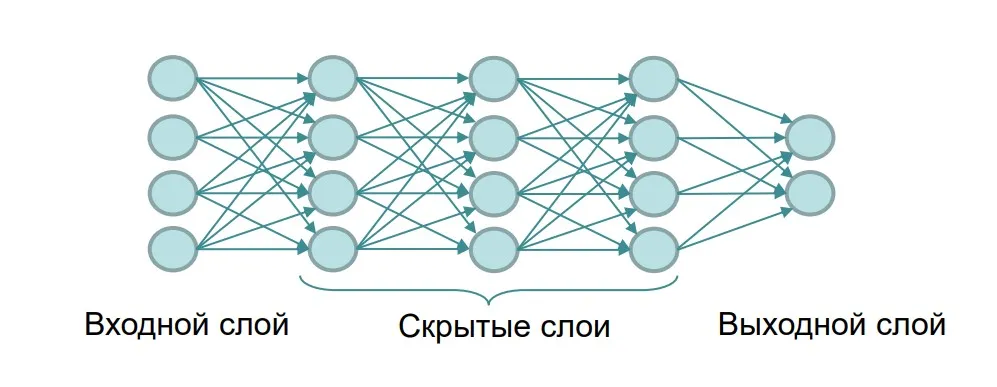
Fully connected networks are the basis of many simple neural networks and are suitable for tasks where the data does not have an explicit structure, such as working with tabular data. But if you add additional hidden layers, you can expand such networks to solve more complex problems. It all depends on the amount of data.
Deep Convolutional Neural Networks (CNN)
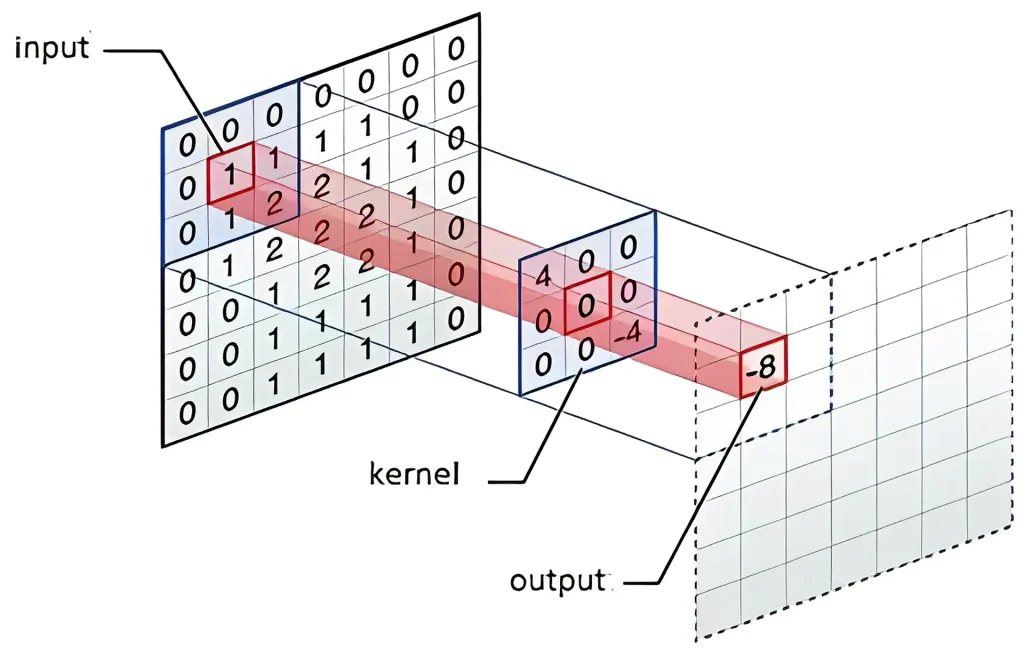
Convolutional networks work differently. A sliding filter is used – what is called a convolution kernel or kernel. It scans the input feature map. Let’s say we submitted a set of geophysical fields with any number of layers. You can do frequency filtering, decompose it into a separate harmonic and make a thousand different cuts at different intervals. Accordingly, we get a kind of three-dimensional tensor – a cube, which has filter coordinates along the X and Y axes, and a set of different data along the Z axis.
Machine learning or how to “feed” a neural network correctly
How can we teach a machine to think in such a way that we can trust it? Experts say that one of the most important factors is the quality of the data on which neural networks learn.
“If absolute nonsense is supplied to the input of a neural network, then a random input (in the output layer) will “light up” at its output. That is, we get a random or, more precisely, meaningless result from the operator’s point of view, although determined by the internal structure of the network. As they say, garbage in, garbage out. Therefore, it is much more important how we prepare the data and how we formulate the problem than what algorithm we use to solve it. The more training examples we give it as input, the finer the weights are adjusted, and the more accurate the answer will be.”
Andrey Karamyshev
In order for the neural network to work by pressing one button, it must first be trained
There are two broad classes of machine learning: self-training and supervised learning.
Unsupervised learning
In the case of unsupervised training, the neural network is trained on unlabeled data. The main task of a neural network that learns on its own is to find hidden patterns without any prior information about the results. Basically we are talking about clustering (grouping similar objects) and searching for anomalies (objects that differ from the majority). For example, you load some set of input data into the algorithm, tell the AI that you have a sample of the mineral composition of rocks and there are six classes into which we distribute all the data. The AI, without human guidance (which only specifies the number of classes), somehow divides this sample into six classes. The network learns in iterations, each time giving an increasingly accurate answer.
Tutored training
The supervised method is when we take databases predesignated (for example, by geologists) and specify an algorithm. The trained model is an alternative to an analytically specified filter, and it is configured itself; we only set the training parameters, network architecture, and quality metrics. Based on our parameters (from the teacher), the model develops some dependence within itself. This can be an analytical dependence, or rather its analogue, specified using finely tuned connection weights. Unlike analytical filters, which require manual description of rules, a neural network independently identifies complex dependencies in the data, even if they cannot be expressed by a formula. We fit one dependency to another and, accordingly, we consider (and trust) that the network correctly interprets the data.
That is, conditionally, we have some set of parameters: porosity, permeability, resistivity, etc. The trained network produces a prediction that with such and such parameters, our porosity indicator will be this or the grain size will be this.
Training is also iterative, as is the case with unsupervised training. One era of learning has passed, the AI has seen where and how much it is wrong, and in which direction it needs to be corrected. It slightly shifts the weights and learns again, many times, until, using the gradient descent algorithm (ed. – an optimization algorithm in machine learning, used to minimize errors in the model by iteratively adjusting the parameters) and taking into account many variables, the network finds a global minimum of erroneous answers. In fact, AI learns from its mistakes and improves.
Will AI replace the geologist?
Many users of neural networks have the illusion that AI understands us and knows absolutely everything, and that a machine can easily replace a person in the workplace. In fact, this is a misconception – neural networks do not have self-awareness and emotional intelligence. They know exactly what man taught them. In fact, the trained network will imitate the vision of a certain expert, including a geologist. And by the way, if another geologist comes and says that everything is wrong, then the model will have to be retrained.
“In connection with AI, there must be a person who has sufficient competencies to check the results for adequacy. So geologists need to deepen their knowledge in such global, fundamental things as, for example, the processes of ore formation or the formation of geological structures, and the routine will be taken away from them and automated by AI. For example, a manual interpretation process will replace a machine algorithm.”
Andrey Karamyshev
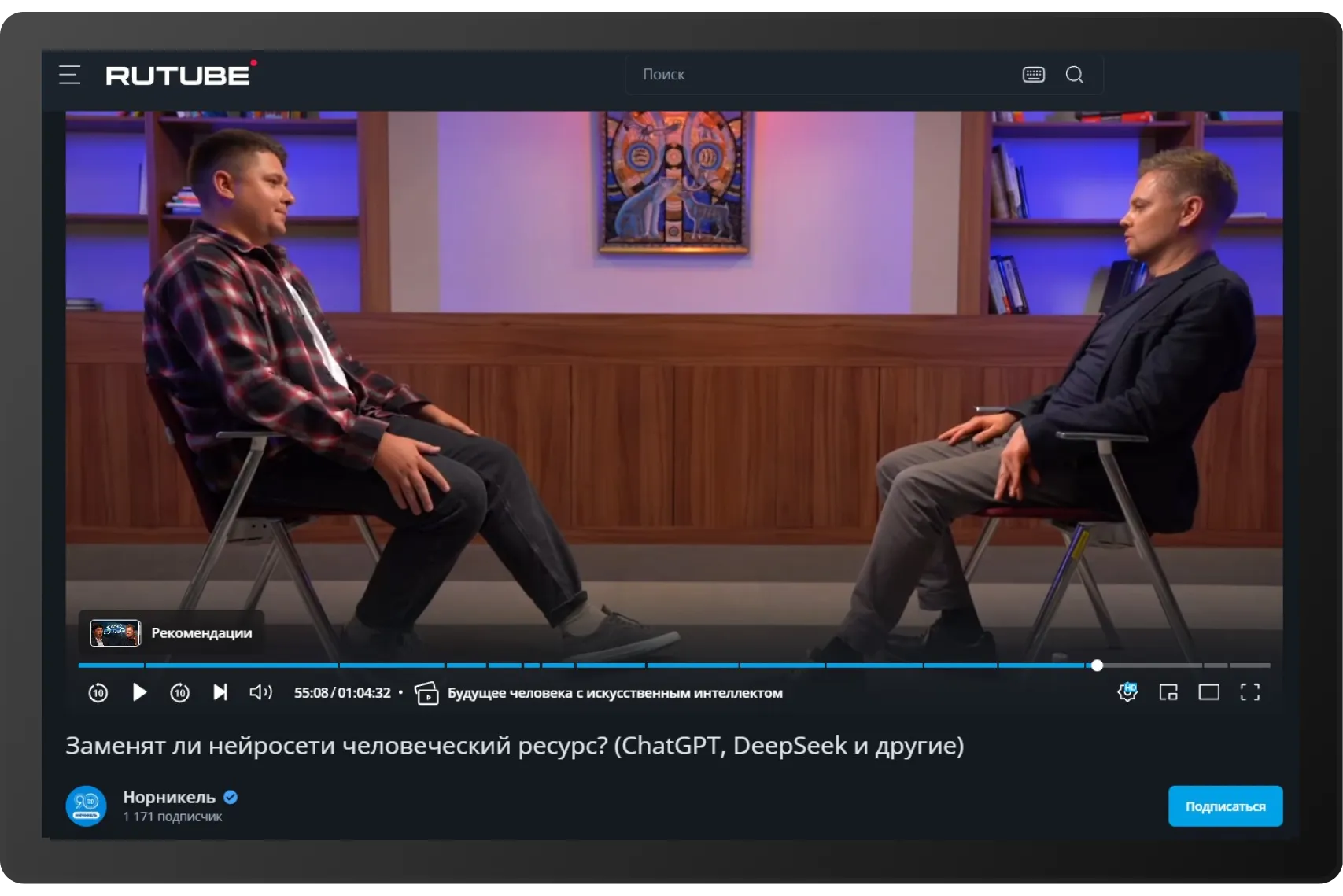
The expert clarifies that we are talking about replacing the routine process associated with visual analysis and comparison of data from various methods, identification and attribution of anomalies. The expert is still drawing conclusions, and this is unlikely to change in the near future. Therefore, we must not forget that AI is just a very smart tool, but the most important job – making management decisions – remains with a specialist. But the need for cheap labor may actually decrease with the advent of AI. This thesis was confirmed in his recent interview Danil Ivashechkin, head of the development and implementation of artificial intelligence at Norilsk Nickel. He also said that the company does not use AI in managing production processes, because if something happens due to incorrect advice from the neural network, then specialists will not be able to understand the causes of the problem and find out why the AI advised to do what led to the incident. So we see that technologies are not applicable everywhere.
In theory, AI can take on not only the routine, but also some not-so-pleasant things. For example, a documentation geologist will be happy not to travel to the field and manually describe the same core. But one cannot completely refuse the participation of a specialist in the process of documenting on site – there are moments that need to be visually checked.
“Finding a good geologist is often problematic, but now we need ones who can work with artificial intelligence.”
Evgeny Baboshkin
And it happens that the AI assistant suddenly stops working, for example, the cable is damaged and data stops flowing to the servers. In this situation, the operator immediately takes control. So, even in the long term, it’s more about working in tandem with AI + Expert, where the machine also needs human support.
Three examples of how AI helps geologists
The use of deep machine learning opens up new opportunities for geologists to understand geological processes and optimize the extraction of natural resources. We have selected three examples where AI has become a working tool for a geologist.
Example 1: AI will find minerals and ore deposits
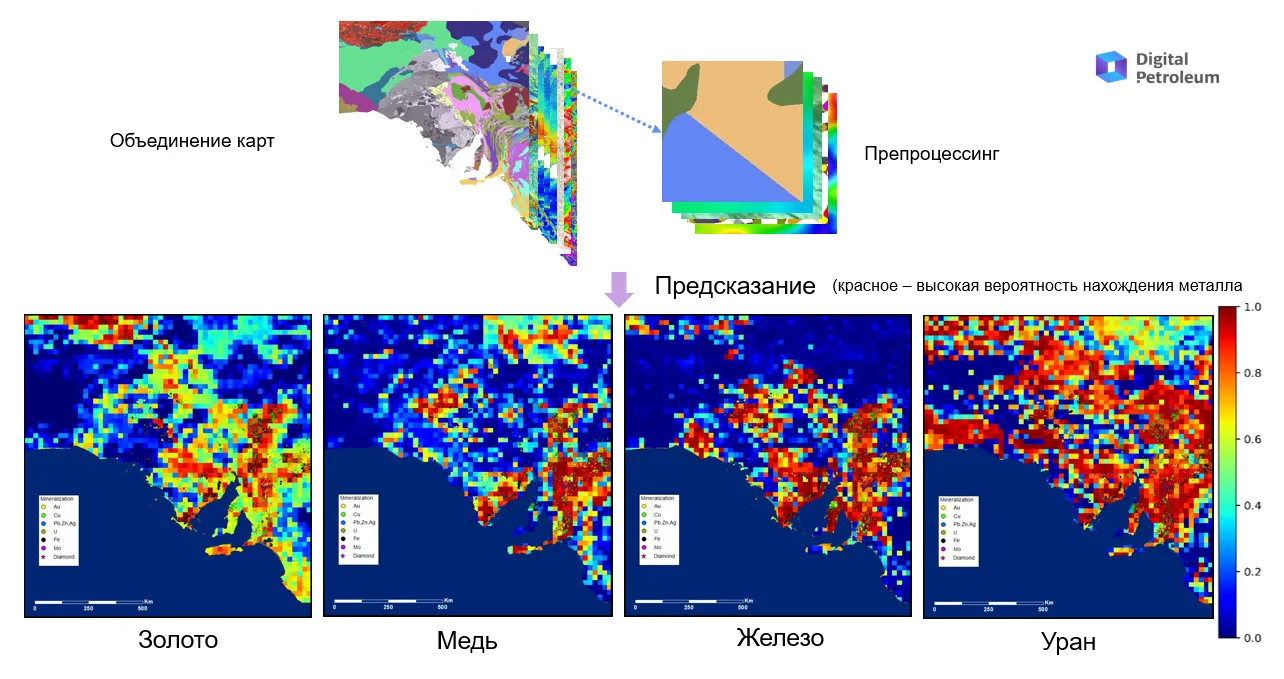
Predictive mapping of mineral potential of deposits (Mineral Prospectivity Mapping) is a multi-step process and involves the collection of a colossal amount of data that is difficult for even an experienced geologist to interpret manually. Therefore, at mining enterprises artificial intelligence is connected to exploration. A trained neural network allows you to automatically find patterns between the geographical location of known deposits (targets) and geological factors influencing their formation (signs), as well as take into account all possible patterns, for example, the intensity of mineralization or its threshold values, other physical and geochemical parameters. This way the geologist gets accurate answers and predictions faster.
The fact that the AI allows you to highlight ore nodes is also useful at the stage of obtaining a license for field development. A neural network can, in a limited time, explore large areas for their prospects and helps the investor clearly understand which area to license. Tamara Golovina, head of the geological exploration technology department of the geological directorate of Polymetal, spoke about this method of using technology when she spoke at the industry conference “Current Issues in Exploratory Geology.”
Example 2: AI describes rocks
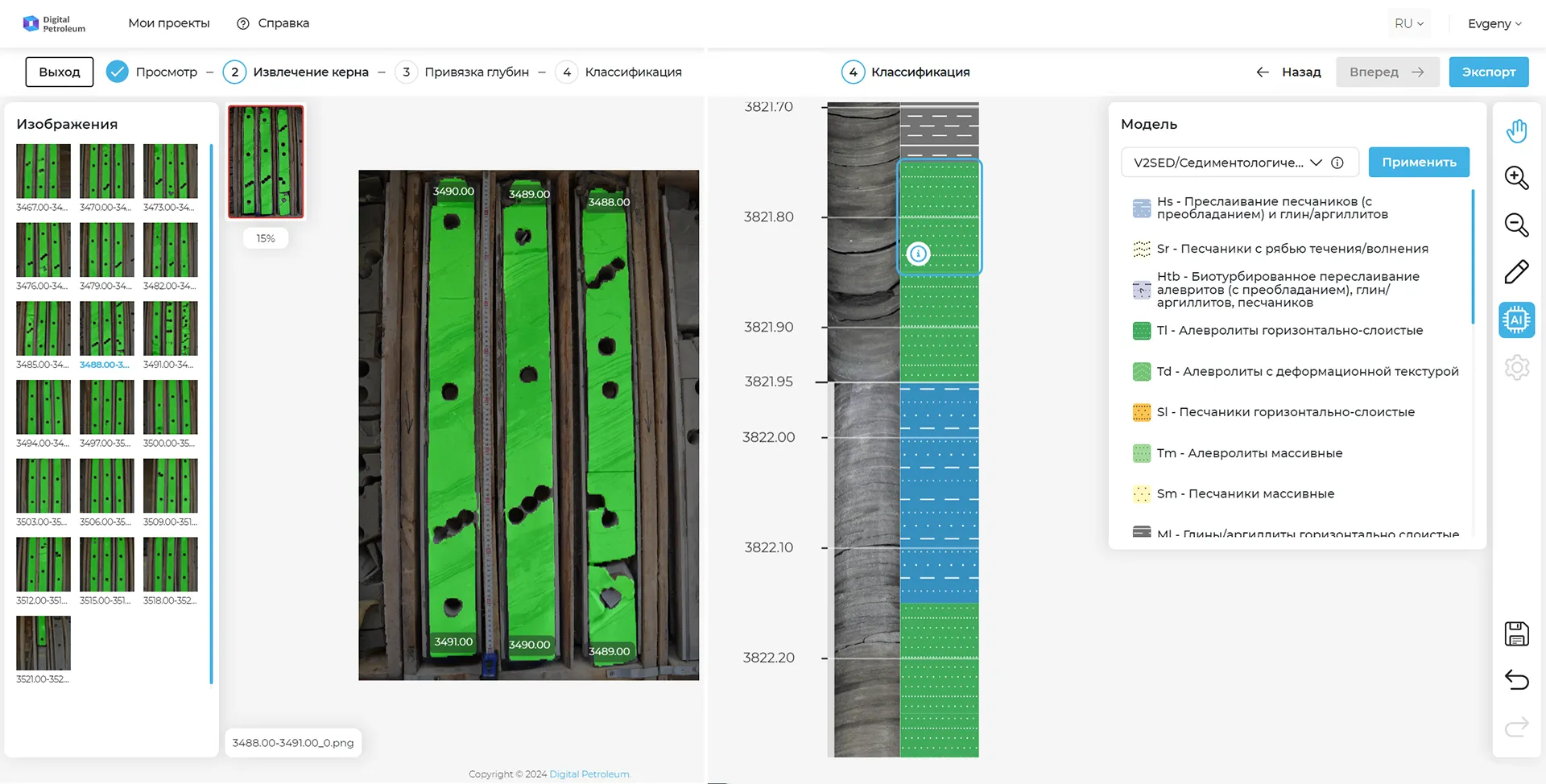
Without studying the core, it is impossible to build a geological model of the deposit, but this is a very labor-intensive process. If automated, a geologist can document 50 meters of well in 40 minutes. And if you do the same task manually, it will take at least a working day.
A team of researchers from Skoltech, led by our expert Evgeny Baraboshkin, trained a neural network to effectively recognize core boxes from photographs rock samples. This made it possible to speed up the analysis process up to 20 times, as well as automate the description of the core.
The program automatically determines the geological characteristics of the core and creates reports for verification by a geologist. And all this is just from the photo.
Another example – software package “Digital core”, designed with its own AI. It was created by specialists from the Tyumen Petroleum Research Center (part of the Rosneft research and design unit) together with the Innopraktika company. The software package allows you to simulate laboratory tests on a digital copy of the rock obtained from tomographic data.
Example 3: AI interprets seismic data
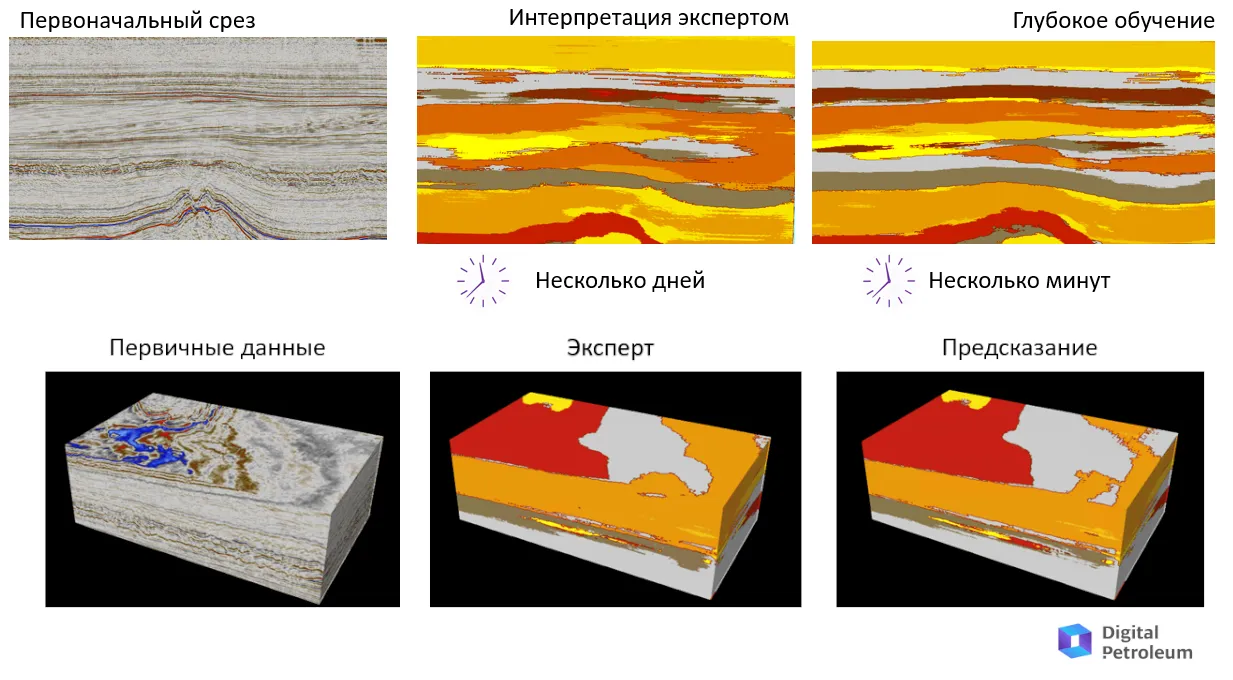
In progress seismic cube interpretations geophysicists carry out routine tasks that take an extremely long time – they have to review each of hundreds of seismic sections dozens of times, manually plotting each fault line. This process can take anywhere from several weeks to months.
To speed up the processing of hundreds of gigabytes of geophysical information and avoid errors associated with the human factor, a neural network with computer vision algorithms was created. Correlation of horizons, structural unconformities, identification of tectonic faults, delineation of geological bodies – the machine will do this instead of a geophysicist in just a few hours, not weeks, and will not miss a single detail. And machine learning algorithms make seismic data cleaner, remove incoherent noise, and get rid of relics of alignment traces.
Nobody but you AI
Russian geological exploration has accumulated many thousands of terabytes of geodata, and all of it needs to be processed and interpreted, taking into account billions of possible variations. It will take a lot of time for a person to cope with this task. So, a quantum leap in the development of geology requires an integrated approach combining AI, expert knowledge and big data. The problem is that many industries are not yet digitized and collect insufficient or low-quality data, and this is slowing down the widespread adoption of AI technology. According to the managing director of the research institute of the Rosgeology holding, academician of the Russian Academy of Sciences Mikhail Epov, today we are ready to implement AI no more than 5–10% geological exploration enterprises in the country.
However, large companies with a high level of digitalization and the ability to invest in technology are already testing the power of AI in their fields. And in future articles we will talk more about how machine learning helps with core description, seismic data processing, mapping exploration and mining, and we’ll also talk about how a geologist can teach neural networks himself.
Do you have experience interacting with neural networks in your work? Do you believe that AI is the future? Share your opinions in the comments below the article.