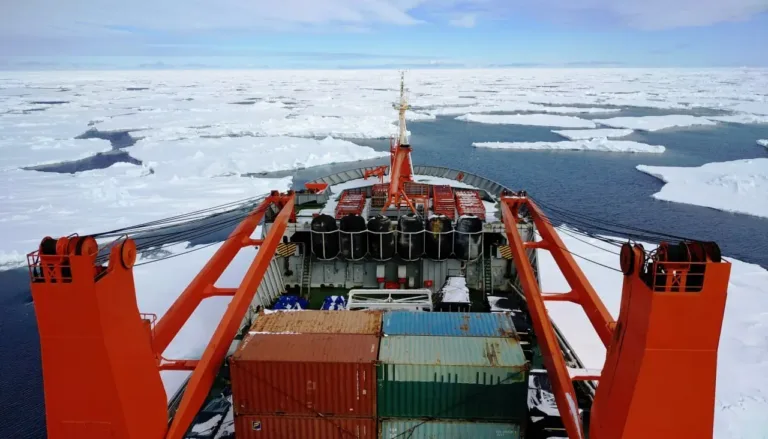
Safety at sea in the Arctic is becoming less dependent on the vigilance of observers on a ship’s bridge. Scientists at the Arctic and Antarctic Research Institute (AARI) are developing a system that can automatically identify dangerous ice formations in imagery, generate forecasts months in advance, and warn captains when vessels are approaching areas of heavy ridging. The human operator is gradually shifting from analyst to supervisor.
The key change, outlined by Sergey Soldatenko, head of AARI’s Ocean–Atmosphere Interaction Department, is the transition from manual interpretation of ice conditions to fully automated algorithms. Instead of spending hours analyzing aerial photographs, specialists will be able to rely on neural networks that automatically identify ice ridges and mark potentially dangerous areas.
The second pillar is long-term forecasting. The model analyzes decades of archived ice observations and produces a probabilistic outlook for the season ahead. The third is short-term forecasting, which continuously combines satellite observations, operational ice charts, signals from ships’ Automatic Identification System (AIS), and reports from vessel bridges in real time.
The result is essentially a digital ice-information platform combining three key components: artificial intelligence for detecting hazardous ice formations, automated interpretation of satellite imagery, and a continuous stream of data on vessel movements.
This could fundamentally change the philosophy of Arctic navigation. In the past, captains relied primarily on experience, visual observation, and occasional radio reports. The new system would provide an electronic navigator capable of assessing ice conditions from the current situation through a forecast horizon of several months.
The Arctic is becoming a proving ground for intelligent predictive systems. The farther north ships operate, the less room there is for error. Neural networks trained on decades of ice observations could become an indispensable navigation tool—one that does not tire, lose concentration, or miss a dangerous formation against the Arctic’s vast white landscape.
Source: Arctic and Antarctic Research Institute (AARI)
Image: Ivan Khokhryakov / AARI