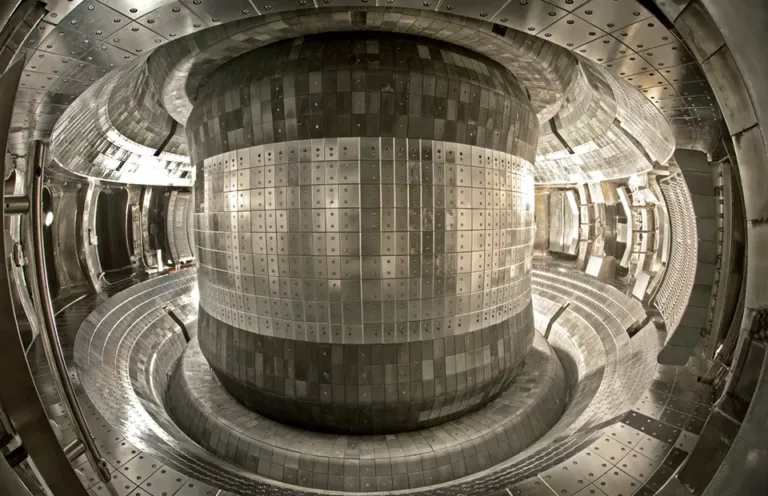
Chinese scientists have taken a major step toward commercial fusion energy by completing assembly of the world’s largest superconducting magnet, weighing 582 tonnes. Measuring roughly the length of two buses and the width of a four-lane highway, the massive system will be used to confine plasma heated to temperatures comparable to those inside the Sun.
The magnet was developed by researchers at the Institute of Plasma Physics of the Chinese Academy of Sciences. It will serve as the core component of CRAFT (Comprehensive Research Facility for Fusion Technology), China’s flagship test platform for fusion technologies. Engineers will use the facility to validate systems required to reproduce the nuclear fusion reactions that power the Sun.
The scale of the equipment is remarkable. The superconducting magnet measures approximately 21 meters in length and 12 meters in width. Its purpose is to generate an extremely powerful magnetic field capable of confining superheated plasma inside a fusion reactor without allowing it to touch the reactor walls. Such magnetic confinement is essential because plasma reaching the reactor structure would instantly damage conventional materials.
Construction of the CRAFT experimental facility is expected to be completed by 2027. If development proceeds as planned, the first demonstration experiments aimed at producing fusion energy are scheduled for around 2030, potentially placing China among the global leaders in the race to commercialize clean, virtually limitless energy.
For decades, nuclear fusion was regarded as a technology of the distant future. However, rapid progress in recent years—including the completion of China’s record-breaking superconducting magnet—suggests that harnessing the power of the stars may be moving closer to reality.
The superconducting giant assembled in Hefei represents more than an engineering milestone. It positions China among the nations seeking to master fusion power, with 2030 emerging as a key milestone in the global effort to demonstrate a fusion system capable of producing more energy than it consumes.
Source: RBC
Image: Chinese Academy of Sciences