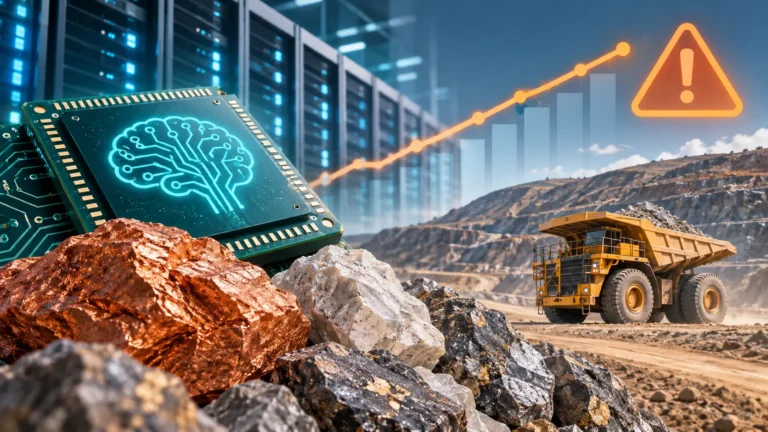
The rapid expansion of artificial intelligence may run into a shortage of critical minerals. According to a Global X forecast, by 2035 demand for copper, lithium, and rare earth metals will exceed supply by 17–22%. A single gigawatt-scale AI data center requires almost 180,000 tonnes of strategic materials, including about 27,200 tonnes of copper.
The gap between the pace of technological development and the capabilities of the mining industry is widening. New mines take an average of 10 to 18 years to develop, so producers cannot keep up with demand from data centers, power grids, electric vehicles, and advanced manufacturing. Global X analyst Madelyn Reid notes that access to resources is becoming more difficult, and concentrated supply chains, long project timelines, and water constraints can raise costs, delay construction, and create geopolitical risks.
Copper stands out in particular: it is needed for wiring, transformers, transmission grids, and cooling systems. Expanding AI computing requires not only new data centers but also upgrades to the power grids that feed them. According to Global X, through 2040 the copper, lithium, and rare earth industries may require almost $550 billion in investment. Including critical minerals and water infrastructure, this sum could exceed $2 trillion.
The risks are not limited to the availability of deposits. Production and processing are concentrated in a few countries, which makes producers vulnerable to trade restrictions and geopolitical shocks. Rare earth metals are critical for permanent magnets in industrial equipment and electric motors, while lithium remains the basis of the battery systems that balance power grids.
However, the forecast does not guarantee a shortage. New discoveries, recycling, material substitution, and efficiency gains could ease pressure in some markets. Mining companies, in turn, face permitting delays, financing constraints, and rising construction costs, which undermine project economics.
The constraint on AI may be not only raw materials but also electricity. Global X forecasts that by 2035 data centers will consume 20% of US electricity, versus about 6% now. At the same time, planned capacity covers only 42% of new demand through 2030. This imbalance could accelerate investment in nuclear power, gas, renewables, and grid modernization. Already, US data center vacancy is forecast to fall to 1% in 2026, and average rental rates have risen 73% since 2021.
The AI boom depends not only on chips but also on metal, energy, and infrastructure. For investors, this is a signal to shift focus from semiconductor makers to mining companies, processors, and energy projects. For the industry, it means the need to speed up exploration and construction, otherwise technology will develop faster than the world can supply it with resources.
Source: Global X