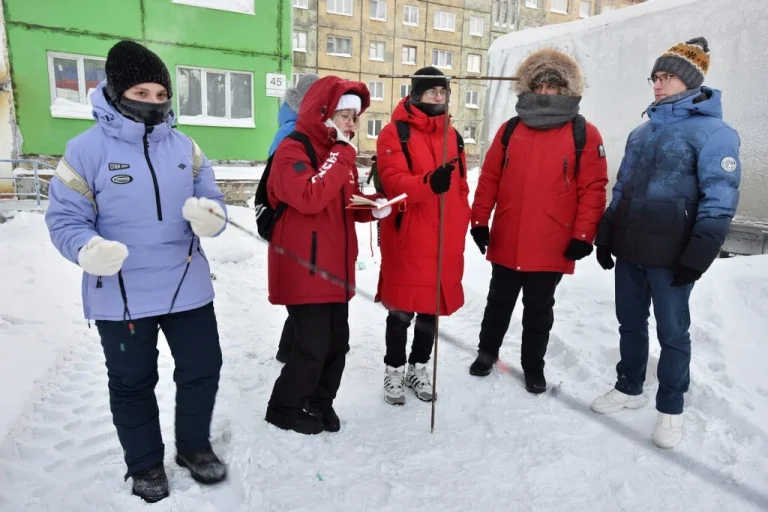
The Winter Field School, organized jointly by the Polar State University and Lomonosov Moscow State University, has started in Norilsk. The main goal of the project is a detailed study of the state of permafrost in the region. School participants conduct research on snow cover and ground temperature in residential areas of the city, and then create analytical maps. This data helps predict possible soil changes and prevent adverse consequences.
Particular attention is paid to storage areas for snow collected from city streets. According to scientists, Norilsk has record snowfalls even compared to other Arctic cities, which creates serious risks for buildings and infrastructure. The constant accumulation of snow masses affects the temperature regime of the soil, which in the long term can lead to its subsidence.
Candidate of Sciences Valery Grebenets, Associate Professor of the Department of Cryolithology and Glaciology of the Faculty of Geography of Moscow State University, has been studying the impact of climate change on permafrost for more than 40 years. He notes that in Norilsk there is a tendency for the soils to warm, which weakens their ability to hold the foundations of buildings. However, there are engineering methods that can stabilize permafrost and prevent the destruction of urban buildings.
As part of the school, students and teachers visit research sites, take measurements and refine previously created mathematical models. This year, special emphasis is placed on studying snow dumps, since their effect on ground temperature is critically important. According to scientists, the temperature under snow piles is much higher than in open areas, which accelerates the process of thawing permafrost.
Director of the ZSU Research Center Pavel Kotov explains that the data obtained during the research makes it possible to calibrate existing models and more accurately predict changes in soil temperature conditions. This will help develop measures to minimize the effects of climate change in Arctic cities.
Last year the snow masses in Norilsk were relatively small, but this winter their height in some places reaches five meters. The temperature difference on the surface and under the snowdrifts is noticeable: if outside it is -30°C, then under the snow -16°C. Research also shows that in recent decades, ground temperatures at a depth of 10 meters have risen by almost 4 degrees.
Moscow State University master’s student Tatyana Sidorova emphasizes that timely snow removal is a key measure to prevent the destruction of permafrost. It is important to prevent excessive accumulation of snow masses within the city, as this leads to undesirable changes in the soil. The data obtained during the school can become the basis for developing uniform approaches to managing snow deposits in all Arctic cities.
Research from the Winter Field School in Norilsk confirms the need for competent management of snow masses in the Arctic. Removing snow outside the city is an important measure that prevents the destruction of the permafrost layer, and hence the stability of the city infrastructure. Scientists and students continue to work to develop effective solutions to maintain the sustainability of Arctic territories.
Source: izyskateli.info with reference to the Yenisei TV channel
Photo: Taimyr Telegraph