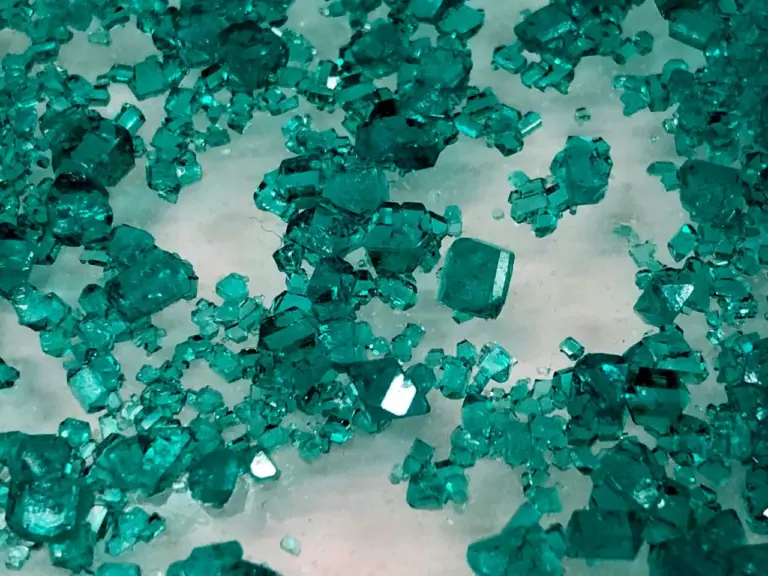
Specialists from St. Petersburg University have made a breakthrough. In a sample of Orgueil (CI), a carbonaceous cosmic body that fell in France in the mid-19th century, the presence of a mineral form of a nitrogenous compound has been documented for the first time. This meteorite belongs to a rare class of stony space objects saturated with hydrocarbons and volatile substances. Its chemical composition is similar to samples returned from the asteroids Ryugu and Bennu, making it valuable material for understanding ancient processes.
Discovered substance – nickel-containing bussengautite, which is a complex compound of magnesium, nickel elements and water molecules. Nitrogen compounds in the form of ammonia serve as a universal source of biogenic nitrogen throughout space – an element without which the biochemistry of living beings is impossible. The identification of its mineral occurrence in meteorite matter expands scientific understanding of the factors that contributed to the origin of organic life and voices hypotheses about the chemical conditions in the young Solar System.
The research team used an arsenal of modern tools from the research centers of St. Petersburg State University to verify the find: X-ray diffraction approaches and computer modeling made it possible to identify the chemical structure with high accuracy. Research leader Sergei Britvin pointed out that bussingautite acts as a marker of the presence of bound nitrogen gas in cometary and asteroidal matter. In addition, this substance potentially explains the previously mysterious features of the infrared spectra obtained from the comet Churyumov-Gerasimenko and the dwarf planet Ceres.
Nitrogen minerals Rarely encountered in the interplanetary medium, they are unstable to liquid water and thermal decomposition, which has historically made them difficult to detect. For many years, scientists have hypothesized about their existence, relying only on indirect evidence obtained by remote spectral analysis methods. This discovery provided researchers with tangible evidence and a real subject for in-depth analysis. The study of crystal structure through modern analytical techniques creates new opportunities for resolving old problems in space mineralogy and may lead to a revision of methodological approaches when working with extraterrestrial material.
The identification of the first example of a nitrogenous mineral in meteorites marks a major turning point in the development of space biology and mineral science, providing concrete evidence of prebiotic raw materials in space and helping to reformulate our views on the premises from which life arose.
Source: Naked Science
Photo: Sergey Britvin