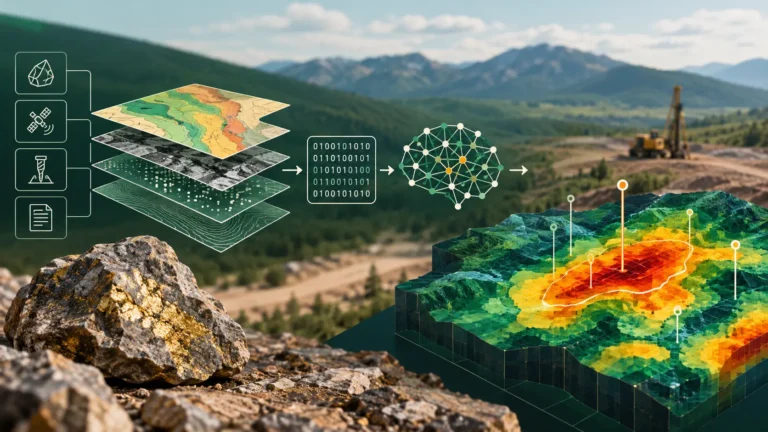
Accuracy of 88%, half the memory, and a third faster training — these are the results achieved by scientists at Perm Polytechnic after training a neural network on real geological data from the Agbaou gold complex in Côte d’Ivoire. The method is based on an algorithm that converts rock descriptions into a compact set of numbers.
The essence of the development is that each geological description is compressed into a single number. The algorithm assesses how often a feature occurs in rich and barren areas and calculates the contrast between them. Thirteen original features are turned into six — the set remains meaningful but becomes several times more compact.
The problem the Perm researchers tackled is familiar to the industry. Geologists comb vast territories, accumulating samples, satellite images, and drill hole data. All the information is placed on a map divided into thousands of fragments. Such a volume cannot be processed by hand, and neural networks do not understand professional terminology and work only with numbers. Earlier methods of converting rock names into figures either pushed machines to their limits or failed to give an answer on the presence of ore.
A trial at the African deposit showed that the approach works. Besides accuracy, it halved memory requirements and cut training time by a third. The code is written in Python.
Assoumou Hervé Mathieu Nkrumah, lead engineer at the Department of Information Technologies and Automated Systems at PNRPU, noted that the algorithm does not stop at stating the presence of ore. It assesses a site’s prospectivity on three levels: high, medium, and low.
If the method is scaled up, exploration will gain a tool that saves resources and speeds up drilling decisions. For now it is academic work, but its results have already been confirmed on real data.
Source: @dprom