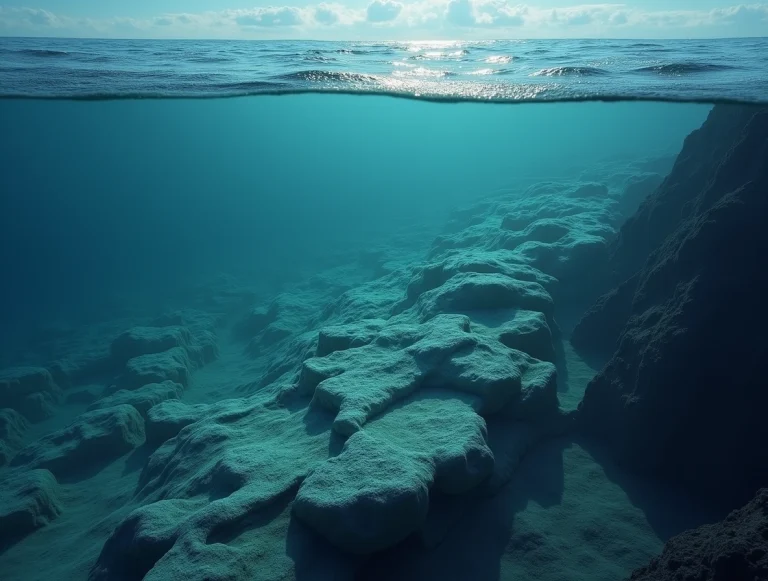
An international team of scientists has discovered a relict glacial relief on the bottom of the North Sea, which is estimated to be 1 million years old. The discovery sheds light on climate change and glacial history in the region.
Using modern 3D seismic methods, researchers studied the structure of the North Sea bottom. At a depth of about 1 kilometer, they discovered traces of ancient glacial topography, which was preserved due to the rapid retreat of the ice sheet. Scientists have identified smooth landforms created by the movement of ice, as well as ridges marking the boundaries of the glacial front.
The age of these structures dates back to the period of the Middle Pleistocene transition, when global cooling occurred on Earth. At this time, an ice sheet from Norway began to spread towards the British Isles. The high preservation of the relief indicates that the glacier retreated quickly, and its frontal boundary rose and floated.
Linear grooves were also discovered under the glacial forms, which scientists believe were formed by strong currents on the seabed. These findings allow us to reconstruct the history of the North Sea, showing that about 1 million years ago powerful currents prevailed here, and later ice cover began to form.
However, the exact age of the relief remains unknown. To clarify the data, the researchers plan to study sediment cores, which will help determine the chronology of events.
The discovery of relict glacial landforms on the floor of the North Sea is of great importance for understanding the climate history of the Earth. Scientists hope that further research will help establish a link between changes in ice cover and climate, which could be useful for predicting future climate changes.
Source: geonews.ru