An international team of researchers has developed a new method for creating synthetic diamonds with a hexagonal crystal lattice that are superior in hardness to their natural counterparts. These diamonds can find application in industry and microelectronics.
Scientists were able to grow diamonds from graphite, which turned out to be harder than natural ones. To do this, they created special conditions that allowed the formation of a hexagonal crystal lattice. Such diamonds could be a breakthrough in various industries, from drilling to microelectronics.
Diamonds are valued all over the world due to their unique properties. Jewelers value them for their brilliance and clarity, and engineers and dentists value them for their exceptional hardness. On the Mohs scale, which evaluates the hardness of minerals, diamonds rank at the highest level – 10 out of 10. This makes them indispensable for processing other materials such as ceramics, metals and rocks.
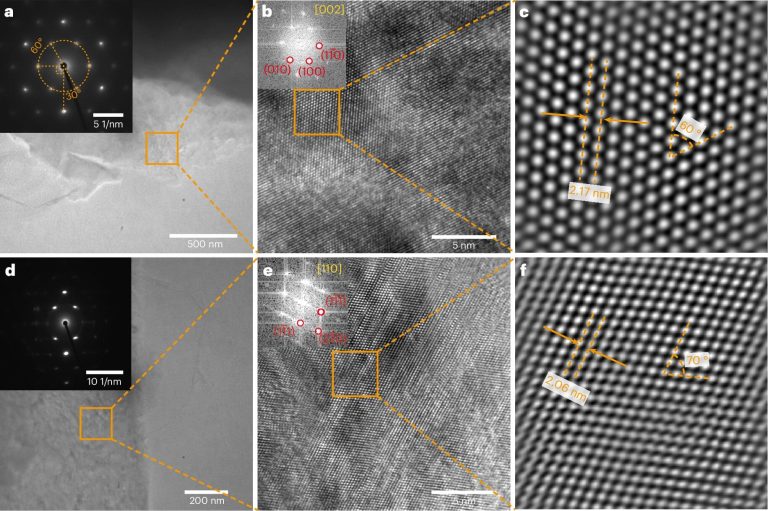
Most natural and synthetic diamonds have a cubic crystal lattice. However, researchers have long tried to create harder diamonds with a hexagonal structure, like those found in meteorite craters called lonsdaleite. Until now, such samples have been too small and of poor quality for industrial use.
An international team of scientists was able to overcome these limitations. They heated graphite to 1500 degrees Celsius in a high-pressure chamber, which made it possible to obtain synthetic diamonds with a hexagonal lattice. The results of the study were published in the journal Nature Materials.
The created diamonds, measuring a few millimeters in size, showed a hardness of 155 gigapascals, which is significantly higher than that of natural diamonds (70-100 gigapascals). In addition, they remain stable at temperatures up to 1100 degrees Celsius, while natural diamonds begin to break down at 700 degrees.
The new diamonds are unlikely to be of interest to jewelers, but their increased hardness and thermal stability make them ideal for use in drilling, materials processing and microelectronics. Scientists are also considering their use in superconductivity research and as substrates for growing transistors.
Source: naked-science.ru