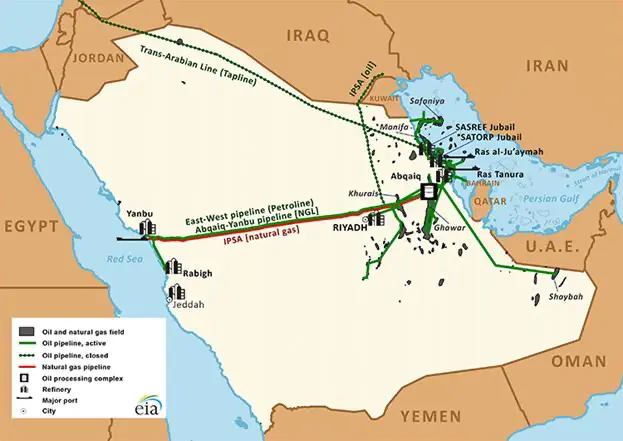
Saudi Arabian state oil company Saudi Aramco pushed the throughput of its East-West crude oil pipeline (Petroline) to 7 million barrels per day in the first quarter of 2026 — an all-time record in the pipeline’s operating history. The capacity increase has allowed the kingdom to scale up crude exports through Red Sea ports, bypassing the Strait of Hormuz entirely, which has effectively been closed due to an ongoing armed conflict.
The 1,200-kilometre pipeline connects the oil-producing Eastern Province to the Yanbu terminal on the western coast. Its standard historical capacity stood at 5 million barrels per day. To reach 7 million, the company conducted an emergency conversion of parallel pipelines previously used to transport natural gas liquids (NGL), switching them over to crude oil service.
In April 2026, one of the eleven pumping stations along the route was damaged in a drone strike during the Persian Gulf conflict, causing throughput to temporarily drop by 700,000 barrels per day. Saudi Aramco restored operations quickly, and the pipeline is now running at full capacity.
Of the 7 million barrels arriving at Yanbu each day, approximately 2 million are directed to three local refineries and power plants. The remainder is exported through the Yanbu North and Yanbu South marine terminals, or fed into Egypt’s Sumed transit pipeline.
Saudi Arabia’s success stands in sharp contrast to the situation facing other Gulf states. Kuwait, Qatar, and Iraq have no comparable overland alternatives. Their exports through Hormuz are completely blocked, a factor keeping global oil prices above $100 per barrel.
Beyond Petroline, Saudi Arabia operates several other significant pipelines. The Shaybah–Abqaiq line (639 km) connects a southeastern field to the world’s largest crude stabilisation facility, with a capacity of 350 million tonnes per year. The Haradh–Abqaiq pipeline supplies crude from the Ghawar field. Bahrain receives oil via four subsea lines from the Abu Saafra and Dammam fields, amounting to roughly 12.5 million tonnes per year. Two mothballed pipelines remain in reserve: Tapline (over 3,200 km, capacity 24 million tonnes per year), which formerly ran to the Lebanese port of Sidon via Jordan and Syria, and the Iraq–Saudi Arabia pipeline (85 million tonnes per year), which once linked Iraqi fields to Yanbu. Its Saudi section has since been repurposed for natural gas transport.
Saudi Aramco has not only set a new throughput record — it has demonstrated that overland bypass routes are critically important for energy security when maritime corridors are blocked.
Source: CDU TEK
Image: Middle East Institute