Specialists from the Institute geochemistry and Analytical Chemistry named after Vernadsky RAS, they reconstructed the geological past of the Martian Nergal Valley. The study revealed traces of ancient water activity and glacial processes, which changes ideas about the climatic history of the Red Planet.
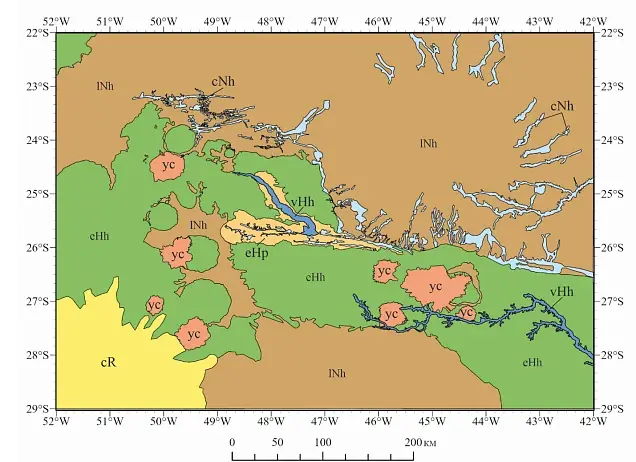
Russian scientists have conducted a detailed photogeological analysis of the upper Nergal Valley on Mars. As a result of the work, a detailed geological map of the region and reconstructed its complex history of formation.
The most ancient formations in this area were hills more than 3.7 billion years old. Their uneven surface has preserved traces of meteorite bombardment, and a network of small river channels has been discovered on the northern slopes. Researchers suggest that the formation of these channels occurred in several stages. Episodic warming events caused by meteorite impacts or volcanic activity could lead to the melting of subsurface ice and the creation of temporary water flows.
On a younger lava plain formed about 3.7 billion years ago, scientists discovered the Nergal Valley itself. Its slopes contain significant accumulations of clay minerals, which usually form in the presence of water. Of particular interest is the light area on the plain, whose topographic features indicate possible glacial activity between 3 and 2.4 billion years ago.
“The results of our research will serve as the basis for further study of clayey deposits in this region,” noted Ekaterina Cholovskaya, research engineer at the Laboratory of Comparative Planetology of the Geochemical Institute of the Russian Academy of Sciences. Analysis of the occurrence and mineralogy of phyllosilicates will help determine specific episodes of water activity when these minerals could have formed.
Scientists have identified two main stages of geological activity in the history of the Nergal Valley. The study confirms that impact events could cause temporary warming of the climate, leading to melting of ice and the emergence of water flows. These discoveries are important for understanding the evolution of the Martian climate and searching for traces of possible ancient life. The work was carried out with the support of the Russian Ministry of Education and Science.
- cR – Ritchey Crater
- vHh – Valleys
- cNh – Rusla
- eHp – Eroded volcanic deposits
- Us – Young craters
- cHh – Early Hesperian lava plain
- INh – Noachian Hills
The material was prepared with the support of the Russian Ministry of Education and Science as part of the Decade of Science and Technology.
Source: minobrnauki.gov.ru