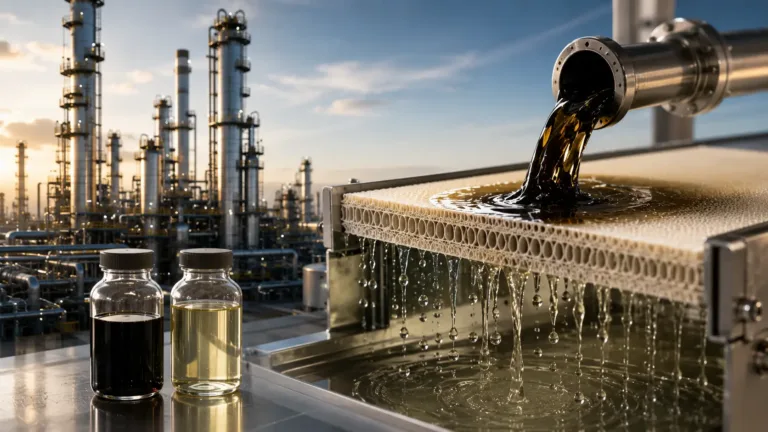
The century-long dominance of distillation columns in oil refining may finally be facing serious competition. Researchers from KAIST (Korea Advanced Institute of Science and Technology) and the Georgia Institute of Technology have demonstrated that an inexpensive polymer membrane can separate crude oil fractions without massive furnaces or extreme operating pressures. The payoff is substantial: energy consumption falls by more than 31%, while greenhouse gas emissions are reduced by nearly 38%.
Distillation is the backbone of every oil refinery, but it is also one of the industry’s most energy-intensive operations, consuming enormous amounts of heat and generating tens of millions of tons of carbon dioxide each year. Engineers have long sought to replace bulky distillation towers with compact membrane systems, but two major obstacles have stood in the way: slow filtration rates and the high cost of manufacturing ultra-thin selective membranes.
The research team overcame both challenges with an unexpectedly simple approach. Instead of developing an entirely new material, they used a commercially available porous polyacrylonitrile (PAN) membrane, already produced on an industrial scale for conventional filtration applications.
The membrane effectively transforms itself during operation. As crude oil passes through it, heavier hydrocarbon molecules become trapped inside pores approximately 15 nanometers wide. These deposits gradually narrow the flow channels to less than 2 nanometers, creating an ultra-selective molecular sieve. Once the channels shrink, the heavy molecules that caused the constriction can no longer pass through, while lighter fractions—including naphtha and kerosene—continue to flow with minimal resistance.
The results were exceptional. The membrane achieved a filtration rate 23 times higher than previous state-of-the-art systems, reaching 0.591 liters per square meter per hour. It also operated continuously for four weeks without any measurable decline in performance.
Researchers also evaluated a hybrid refinery configuration in which the membrane module performs the initial separation before conventional distillation. Their analysis indicates that such a system could reduce total energy consumption by 31%, cut CO₂ emissions by nearly 38%, lower cooling water demand by 21%, and decrease operating costs by 36%.
Unlike many laboratory-scale membrane studies, this technology was tested using real crude oil supplied by the South Korean refiner HD Hyundai Oilbank. The research team is now preparing to scale up the technology and integrate membrane modules into existing refinery operations.
The breakthrough comes from an unlikely source: a simple, inexpensive material that has been available for decades has unexpectedly proven capable of functioning as a highly efficient molecular sieve. If large-scale trials confirm the laboratory results, compact membrane systems could begin replacing conventional distillation columns in the years ahead.
Source: Science