It’s hard to believe that the clear gasoline in the tank was once a thick, dark mass from the depths of the Earth. Today, oil is used to make not only fuel, but also plastics, medicines, cosmetics, clothing – more 70 different products, without which it is impossible to imagine life.
Let’s look at how this process works and what happens to oil at an oil refinery: how energy, heat and materials for everything from airplanes to toothpaste are obtained from heavy raw materials.

What is the oil refining process and why is it needed?
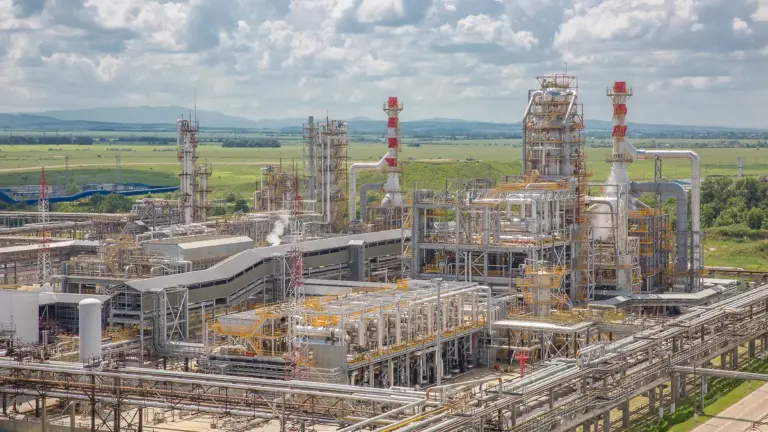
Crude oil is a thick mixture of thousands of hydrocarbons. In order for it to turn into fuel, plastic, medicine or shampoo, it must be “disassembled” into its component parts and “reassembled” – this time in the form of useful products. This is what oil refineries (ORPs) do. At such enterprises heavy oil passes through furnaces, columns and reactors, where molecules change structure under the influence of temperature, pressure and catalysts.
The recycling process is a whole chain of physical and chemical processes. It begins with the purification of oil from water and salts, continues with separation into fractions and ends with reactions that improve the quality of the fuel and convert heavy residues into new products. Factories all over the world operate according to these principles – from Omsk to Texas City.
Methanol production in fields – PNIPU technology — how using associated gas instead of burning it reduces emissions and makes processing more environmentally friendly.
Main stages and processes of oil refining
Before oil is turned into gasoline, diesel or raw materials for plastics, it goes through several technological stages.
Oil preparation: removal of water, salts and impurities
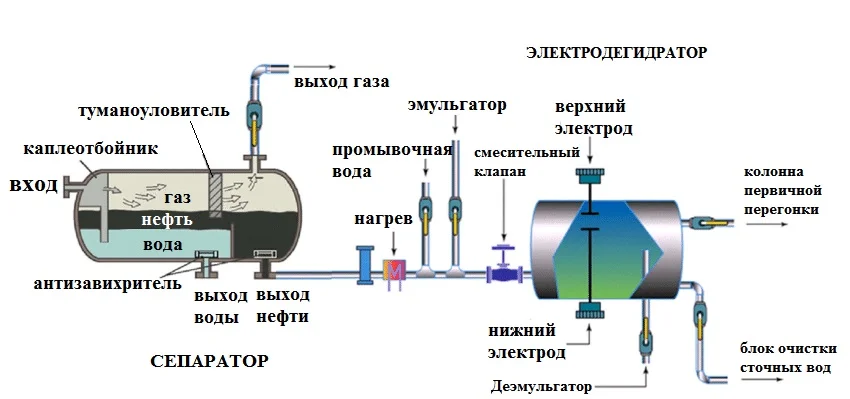
The oil entering the plant contains water, salts and sulfur. These impurities can cause corrosion and equipment damage. Therefore, the first stage of processing is cleaning.
Raw materials heat up, add demulsifiers and place in an electric field. Under its influence, microdroplets of water stick together and settle – in much the same way as condensation forms on the lid of a pan. As a result, moisture and salts are removed, and the oil becomes ready for distillation.
Primary oil refining processes: atmospheric-vacuum distillation
At this stage, the oil is divided into fractions based on boiling point. First her heat up to approximately 360 °C, after which it enters the column. Light fractions (gases, gasoline, kerosene) rise to the top, heavy fractions (diesel and fuel oil) remain at the bottom.
Secondary oil refining processes: cracking, reforming and isomerization
After distillation, some of the heavy fractions cannot be used directly. Then let’s get going enter chemical processes of oil refining that improve the quality of fuel.
- Cracking “cuts” long hydrocarbon molecules into shorter ones, turning heavy raw materials into light fuels.
- Reforming rebuilds the structure of molecules, increasing the octane number of gasoline from 60 to 92.
- Isomerization makes the fuel more stable and environmentally friendly.
At this stage the oil becomes gasoline. Here additives are added to obtain Euro-5 standard products.
Deep processing: production of petrochemical raw materials
Heavy residues become raw materials for petrochemicals. At deep processing plants, they are used to produce bitumen, oils and lubricants, the basis for the production of plastics, synthetic fibers and solvents. So modern technologies allow recycle almost no oil left – up to 98%.
Russian polymer for hydraulic fracturing: Gazprom Neft increases oil recovery is an example of how petrochemical products are returned to production, increasing the efficiency of wells.
What is made from oil
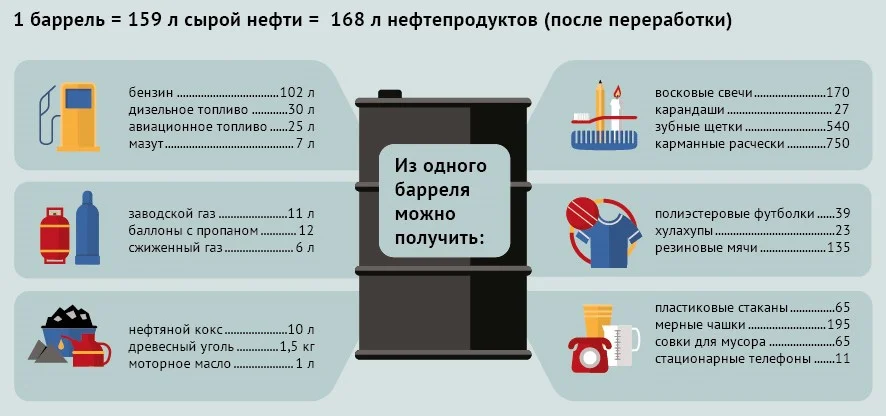
The main part of the processed raw materials is used to produce fuel for cars, planes, trains and ships. It is used to make plastics for phones and toys, synthetic fibers for clothing, wax for candles, cosmetic oils and even medicines. From one barrel of oil you can produce more than 70 different products.
Environmental aspects and the future of oil refining
Modern refineries are high-tech complexes where processes are monitored by digital systems and robots.
The largest enterprises are switching to energy-efficient technologies and deep processing plants, which make it possible to obtain more light fractions and almost completely eliminate waste. For example, at the Moscow Gazprom Neft refinery work modular bioreactors that purify wastewater to drinking quality.
To reduce emissions, plants are introducing hydrotreating, catalytic cracking and closed water circulation systems. According to Rosneft, the share of associated petroleum gas use is already reached 80%, which reduces CO₂ emissions by more than 1.1 million tons per year.
Read also: Oil production in the world: statistics by country
Another example — robotization of petrochemicals. Modern factories are equipped with autonomous monitoring systems that are capable of diagnosing the condition of equipment around the clock. According to Rosneft estimates, digitalization has brought an economic effect of over 11.5 billion rubles per year.
In the Arctic, where about 21% of Russian oil is produced, are being implemented biotechnologies for cleaning areas from oil pollution. The method using bacteria and calcium peroxide allows you to neutralize up to 93% of oil products in the soil. This is how a new philosophy of oil refining is formed – not just extracting energy from oil, but doing it responsibly, cleanly and efficiently.
Have you ever wondered how many things around us start with a drop of oil?
Cover photo taken from Kommersant publication
The material was prepared with the support of the Russian Ministry of Education and Science as part of the Decade of Science and Technology.