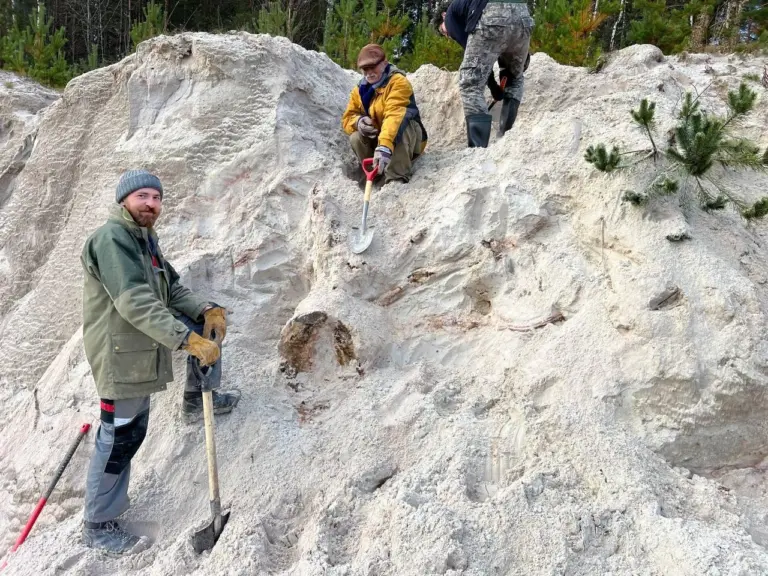
A unique fossil was discovered by paleontologists near Luga. The stump found is about 385 million years old, making it older than dinosaurs. The excavations lasted almost a week, after which the find was taken to the St. Petersburg State university for research.
In the Shalovo-Perechitsky quarry near Luga, scientists found a fossilized stump, the age of which is estimated at approximately 385 million years – this is the middle of the Devonian period, when the first plants and trees began to populate the land. The work was carried out by specialists from St. Petersburg State University under the guidance of the head of the Paleontological Museum of St. Petersburg State University, candidate of biological sciences Dmitry Grigoriev.
According to the researcher, at first scientists assumed that they had discovered the so-called prototaxite – an ancient organism that some classify as fungi, while others classify it as bacteria. However, during excavations under the rock layer, roots were noticed, which made it possible to establish that these were the remains of an ancient tree. Some roots reached a length of more than a meter, others – about forty centimeters. This structure is characteristic of ancient woody plants.
The stump is believed to be a Middle Devonian tree that existed around 385 million years ago during the Givetian Stage. The exact species will be determined later, after laboratory tests. According to scientists, such finds are extremely rare for Russia, especially specimens with a preserved root system.
“This is a significant discovery not only for the Leningrad region, but for the entire paleontology,” noted Dmitry Grigoriev. — In Russia, such stumps are almost never found. The latest finds of this age were previously recorded only in the Donbass.”
Researchers note that at the time when this tree grew, there was a shallow sea on the site of the current Leningrad region. Armored fish and ancient jawless creatures lived in these waters, and the first plants were just beginning to colonize the land. The stump, according to experts, could have been carried by water from the shore or preserved in the place where an ancient coastal forest was once located.
The discovery in the Shalovo-Perechitsky quarry may become one of the most important paleobotanical sensations of recent years. After completing the research, the stump will take a place in the collection of the Paleontological Museum of St. Petersburg State University and will help scientists better understand how life began on land hundreds of millions of years ago.
The material was prepared with the support of the Russian Ministry of Education and Science as part of the Decade of Science and Technology.
Source: fontanka.ru
Photo: Grigoriev D.V.