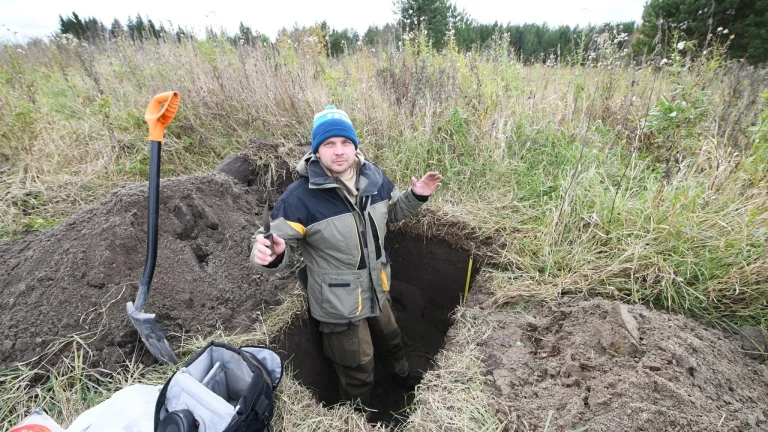
Biologists and archaeologists from Tomsk State University (TSU) have found that human activity over the centuries has increased fertility and accumulated carbon in Siberian soils. The research was carried out on the territory of ancient settlements – Ket fort and Shaitan III. The results showed that even hundreds of years after the disappearance of these settlements, the soils retain elevated carbon and nutrient content.
Scientists studied four soil profiles at two archaeological sites and compared them with intact taiga sites. It turned out that in places where people lived, the concentration of carbon is several times higher than in natural analogues.
Ketsky fort is a settlement of the 17th–20th centuries, where local residents were engaged in agriculture. Thanks to soil fertilization with ash and organic waste, their fertility is still preserved, although people left this place more than 60 years ago.
Shaitan III – a settlement of metallurgists and horse breeders (X–XVII centuries). Here the soils are rich in carbon due to charred organic matter, making them similar to the famous Amazonian dark lands. However, unlike the Amazon, these changes were not the result of targeted influence, but of the daily activities of people.
The study found that Shaitan III soils stored carbon 10 times more efficiently than pristine taiga sites. Even 400 years after people left the site, carbon remains in a stable state.
“Such territories can be called ancient carbon farms,” explains Sergei Loiko, head of the BioGeoClim laboratory at TSU. “People didn’t set out to improve the soil, but their economic activities led to long-term carbon accumulation.”
Scientists plan to continue searching for similar soils in the Tomsk region to assess their potential for reducing greenhouse gas levels. Some of these sites may receive protected status as cultural heritage sites.
The study was carried out within the framework of the TSU project “Global Earth Changes: Climate, Ecology, Quality of Life” with the support of the Priority 2030 program.
Source: naked-science.ru
Photo: Excavations of the monuments of Shaitan III and the Ket fort / © Photo courtesy of TSU BI scientist Sergei Loiko, TSU press service