Every year more rises from the depths 4 trillion cubic meters of gas – enough to fill Europe’s underground storage facilities 36 times. Almost half of the produced fuel is in the hands of the United States, Russia, China and Iran. In this article, we explain why the world’s production leaders keep the gas market under control – thanks to large reserves, modern technologies and long-term contracts – and what can change the situation.
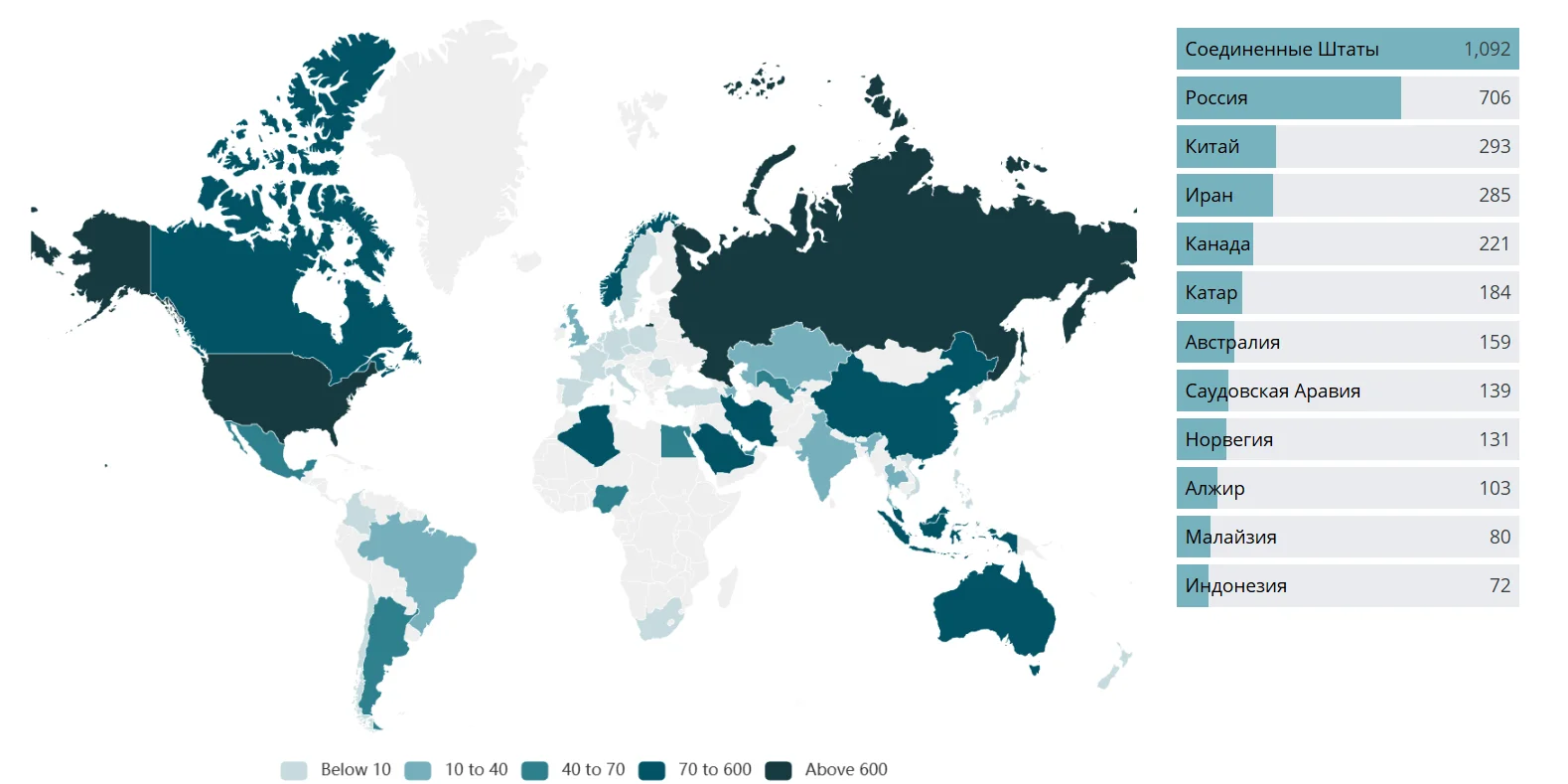
Top 10 leading countries in gas production
In 2024, global gas production reached a new maximum of 1,2% – not much at first glance, but in reality this is plus tens of billions of cubic meters. Fuel remains in demand despite the craving for “green” energy: if in 1980 all countries in the world pumped out 1.46 trillion m³ gas, today it is three times more. The main growth occurred in North America and the Middle East. For example, in the USA, more than 40% electricity, while growing demand for blue fuel in industry (chemistry, fertilizer production, metallurgy).
The top 10 includes leading countries in natural gas production, which supply more fuel to the market than others. The USA retained first place and raised 1092 billion m³ from the depths – this is the highest figure in the history of the country. Russia retained second position: about 706 billion m³, adding about 7% to the 2023 figures.
China, with its 293 billion m³, gained a foothold in the top 5 thanks to stable growth in domestic demand and production in new provinces. At the same time, it slightly overtook Iran, which in 2024 updated its historical maximum (285 billion m³).
The remaining leading countries in gas production provided a significant share of global supplies, especially against the backdrop of growing consumption in the Asia-Pacific region (APR). Over the past ten years, these countries have begun to spend approximately by a quarter more energy than before and now accounts for about 50% of total global demand. Contracts with India, South Korea and China (the largest consumers after the USA) influenced on the directions of LNG and pipeline gas supplies in 2024.
To understand who is gaining ground and who is losing ground, it is important to understand what is behind the leadership of each country: technology, resources or export infrastructure.
Why are some countries leaders in oil and gas production, while others are not?
Leaders in gas production hold on at the top thanks to different development models. USA relied on technology. The Barnett, Haynesville, Utica, and Permian shale fields have provided the country with more than 70% of the increase in production over the past ten years. Horizontal drilling and high speed of launching new wells (from two to four weeks compared to complex offshore projects that can take up to a year to prepare) allow US companies to respond instantly to prices and keep production above 1 trillion m³ per year.
Countries with the largest reserves have a different logic. Their advantage lies in the scale of the resource base. On the territory Iran about 17% of the world’s proven reserves are concentrated (34 trillion m³), in Russia – even more (63,5 trillion m³). Thanks to this, countries pump out large volumes of fuel despite sanctions. Thus, in 2024, Russia increased production and compensated for the decline in exports by increasing supplies to industry and the population within the country, as well as launching large LNG projects in Yamal and other Arctic regions.
Qatar and Australia They follow the third path – they rely on the LNG infrastructure. Qatar ranks third in the world in gas reserves (approx. 24 trillion m³). It is actively expanding the capacity of the North field and plans to increase LNG exports by 40% by the end of the 2020s. Australia is betting on offshore and contracts with Japan and South Korea, remaining one of the three largest LNG exporters in the world. For both countries, export terminals and logistics are important, and not how many cubic meters of gas they themselves consume. LNG is advantageous in that it can be quickly sent by tankers to any market, and the volume during liquefaction is reduced by 600 once.
As a result, the leaders in gas production in the world are those who know how to combine three pillars – technology, resources and export infrastructure. If one of them fails, the country begins to lose share. This is already noticeable in Libya and Algeria, Norway and Great Britain, where old deposits are being depleted faster than they appear new projects.
In the 20th century everything depended on oil and gas, and in the 21st century there is a reliance on rare earth metals – will Russia find “Arctic treasures”, read in our article
Russia is among the leading countries in natural gas production
To remain in the top 3 leading countries in gas production, it is important not only to have large reserves, but also develop new directions. Now Russia:
- develops deposits on the shelf (Prirazlomnoye in the Arctic, named after Yu. Korchagin and named after V. Filanovsky in the Caspian);
- builds and expands plants for the production of LNG (Yamal LNG, Sakhalin-2), which can be transported by sea;
- is looking for new gas deposits – in 2025 there will be more than 4000 licenses for production and exploration in the Yamalo-Nenets Autonomous Okrug, Khanty-Mansi Autonomous Okrug, Krasnoyarsk Territory.
But there are also difficulties. Not all reserves are easy to mine. The development of some Russian deposits requires expensive equipment and long preparation. Therefore, the industry needs investment and modern technologies to move on to new projects. One of the illustrative examples is Shtokman gas condensate field in the Barents Sea. The resources are enormous, but due to harsh conditions and high development costs, the project has not been launched for many years.
In 2022, due to EU sanctions, the export map also changed. Russia began to redirect flows to the East. Thus, exports to China via the Power of Siberia increased from 4 billion m³ in 2020 to more than 30 billion m³ in 2024.
Read about offshore potential and Russian technologies in our material
Where is the gas market heading: forecast for the coming years
The global gas market is experiencing a reboot: first, the pandemic brought down demand and prices, then came military conflicts, sanctions and the energy crisis in Europe. What matters less and less is huge deposits, and what matters more and more is the speed with which a country can extract, liquefy and deliver gas. In the 2020–2030s to first place come out LNG capacity, logistics and export flexibility.
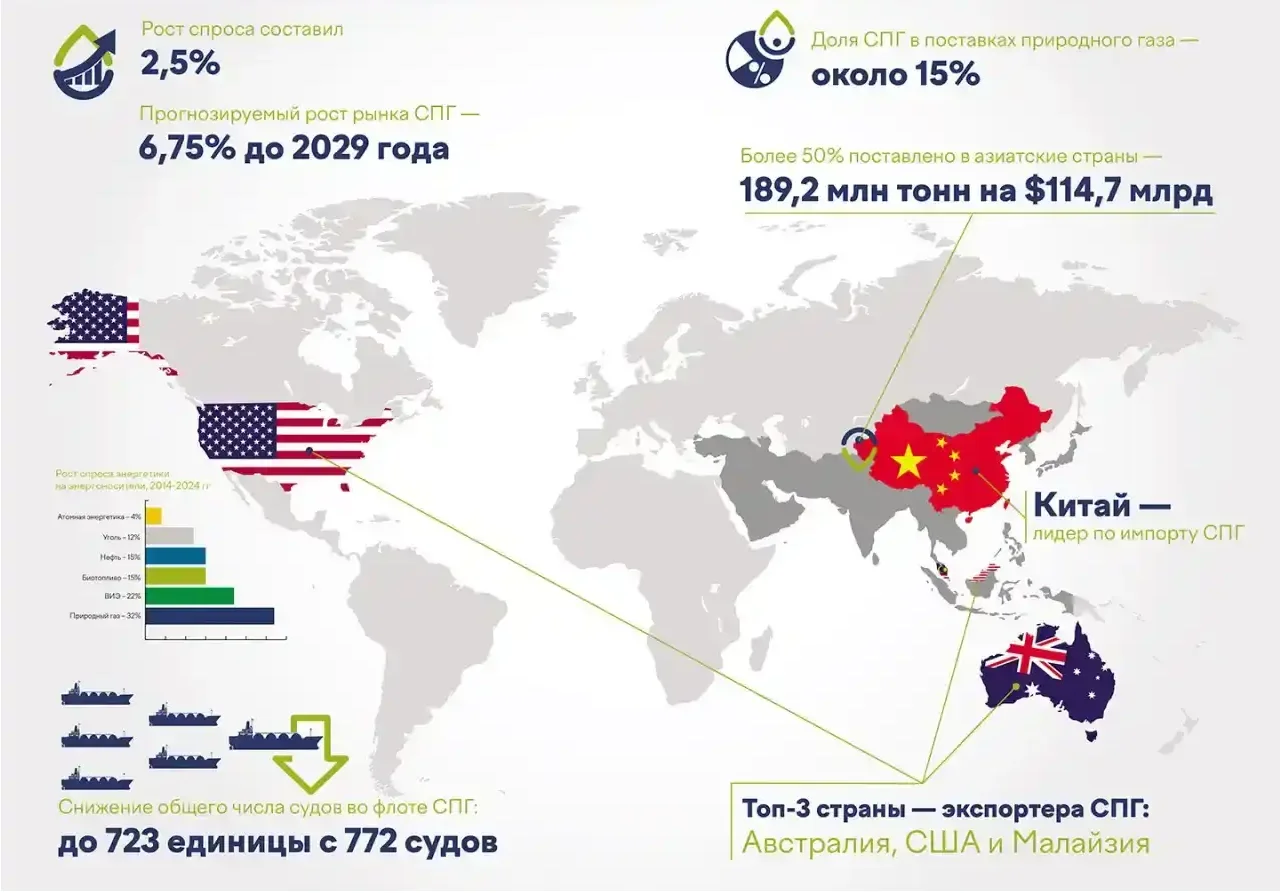
Global LNG trade volume in 2024 made up about 884.8 billion m³, and this is the maximum in history. Exporting countries that quickly introduce new LNG terminals and build shipping routes gain advantages over those that focus only on production and pipelines. This is especially important in conditions of changing demand: now Asia continues to buy gas in large volumes, but not everything is so simple.
“Students of the Mining University are developing the LNG market” — note about the development of LNG in Russia, education and trends
Some countries, such as China, Japan and South Korea, by the end of summer 2025 reduced LNG consumption. This is explained by several factors:
- competition from cheap pipeline gas (for example, it is more profitable for Chinese enterprises to buy local fuel);
- high spot prices for LNG (over $10 for 1 million British thermal units – a loss-making purchase);
- increasing domestic gas production (only at the end of summer 2025 in China found the new Hongsing field with proven reserves of 146 billion m³ of gas).
This means that now any country – an exporter and leader in gas production – must take into account: even the large Asian market does not guarantee stable contracts.
Currently active buyers of gas are France, Spain, the Netherlands, Italy, Belgium, Great Britain and Turkey in Europe, Mexico in North America, as well as Kuwait, the UAE, Egypt, Jordan and Bahrain in the Middle East.
In 2026, experts predict a new turn – Asian countries will again intensively buy gas. This due to the commissioning of new projects in the USA, Canada and Qatar, which will stabilize LNG prices – the fuel will become affordable for China, India and others. In this situation, exporters relying on LNG plants, a fleet of gas carriers and a network of terminals can quickly redirect supplies between Europe, Asia and the Middle East, adjusting to seasonal demand.
Do you agree that the future lies with LNG and flexible supply routes? We are waiting for arguments for and against in the comments.
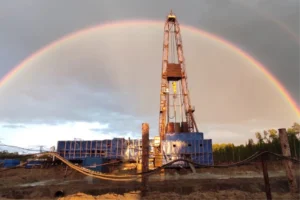
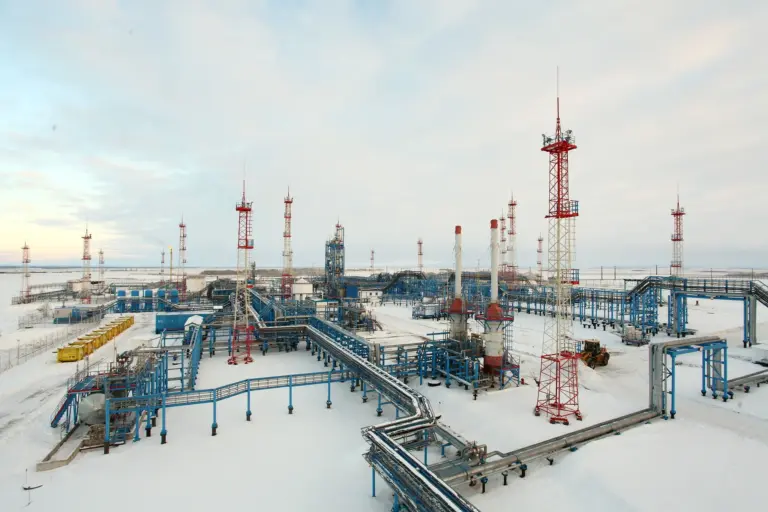
The cover photo was taken from the official website of Gazprom Dobycha Noyabrsk LLC