
This is our first grant – and, of course, now the amount of 1.6 million rubles looks impressive. Plus, mandatory co-financing is added to it – another million. For the media, which all this time existed exclusively due to my own investments, this is serious support and a new stage.
I have long understood: without external funding, without partners and new resources, we will not be able to develop. High-quality content is expensive, and support allows us to do more – deeper, more professional, more stable. Perhaps in a year this amount will seem small compared to other opportunities. But I want to capture this moment – because now it is really important. It’s not just money. This is a confession. Recognition that the concept with which we entered the competition was heard and received support.
Next, I will tell you how the preparation went, why I decided to apply in the first place, although at first I was quite skeptical about the word “popularization”. But thanks to you – our readers – my attitude has changed. I hope my experience will inspire someone else to apply for a grant and support their own project – be it a blog, website or event series. I believe sharing stories like this is important.
How it all started
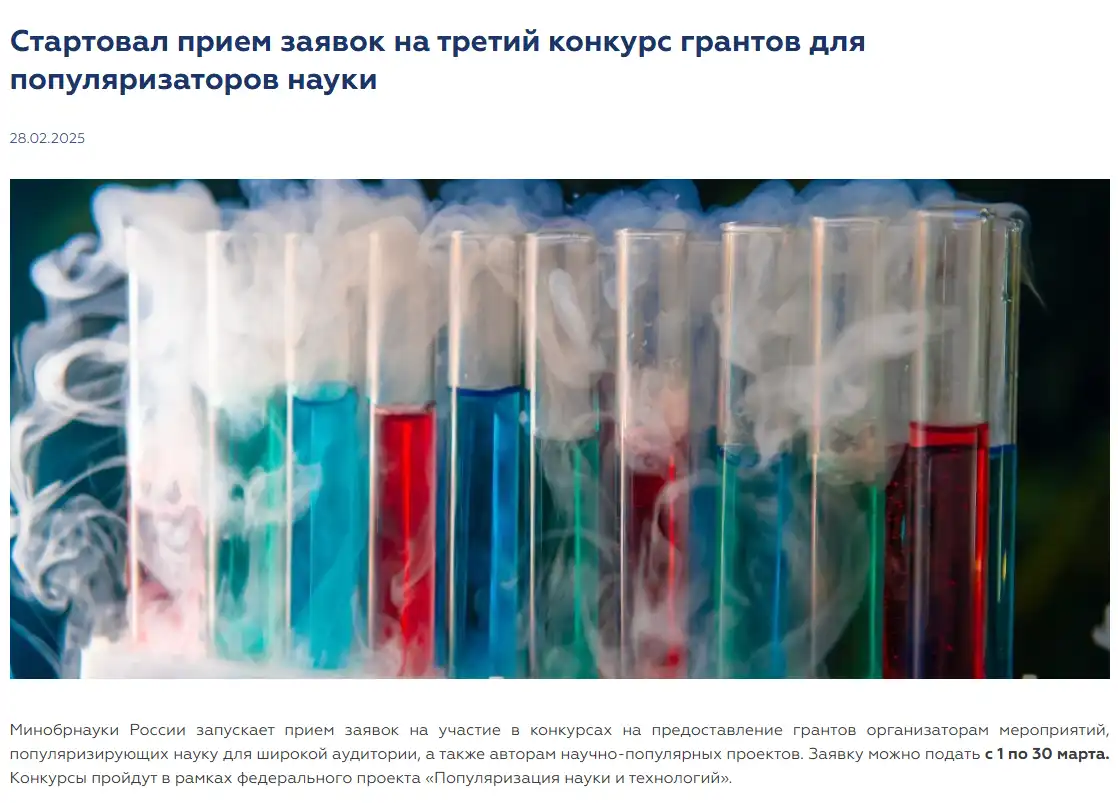
I learned about the grant for authors who popularize science by accident – I saw a story from blogger and geologist Iskhak Farkhutdinov. I took a screenshot so as not to forget, and decided to study the conditions in more detail. At first it seemed that this was something far away – not for people like me, but for “serious” scientific projects with a large background. I don’t have an institute, I don’t have an NGO. But then I remembered: I already have a whole editorial team behind me. GeoConversation is not a hobby, but media that requires development. This means it’s time to look for real sources of financing.
I went to website, read the terms of participation and wondered how our project corresponds to the theme of the competition. We do not publish scientific reviews or post articles from academic journals. Our materials are stories about: how expeditions go, how geologists work and geophysics, what problems specialists solve in the field.
But this is exactly what science is all about. We carry out geophysical research that is based on physical laws, we work with high-tech equipment, analyze and interpret the data. Everything we do in the field is applied science, told in living language. But I still had a question: can I be called a popularizer? Yes, I talk about my profession, show how the industry works from the inside, but whether I consider this precisely the popularization of science – that’s where I had my doubts.
I didn’t set out to popularize science. I was just telling you how I work
In my mind, “popularization” looked like something abstract, artificially invented: someone from above says that it is necessary to develop geological sciences, attract students, cultivate specialists – and somewhere in high offices a decision is made “let’s popularize.” Then boys and girls are hired and start making content.
Most often, these people are not from the industry themselves – journalists, editors, content managers. They are afraid of geology as too narrow a topic and try to speak in such a way as to please everyone. Posts appear like: “What is geology?” or “Which mineral is the hardest?” And the result is a strange effect: the mass audience is not interested in it – it’s too abstract and “not about me.” But for professionals, such texts are primitive and cause confusion. As a result, this approach does not work for any audience. Trying to be “understandable to everyone”, you do not receive attention from anyone.
I’ve been here for five years I blog about my work — about geophysics. And, probably, this is what real popularization is: when you show from the inside how the profession works. Honestly and without oversimplification. Yes, I talk about how we carry reels, how we live in the field, how we get to work by helicopter. I explain how the gravitational and electromagnetic fields work, but I try not to overload with terms – so that it is understandable and interesting even for those who are far from the industry. I keep a balance so as not to slip into simplification and not to overload with technical details.
Content about tents, bears and life in the field is always welcome. But this is not the main thing. The main thing is to talk about the essence of the work: what geophysicists do and how they help find new deposits.
And it seems to me that real popularization only works when it is done by those who actually work in the profession. Because it will always be sincere. Only a person who loves his job can talk about it in such a way that he wants to become a part of it. One subscriber once wrote that he saw a video of geologists riding an all-terrain vehicle and realized: “I want that too.”
It was with this skepticism that I applied for this grant. I thought: well, the popularization that the grant organizers have in mind is probably not about me. But we meet the formal criteria, which means we have to try. And then, in the process of preparing the application, collecting documents and especially developing the presentation, I suddenly rethought the entire project. And I realized: yes, what we are doing is the real popularization of geology. Real, living and from within the profession.
First obstacle: legal entity
The first difficulty I encountered was the requirement to have a legal entity to apply. And at that time I was registered as self-employed. I hesitated for a day or two: registering an individual entrepreneur seemed like a risky step. But if I seriously want to develop media, I had to legalize the project. I issued an electronic signature, submitted an application through State Services – and a few days later I received a notification: now I am an individual entrepreneur Kostina. This seemed like a big step forward.
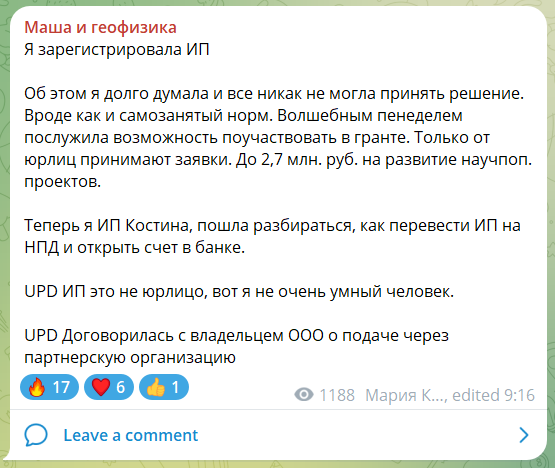
However, the joy was short-lived. The terms of the grant directly state: the applicant must be a legal entity, and an individual entrepreneur is not considered one. The minimum form is LLC. And there was less than three weeks left before the deadline. It was impossible to register an LLC and prepare all the documentation during this time.
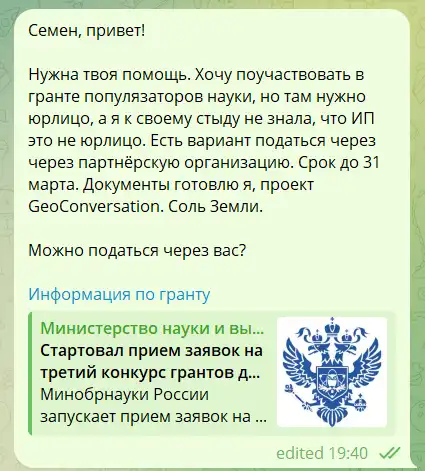
The first reaction was: “Well, that means it’s not fate.” But after a few minutes another thought came: “If I can’t apply myself, then I need to find those who can help.” I started going through my friends with legal entities in my head and almost immediately remembered Semyon Inozemtsev – Head of the content agency “Strategy”. We have known each other for a long time and cooperate professionally.
I wrote to him: “Semyon, help. I want to apply for a grant, but I need a company.” And the very next morning I received a short and decisive message from him: “Yes, I will help. Write what you need?
Creating a presentation and concept
Support from the content agency “Strategy” and its head became an important resource. There were only two weeks left for preparation: it was necessary to develop a project concept and prepare a presentation. I started working at an accelerated pace.
Preparing the presentation took only three days – largely due to the fact that I worked not alone, but in tandem with artificial intelligence. Chat GPT helped quickly put together a structure, process ideas, and format the text. But it is important to clarify: I did not use the neural network as a generator of ready-made solutions. I didn’t write something like “make me a presentation for a grant” in Chat GPT – such template requests don’t work. I interacted with AI as a partner: I dictated ideas, inserted fragments from editorial policy, formulated goals, described the audience and the specifics of our work. At first, the budget was drawn up manually, and the neural network helped with editing, structuring and designing the data.
Took over the design and visual part of the presentation Alexey — my partner on the site. Thanks to his work, the presentation turned out to be really strong: concise, visually accurate and professional.
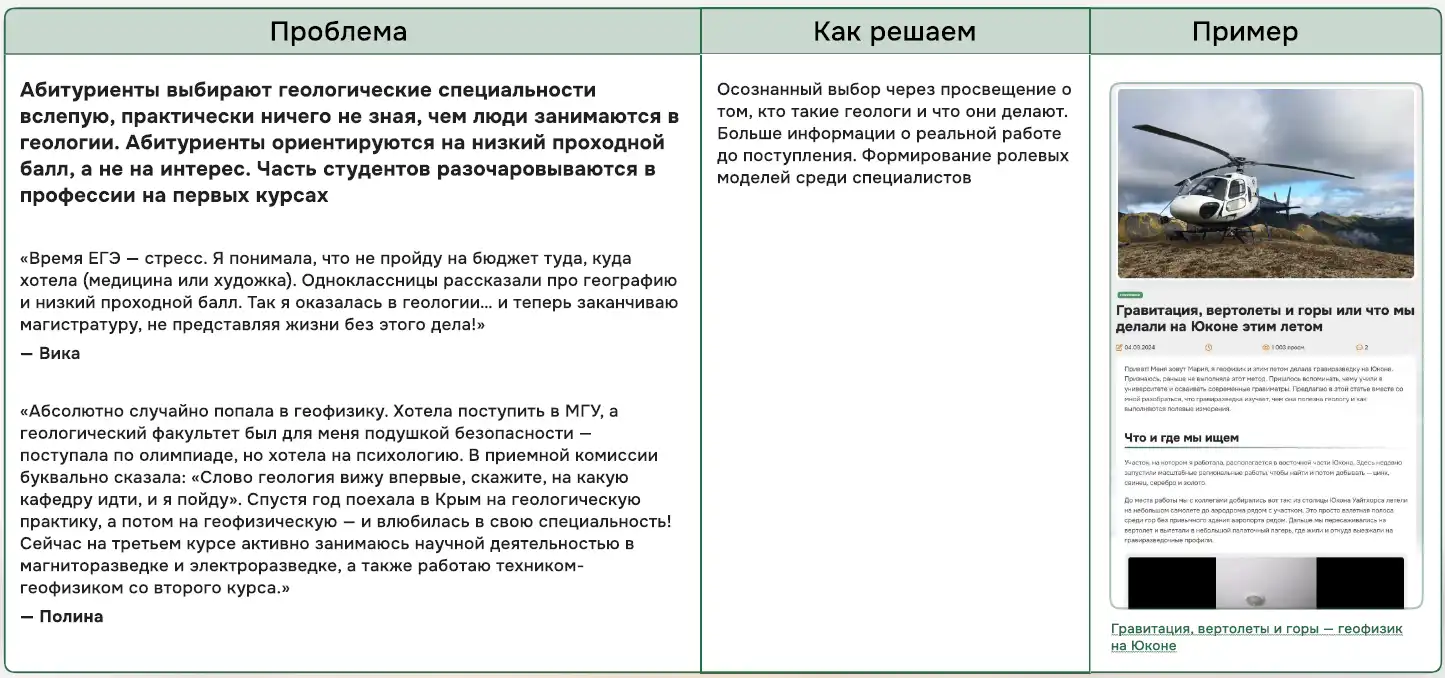
When Alexey began to prepare the presentation, I simultaneously asked a question on the blog “Masha and Geophysics”: How did you choose your profession? And I received answers that radically changed my understanding of what GeoConversation actually is – and what real popularization of geological sciences is.
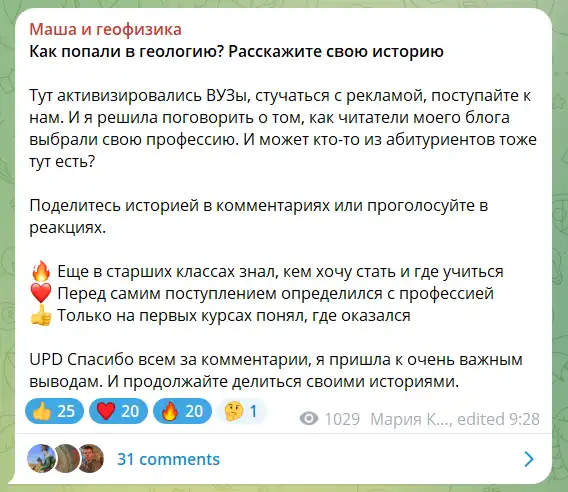
When subscribers began to respond, it turned out that the majority had chosen a profession without having virtually any idea about it. I also remembered myself in my first year: out of 30 people in the group, only three knew what geophysics was. Geology could still be heard in geography lessons, but geophysics was a dark forest. Two of them knew because they came to the university after geological exploration college, and I – a little later school club. The rest just came at random.
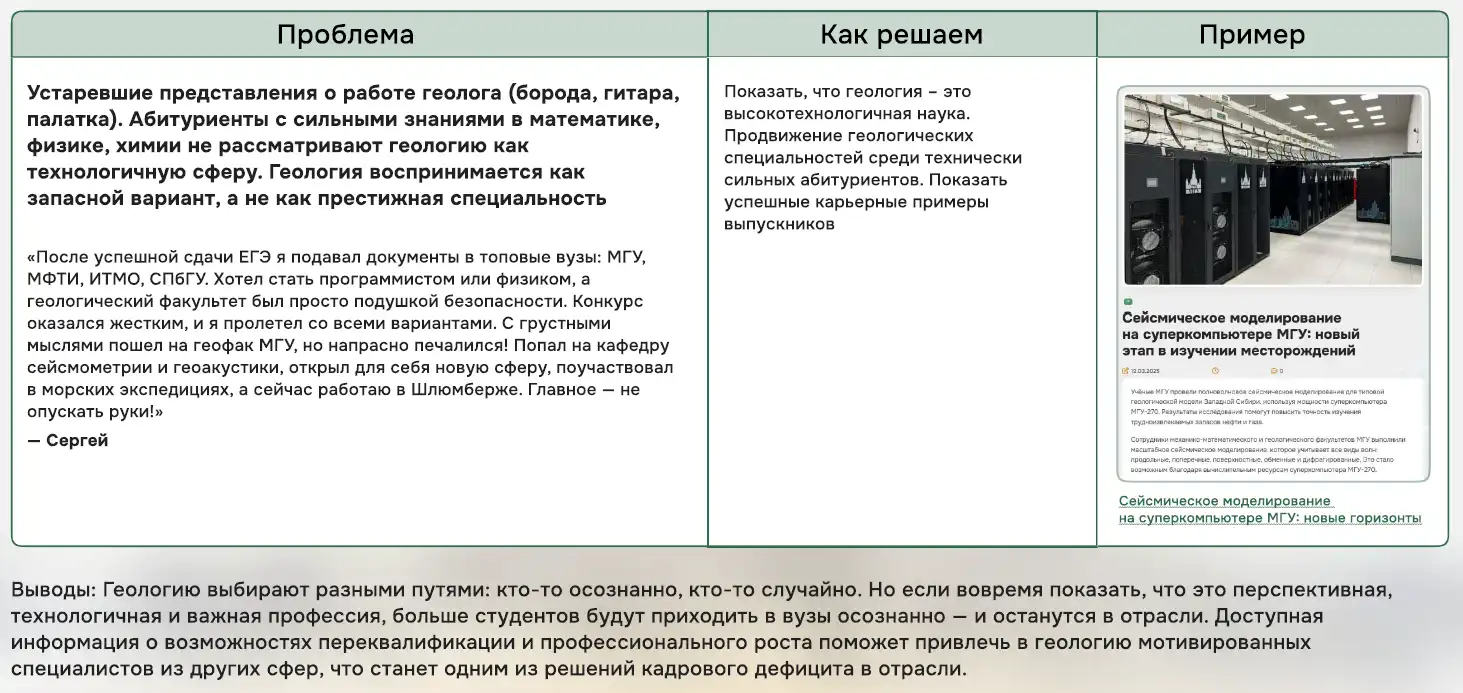
Your comments tell the same story. Some got in by accident, others because of a low passing score. Yes, in the comments you write that it was a happy accident, but this is rather an exception and a typical mistake of a survivor. After all, those who did not understand where they ended up left. Some dropped out of school, others completed their studies, but are not working in their specialty. Another pain is that applicants with high results in physics and mathematics tend to enroll in mechanical engineering, but go into geology “on a residual basis.” But today geology is not just about tents, beards and guitars around the fire. This is a high-tech industry where programmers are needed and actively used artificial intelligence — and this is also important to talk about.
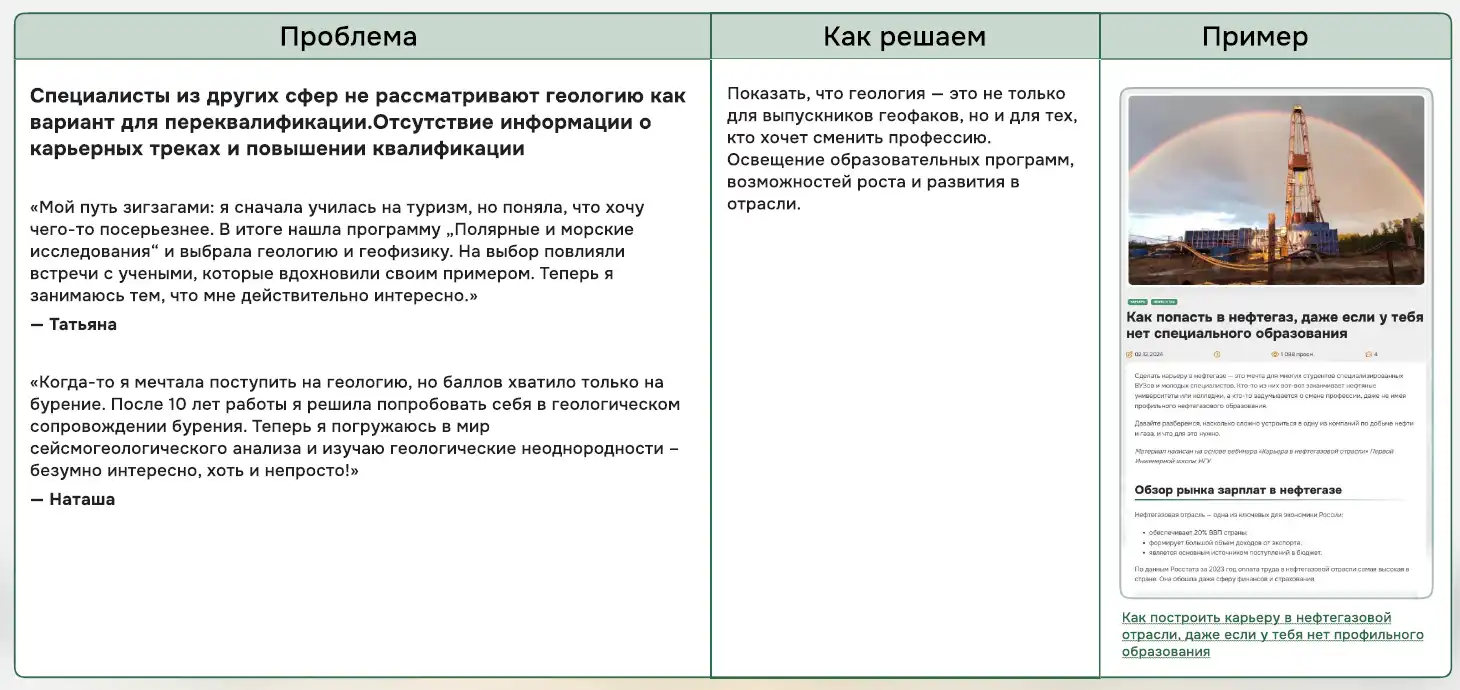
And then there are those who came to the industry consciously, after another profession. For example, former economists who changed their field and became geologists.
These are important stories, and they inspired me to reconsider how we frame GeoConversation’s mission.
At that time, Alexey had almost finished the presentation. But I realized: we need to change one of the key slides. I wrote to him: “Please do not design this block – I will rebuild it.” We redesigned the presentation of the concept and re-formulated, How GeoConversation is involved in popularizing science. We made it in time: the presentation was ready a week before the deadline for accepting applications.
Documents, bureaucracy, panic
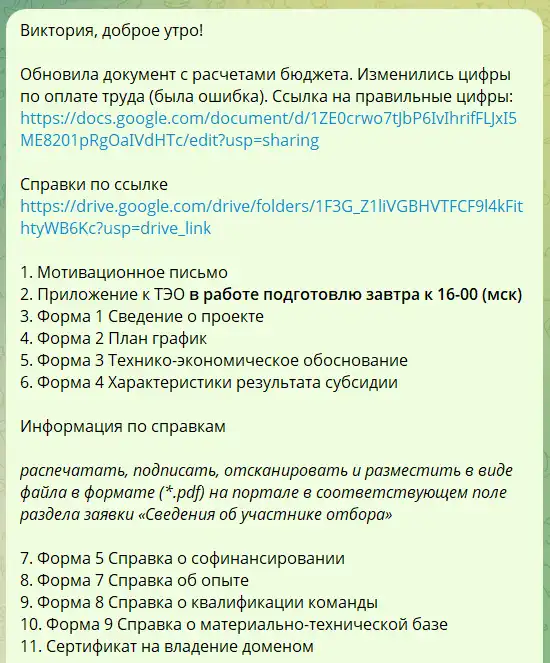
At first, it seemed like sending the presentation was the final step, but it was just the beginning. Since it was not me who submitted the application, but a partner company, I did not have access to the system. In the last week before the deadline, regular messages began to arrive from Victoria, an employee of the company that was handling our application: it was necessary to fill out many additional forms – calculations, justifications, spreadsheet documents. Although the budget had already been spelled out in the presentation, now everything needed to be drawn up again – on other lines: salaries, taxes, contributions, administrative expenses.
For three days I worked closely on these documents. Here again, artificial intelligence helped: it accelerated some of the processes and helped edit and structure the data. As a result, we managed to prepare and upload more than ten documents on time.
How I felt after sending
When we uploaded all the documents into the system and clicked the “Submit” button, I exhaled and decided to forget about it as a difficult, but completed stage – and did not at all hope for victory. How can you prepare a full-fledged project in just two weeks? I was sure that among the participants there were definitely teams that started work early, with a well-developed concept, experience and resources. So I decided: let this be a training session. Even if we don’t win, I’ll come to the next competition more prepared. I knew that participating in grants is a story with a cumulative effect: the more you apply, the higher your chances in the future. Our project is less than a year old, so I didn’t expect to win.
The first joy was that all the documents were accepted – this was in early April. I thought: it’s good, at least everything was formatted correctly. Later, at the end of the month, letters from the organizers began to arrive with clarifying questions. Somewhere it was necessary to fill in the missing fields, correct something. And then the first excitement appeared: perhaps we really won. But until recently I didn’t allow myself to believe it.
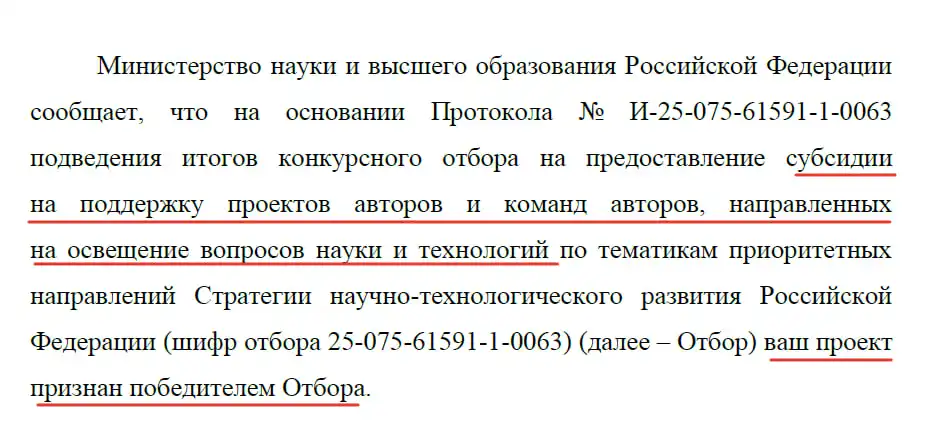
Until the official letter arrived: we won the grant.
New alarm: coordination, recalculations, agreement
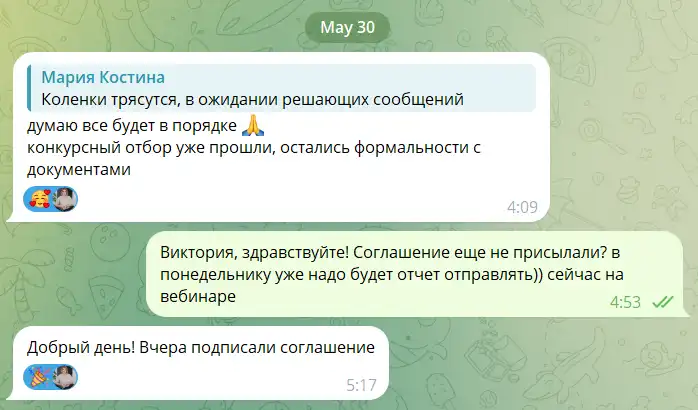
When it became possible to talk about the victory publicly, I blogged about it. The joy was enormous – but along with it a new wave of worries began. The whole of May was spent on approvals: they recalculated the budget because they approved the amount less than the requested amount, redid the estimate, and prepared the documents again. There was a feeling that everything could be ruined at the finish line. But on May 30 I received a message: the agreement was signed. Now everything is official.
And there is a new responsibility ahead. Even without the grant, we would have continued to publish articles and maintain social networks. But now we have specific obligations, deadlines and reporting.
What’s next
For me, this grant is not just support for the project. This is the first step on a long journey. It is responsibility, opportunity and confidence that we are doing something important. Thanks to the grant, we will create more articles, conduct more interviews, expand sections, make videos based on our texts, and be more active on social networks. But the main thing is that we will create more reasons for conversation. About geology, about the profession, about technology, about the people who work in this field.
And perhaps someone will accidentally see a video of me walking through a windfall with a backpack, or a geologist climbing in the mountains, and will think: “I want the same.” Or an IT specialist who is currently developing applications will read an article about artificial intelligence in geology and decide: “But I can apply my knowledge here.”
We never know who our material will affect and how. The article is like a child whom you release into the adult world and no longer belongs to you. I believe GeoConversation has a long road ahead. Thanks to everyone who reads us, shares articles, comments and supports us. You are part of this story.