Scientists have completed a study of soil samples returned from the asteroid Bennu by the OSIRIS-REx spacecraft and found that the minerals contained in these samples were formed in an aquatic environment. These results could give scientists clues about how water and organic matter may have influenced the origins of life in the solar system.
New research published in the journal Nature, confirmed the presence of water in the mineral compositions of samples obtained from the asteroid Bennu. These samples were brought to Earth by NASA’s OSIRIS-REx mission, which took a soil sample in 2020. The researchers discovered large amounts of salt minerals such as phosphates, sulfates and carbonates. These minerals could have formed during the evaporation of brines on the asteroid’s parent body, indicating the presence of water in its past.
The OSIRIS-REx spacecraft was launched in 2016 and reached the asteroid in 2018. Since then, the device has been able to collect valuable samples, which returned to Earth in September 2023. These samples have become important research subjects for scientists seeking to understand how life might have arisen on Earth and other planets.
Bennu was not chosen for the study by chance. This asteroid belongs to the Apollo group that crosses the Earth’s orbit and is of great importance for studying the origin of the solar system. Bennu is also a carbonaceous asteroid, which means it may contain carbonaceous materials preserved from the very beginning of the formation of our star and planets.
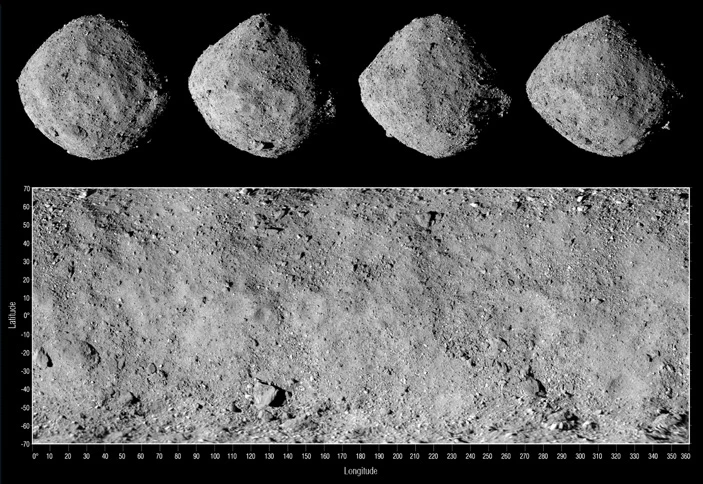
When the device arrived at Bennu, its surface turned out to be extremely rocky and covered with large boulders. This made choosing a sample collection site a challenging task. However, scientists were able to find a crater that seemed to be young and not exposed to external factors. This increased the likelihood that samples collected at this site would be the purest and most useful for further research.
The sample collection process was not easy. The spacecraft used a maneuver known as Touch-And-Go, in which the sampler was carefully placed on the surface of the asteroid. After this, using compressed nitrogen, the collected regolith was transferred to a special container. This process was carefully thought out to preserve the material in its original form.
At the moment, the total mass of the collected samples was 121.6 grams, which is the largest sample of asteroid matter obtained in the entire history of space research. The samples were placed in a special container and are now being actively studied in laboratories around the world.
Scientists have received particular attention from minerals containing phosphates, which are usually formed in aqueous solutions. This discovery confirms the hypothesis that water could have existed on the body of an asteroid in ancient times, which opens new horizons for studying the possibility of the existence of life in other parts of the solar system.
Studying samples from asteroid Bennu gives scientists important clues about how water and organic matter may have contributed to the formation of life. These results also strengthen the hypothesis that asteroids and other celestial bodies could play a key role in transporting elements necessary for life to Earth and other planets. In the future, scientists hope to continue research that will help better understand the history of the solar system and the possibility of the existence of life beyond it.
Source: elementy.ru
Photo from science.nasa.gov