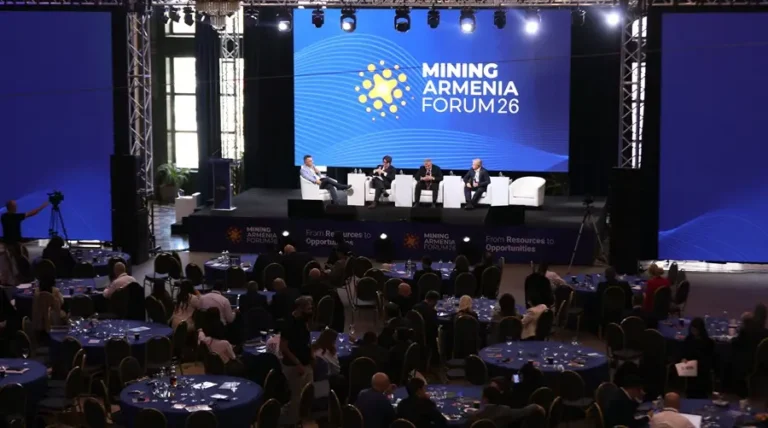
Armenia is stepping up its efforts to attract international investment into its mining industry. The third annual Mining Armenia forum, held on October 16–17, 2026, brought together about 400 mining company executives, investors, and officials. Prime Minister Nikol Pashinyan and Deputy Prime Minister Mher Grigoryan took part in person, underscoring the importance of the industry to the country.
According to Grigoryan, the goal is not simply to mine more but to build a qualitatively new mining industry. Armenia has a long history of copper and molybdenum mining, but resource potential alone is not enough for growth. Investors need reliable geological data, stable regulation, and public support.
A Wood Mackenzie survey identified the country’s strengths and weaknesses. Among the pluses were experienced personnel and geological potential. Among the barriers were limited geological information and regulatory uncertainty. Wood Mackenzie’s vice president of consulting, Wael Jaber, put it simply: the opportunity is there, but new investment requires better data, clear rules, and a predictable environment.
A shift may come from the launch of the Amulsar gold project, one of the largest foreign investments in the country. It started a week before the forum after years of environmental protests and political uncertainty. Pashinyan said that in the near future, together with international partners, the portfolio would need to be reviewed and new opportunities identified.
Former Anglo American chief Mark Cutifani, who gave the keynote address, believes Armenia can move beyond classic mining. In his view, amid changing technology priorities, copper and molybdenum are becoming a source of new value, and the country can develop a broader materials industry. Vardan Janyan, president of the Union of Mining and Metallurgical Industry, forecasts that the sector’s exports in 2027 could reach about $3 billion.
A significant part of the discussion was devoted to sustainable development, as the forum took place on the eve of COP17. Participants discussed biodiversity management, climate risk disclosure, environmental monitoring, and engagement of local communities. Janyan stressed that a growing industry must minimize its impact on nature and meet the expectations of the majority of the population.
For Pashinyan, public trust remains at the center of the discussion: mineral resources belong to the people and the state, and companies merely manage them on behalf of society. It is this balance that will determine whether Armenia becomes a notable player in the critical minerals market or remains a country with rich subsoil and unresolved questions.
Source: Mining Armenia Forum
Image: Mining Armenia Forum