Four years ago, Yana Akhmatova — an entrepreneur and the head of an investment group that works with subsurface-use assets in Kazakhstan — prepared for her first meeting with Chinese investors as if for an exam. Alongside preparing the offer itself — the terms, the figures, the details of the asset — her team tried to anticipate every nuance of business etiquette: chapans were brought into the office, staff were tasked with finding out in advance which clothing colors are considered inappropriate, and the table was rearranged and reset several times.
After that meeting, Yana was left with many questions and doubts:
- Understanding who really stands behind a Chinese company, how serious its intentions are, and by what rules it makes decisions turned out to be far harder than picking the right jacket color. On the other side of the negotiating table could be a representative of a genuine large company, an intermediary interested only in the fact that a deal happens, or a person with no authority to decide anything.
- How real the partner’s financial capabilities actually were. This had to be verified somehow before spending months on meetings.
- The negotiations themselves would now go smoothly, now break off indefinitely without explanation, and it was unclear whether a long silence meant a refusal or just a pause.
- Which details truly affect the outcome of a deal, and which are just a beautiful ritual behind which it is easy to lose sight of the essence.
Yana was helped in finding the truth by Karlagash Mynzhassarova — a negotiator for whom China is both a profession and a part of her life.

Karlagash Mynzhassarova: from China scholar to international negotiator
Karlagash’s first degree is in Chinese studies. She studied Chinese and English philology at the Abylai Khan Kazakh University of International Relations and World Languages. She spent one year studying on a grant in China, in Changchun — it was her first trip abroad. After university, Karlagash was invited into the oil and gas industry, where she worked for nine years in Aktau, after which the company sent her to Calgary to study project management.
That is where Mynzhassarova’s path into China began in the professional sense. Karlagash was invited to Shenzhen, where for several years she was secretary-general of an association tied to the Belt and Road Initiative, worked for a Chinese investment fund, and took part as an expert in mining and other international projects. In total she lived in Shenzhen for five years before the pandemic, and she describes this time as life inside the Chinese industry.
Today Karlagash heads the Asian development division at one of Kazakhstan’s financial groups. Yet her role is not limited to knowing the language or interpreting: she is an international negotiator and adviser on working with Chinese investors. Karlagash helps the parties understand each other’s interests, vets potential partners, prepares negotiating teams for meetings, and eases the path to a decision — whatever that decision turns out to be.

Why Chinese capital is increasingly going abroad
According to China’s Ministry of Commerce, in 2025 China’s outbound foreign direct investment reached $174.38 billion, up 7.1% year on year, while Chinese companies channeled capital into 11,048 enterprises across 153 countries. Behind these figures lies a logic that Karlagash Mynzhassarova states outright:
“The competitive environment inside the country has become so dense that companies are left with virtually no choice but to move beyond China’s borders.”
She puts it succinctly: if a company does not go overseas, it has no future. Since 2000, China has had an officially enshrined state strategy, «走出去» — “Going Out,” which encourages the investment activity of Chinese companies. What Mynzhassarova describes as a practitioner’s personal observation is, quite literally, the country’s official economic policy
This same logic has a flip side — competition that becomes so excessive it turns from an incentive into a threat. A company that stays exclusively on the domestic market puts its own long-term strategy at risk. In China’s economic policy this phenomenon is called neijuan, or “involution” (内卷) — excessive internal competition in which companies in a single sector simultaneously expand capacity, cut prices, and gradually erode their own profitability. In July 2025, the Politburo of the CPC Central Committee named the fight against involutionary competition one of its economic priorities, and Chinese officials and state media began speaking of it as a structural problem requiring state intervention.
China is often perceived as an economy where the state decides everything. State corporations are indeed prominent — in strategic industries and large international projects. But a significant share of the country’s employment, tax revenue, innovation, and GDP is provided by the private sector: 80% of urban employment, 50% of tax revenue, 70% of innovation, and 60% of China’s GDP. These proportions are well known to scholars of the Chinese economy: a similar formula, denoted “56789,” has featured in the speeches of Chinese officials since 2018.
That is why today it is not only large state companies but private investors as well that are increasingly going abroad — largely because decisions in private structures are made faster and more flexibly. From Karlagash Mynzhassarova’s observations in her practice, this capital most often flows into a few areas:
- mining;
- rare earth metals and strategic minerals;
- logistics, including the construction of railways and dry ports;
- energy and green technologies;
- agricultural processing.
This is not an exhaustive list of every sphere Chinese investment goes into, but rather what Mynzhassarova most often encounters in her own work. In Southeast Asia, the Middle East, Africa, and Latin America, Chinese capital behaves in a similar way. In Ghana, for example, in May 2026 the company Zhejiang Huayou Cobalt closed a $210 million deal, fully acquiring Atlantic Lithium and gaining control of the Ewoyaa lithium project — and this is no longer a state corporation but a private company, one of those becoming ever more active in foreign markets. One region where this same logic is clearly visible is Central Asia.
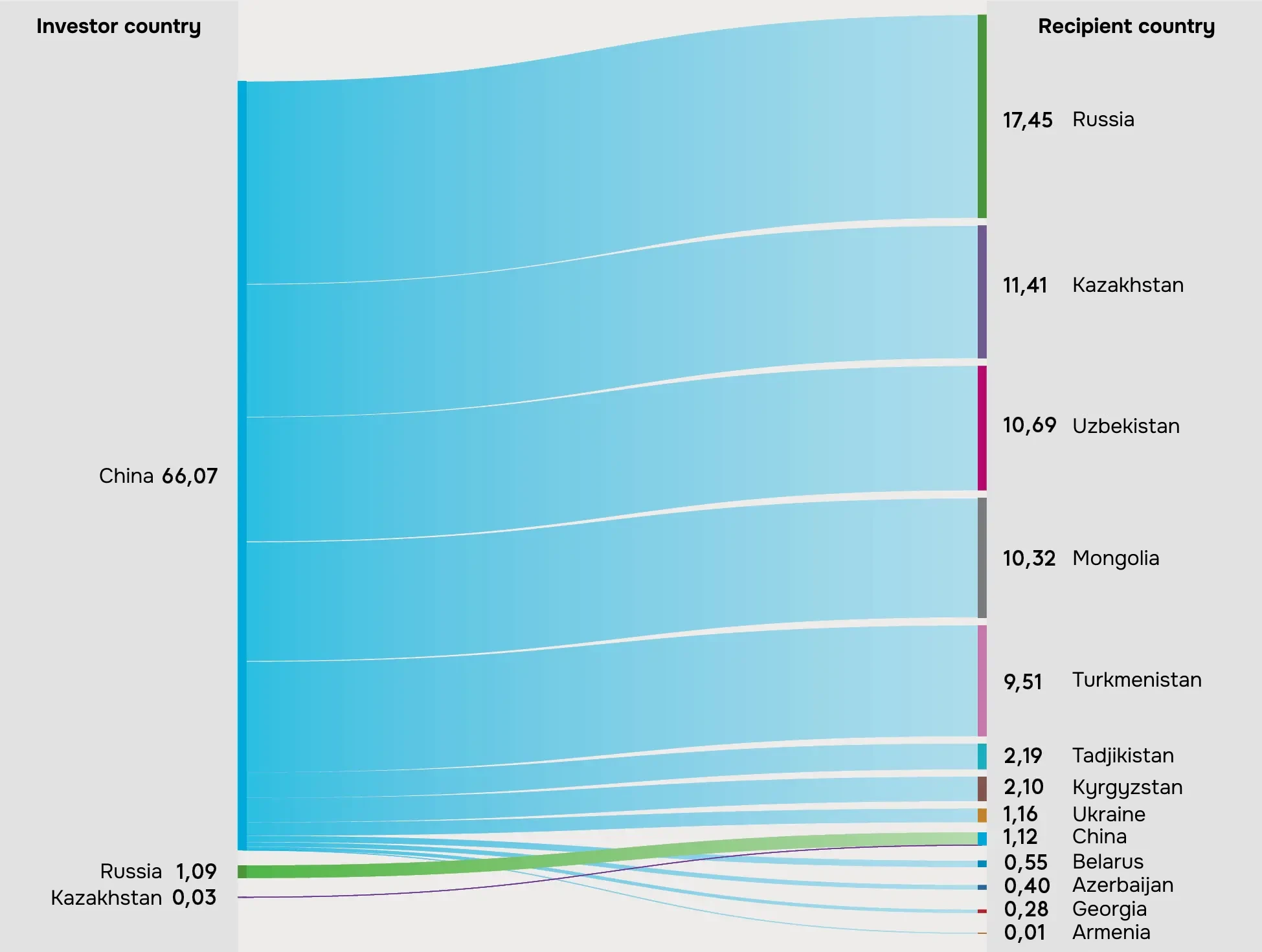
According to the Eurasian Development Bank, China’s accumulated foreign investment in the countries of Central Asia reached $35.9 billion by mid-2025, growing one and a half times since 2020. At the same time, a shift has emerged from simply exporting raw materials toward processing them on site: in Kazakhstan this takes the form of building a copper smelter, in Kyrgyzstan — negotiations over lithium mining, and in Tajikistan — the construction of the first large iron-ore processing plant.
These three projects illustrate a common shift: Chinese companies are increasingly interested not only in access to raw materials but also in processing them and building the accompanying infrastructure. The character of the negotiations that local partners will have to conduct is changing noticeably.
Chinese companies have the money, their interest in foreign markets is growing, and private business is playing an ever more visible role in this process. But the very phrase “Chinese investor” lumps together very different structures: it may be a state corporation, a private industrial company, an investment fund, a bank, or an intermediary, and each has its own goals, its own authority, its own decision-making speed, and its own attitude toward risk. Who exactly will end up on the other side of the table, and why does the entire negotiating strategy depend on it?
The Chinese investor — who exactly is across the table
Until recently it was mainly national companies that were visible in foreign markets, but in recent years private conglomerates have become noticeably more active — not out of cultural preference, but because decisions in private structures are made more flexibly and quickly. Researchers who have studied Chinese investment explain this difference not by the nature of the business but by specific institutional mechanics: managers of state companies are more constrained by political accountability and by how a failed decision will affect their standing within the system, whereas a private company’s manager answers directly to the owners and can afford to act more boldly.
Karlagash Mynzhassarova names two more types of investors — funds and financial institutions. They are set up differently. The largest state funds, such as China Investment Corporation, operate as a tool for long-term capital allocation with the task of maximizing risk-adjusted returns, and their sector preferences are built around the objectives of national strategy. In certain sectors — energy and metals, for example — such investments can also work as a way to hedge against risk, though that is not the only, nor necessarily the main, logic of the fund overall.
Banks are more complex. When assessing individual projects, they may take into account not only the borrower’s commercial indicators but also the country’s strategic or foreign-policy objectives. Since 2017, Chinese investors on the whole have on average become noticeably more cautious and have shifted toward more modestly scaled projects.
Trading and intermediary structures are simpler, but they cannot be reduced to a single pattern. Among them are professional intermediaries with real connections and authority, capable of carrying a deal through to a result. The risk arises from opacity: when it is unclear exactly how the intermediary is compensated, to whom they actually answer, and whether their interests align with those of the ultimate investor.
| Type of investor | What most often drives them | Speed and logic of decisions | Typical risk-assessment logic |
| State corporation | The country’s long-term strategic and resource security | Usually slower: the decision is approved across several levels | More often willing to operate in a less predictable environment for the sake of a strategic asset |
| Private industrial company | Commercial gain and strengthening its position in its industry | Usually faster: the decision is often made by a narrow circle of owners | More often sets stricter requirements for commercial payback and risk level |
| State investment fund | Long-term risk-adjusted returns embedded in national strategy | A formalized procedure with a long planning horizon | In certain sectors, investments can work as a way to reduce risk |
| Financial institution (bank) | A combination of commercial and the country’s strategic objectives | Multi-stage approval within the bank; on average more cautious since 2017 | Since 2017, increasingly shifts toward smaller and less risky projects |
| Trading or intermediary structure | May be either a legitimate partner or a recipient of a commission not tied to the deal’s outcome | May look fast on the surface, but the real authority should be verified separately | Risk is determined not by the type of structure but by the transparency of its role and compensation |
Understanding who is across the table is only the first step. Next, it is important to work out how this investor makes a decision: what it looks at in a project, which risks it assesses, and why strong figures alone sometimes do not guarantee a deal.
What the Chinese side evaluates — and why trust is inseparable from due diligence
From Karlagash Mynzhassarova’s observations, grounded in her practice of supporting negotiations with Chinese investors, they usually assess four factors in sequence:
- The project or asset itself. What exactly is being offered to the investor: a deposit, an enterprise, an infrastructure or energy project, a stake in a company, a technology, or joint production. Whether this asset fits the investor’s strategy and what position it can give them in the supply or production chain.
- The project economics and supporting data. For a deposit, that means reserves and resources, planned output volumes, capital and operating costs. For an enterprise or infrastructure project — production indicators, the sales market, revenue, and the payback period.
- The country — geopolitical risks and the legal framework that allows a particular business model to be implemented. Here Mynzhassarova gives an example from her practice: in Kazakhstan, restrictions set out in the law on precious metals apply to gold — the raw material must be processed at a Kazakhstani refinery unless the refinery itself declines to process it, the state has a priority right to buy the finished gold, and it can be exported only if that right has not been exercised. In some African countries there are no such restrictions, and this difference in legislation becomes a factor in its own right for an investor deciding where to invest capital.
- The people behind the project.
To avoid a mistake at the initial stage, Chinese companies today prefer to work in tandem with a local partner. The partner helps navigate the administrative, legal, and operational procedures on the ground — something a large foreign investor finds hard to handle on its own, whether it is a state corporation or a private fund. Mynzhassarova explains that relations with the Chinese side are built on trust, and that trust must be mutual.
Guanxi and xinyong
Personal connections and trust in Chinese business practice are not mere politeness but something researchers have learned to measure and link to the outcome of negotiations. Stronger personal relationships between the parties are associated in studies with lower perceived risk, greater resilience of cooperation, and a greater willingness of the parties to seek compromise on contentious issues.
Researchers distinguish two concepts here. Guanxi (关系) is the network of business connections as such, while xinyong (信用) is a specific person’s reputation within that network as a reliable and trustworthy partner — a narrower and more concrete concept than the general word “trust” (信任, xinren). It is xinyong that is most strongly tied to the outcome of negotiations and to whether the partners will remain loyal to one another in the future.
Put simply, a Chinese investor evaluates not only the object of investment but also the person who stakes their reputation on it.
Why negotiations drag on, break off, and resume
Yana Akhmatova recounts that in her own practice a decision on a project sometimes stretches out indefinitely, and it also happens that contact with a Chinese company is lost for a year or two, after which the negotiations unexpectedly resume, as if picking up from the same place.
Some of the delays are explained by the structure of the investor company itself. The decisions of state corporations pass through several levels of approval, and at each level the application is reviewed by a separate committee.
There is also a general trend. Beginning around 2017, Chinese investors as a whole became noticeably more cautious: they choose less risky and more modestly scaled projects. This in itself lengthens the decision-making process — even where it used to take less time.
Another part of the delays has nothing to do with either culture or the company’s internal hierarchy. It is ordinary market volatility, and it affects investors from any country equally. An example of how this can work in practice: in 2025 China tightened export restrictions on tungsten, and prices for the metal rose by more than 200% over the year. If a project’s economics were calculated before such a price spike, they have to be recalculated — which means that a pause in negotiations in a situation like this may well be explained not by a loss of interest but by the parties simply still reconciling the numbers before moving on.
Hence a simple practical conclusion: a long pause in itself says nothing about the outcome of a deal. It should not be chalked up to any special Eastern unhurriedness or to anything specifically cultural. It is better to work out what exactly lies behind the silence: whether an internal approval is under way on the investor’s side, whether market prices have changed, or whether the partner is simply still taking a closer look.
It is time for a reciprocal check: just as a Chinese investor studies its partner, the receiving side should take a closer look too. Who exactly has come to the negotiations — a real industrial group, a fund, an intermediary, or a person who simply has no right to make decisions? Does the company have the assets and experience it claims, who are its actual owners, and is it involved in any litigation?
These questions cannot always be answered. In negotiations, a Chinese company may present itself under an English name that does not match its official name in Chinese, and it can be not so easy to find even on Google, while a website, a presentation, and a business card prove nothing in themselves.
How to check a Chinese company before a deal
Karlagash Mynzhassarova suggests studying your Chinese counterpart before signing a memorandum of understanding, and for this it is worth applying several methods. This is specifically a preliminary check — it does not replace full legal, financial, and sanctions due diligence, which for a large deal should in any case be entrusted to professionals.
The National Enterprise Credit Information Publicity System (国家企业信用信息公示系统, GSXT for short) is the official state system run by China’s State Administration for Market Regulation (SAMR). A basic search by the exact legal name in Chinese or by the unified social credit code is free and requires no registration: you can see the company’s status, registration date, legal address, founders, and the size of its registered capital. But the interface exists only in Chinese, and to reach deeper data — for example, certain types of reporting — verification via a Chinese phone number or an identity document has been required since late 2021.
The two largest commercial platforms for checking Chinese businesses are Qichacha (企查查) and Tianyancha (天眼查). Both aggregate data from the official register and supplement it with information on litigation, affiliated companies, and ownership structure. Unlike GSXT, here a Chinese phone number is needed for the account registration itself, and some data — for example, information on the ultimate controlling person — remains paid even after registration.
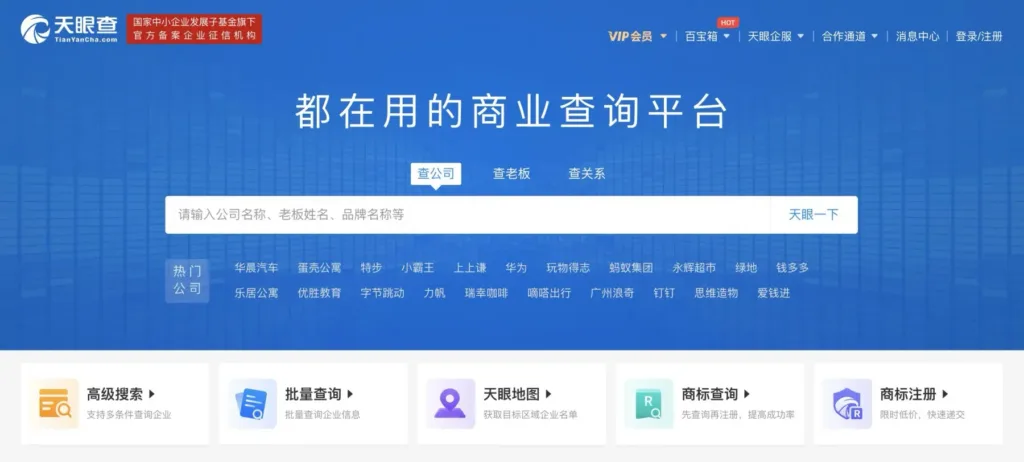
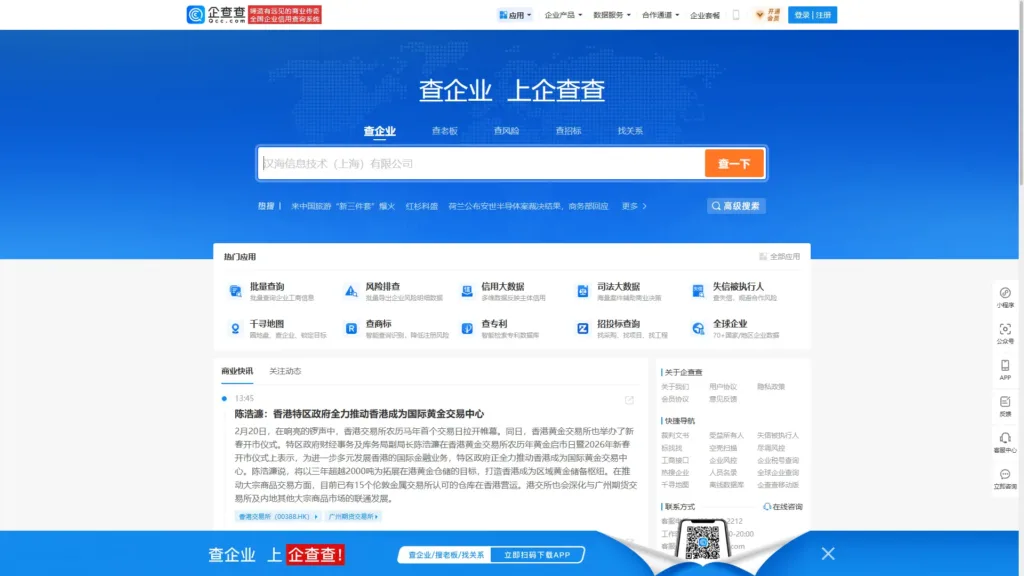
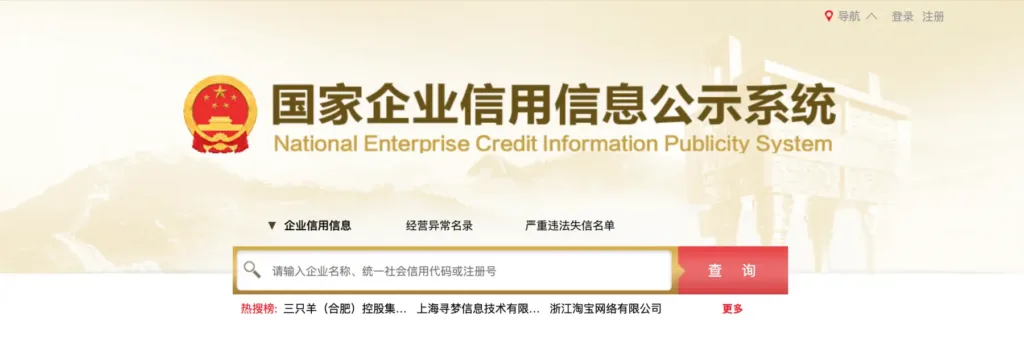
The difficulty Mynzhassarova points to concerns not the search itself but the mismatch of names: one and the same company may be listed under different English transliterations, whereas in Chinese its name is written in characters and may sound entirely different, so that, in her own experience, a search on these platforms sometimes simply yields no result.
Because of the language barrier and the differences in names, Karlagash Mynzhassarova advises not checking a company on your own but finding a legal or consulting firm that works specifically with such requests. It is enough to give such a partner in China the organization’s name or its registration number to receive a detailed report.
If possible, it is worth making an in-person visit to the enterprise: to see whether the plant actually exists, to assess the real capacity and equipment and compare them with what was stated in the negotiations — and then to check these data against your personal impression of the conversation with the person running the deal.
What you can check in the first 10 minutes
- First, obtain the company’s exact legal name in Chinese characters or its 18-digit unified social credit code.
- Next, enter this code or name into GSXT for a basic check of registration status, founders, and the size of registered capital.
- Then, if a deeper check is needed — into Qichacha or Tianyancha for information on litigation, debts, and subsidiaries.
This gives a first impression of the partner within a few minutes, but it does not remove the need for a deeper check — legal, financial, and sanctions-related — when it comes to a deal involving real money
The meeting and business etiquette: what works and what turns into a stereotype
First, Karlagash Mynzhassarova says that hierarchy and respect for status matter. Where the head of the delegation sits and who enters first carry significance for the Chinese side. Second, informal communication, lunches, and dinners play a special role, because it is in such settings that people open up and let themselves be known better. In Mynzhassarova’s observation, in Western culture the numbers come first and the people second, whereas in Chinese culture it is people first and numbers second; the informal part of a meeting works as a way to understand whether the person across the table can be trusted at all.
Mynzhassarova describes punctuality through her own work experience: if a meeting is set for three o’clock, she already knows that by half past two the Chinese delegation will be downstairs, and in her practice this is factored in ahead of time as the norm.
Preparation matters no less: from her observations of forums in China, before which the speeches are fully rehearsed, the Chinese side greatly values it when the host company comes with a ready agenda, a commercial offer, or a presentation.
Separately, Karlagash Mynzhassarova describes the very procedure of receiving guests: in many companies it is not customary for anyone to come down to meet guests at the entrance, but she recommends the opposite — that a representative of the host side come down with colleagues, meet the delegation on the ground floor, and go up to the meeting room together with them. In her words, this works as a signal of respect, and even when she herself has to meet a delegation of six or seven people, it is better to have someone else alongside, even if not from her own team, because the number of people sent to greet the guests is itself read as an indicator of how seriously the relationship is taken.
In the meeting room, the delegation may be greeted by a screen with a welcome message in Chinese. In front of each participant is placed a name plate with their name and position; it is advisable to duplicate the details of both the guests and the host-side representatives in Chinese. This makes it easier for everyone to immediately understand who is responsible for what and how to address one another correctly — without asking again for names through assistants or an interpreter.
Karlagash Mynzhassarova approaches gifts with the same practical precision. In her experience, before a meeting she, together with an assistant, checks in advance with the side preparing the delegation whether the guests plan to bring a gift, and if so, she prepares a response of roughly the same scale and value. If no gift is expected from the guests, she deliberately does not prepare a reciprocal gesture either — in her words, an unprompted gift in this case puts the guests themselves in an awkward position, just as the situation where the guests bring a gift and the host side does not respond in kind.
But even a perfectly prepared meeting guarantees nothing if the parties cannot genuinely understand each other. After the greetings, the seating, and the exchange of business cards, the main event begins — the negotiations, where a literal translation often proves insufficient.

Why an interpreter may not be enough
Translating words and understanding each other are not the same thing. You can translate every phrase precisely and still fail to convey the idea, because the context, the things left unsaid, or the way a particular wording will sound to the other side is lost.
Karlagash Mynzhassarova has seen how this plays out in practice. Recently she attended a meeting where two strong entrepreneurs — both with high emotional intelligence, both able to sense people — still failed to convey to each other the scale of their ideas and proposals, because between them stood only linguistic translation, without full negotiation support.
An interpreter conveys words. A negotiator conveys what stands behind them: the interests of both sides, the hierarchy in the room, the things left unsaid, and exactly how a particular wording will be received by the other party. The former is enough for the parties to understand a proposal technically. The latter is needed for the parties to understand each other.
Mynzhassarova herself arrived at exactly this conclusion in due course: she obtained a second degree because she realized that it is not enough simply to translate language — you have to translate thinking, interests, and culture, to be able to read the entire field of a conversation. Here she draws a parallel with the Japanese expression “reading the air” — a concept from another culture, but one that denotes the same ability to catch the unspoken that she speaks of in relation to China.
“It is not enough to translate language; you have to translate thinking,” says Mynzhassarova.
She describes her role this way: she used to feel like a bridge between the parties, but now she sees herself more as a catalyst — someone who speeds up negotiations so that the parties reach a result faster, whatever it turns out to be, positive or negative, because the most valuable resource today is time.
The operational efficiency and scale that work superbly inside China — the ability to ramp up production quickly, cut costs, and act on an already proven model — are far from always transferable directly beyond its borders: a foreign market does not yield to the same levers of speed and scale, and what decides things there, as this whole text shows, is relationships and trust. Genuine global competitiveness requires far deeper things: trust, cultural intelligence, and the ability to build relationships in a language the other side understands.
Does this mean that learning Chinese yourself is not necessary if the team already has an interpreter and a negotiator? Mynzhassarova is not categorical: knowledge of the language is not a prerequisite for successful work with China, and among her acquaintances there are businesspeople who have built strong relationships without any Chinese at all — she respects them for what they had to go through along that path. Learning the language at least at a basic level will never hurt: it does not replace a negotiator, but it does help you notice the nuances of a conversation yourself and depend less on intermediaries.
What to do before meeting a Chinese investor
Four years ago, the first meeting with Chinese investors was almost an exam for Yana Akhmatova: it was unclear who exactly would come, how to behave, what mattered, and how serious the other side’s intentions were. Over time, preparation became a working routine for her — not because the details ceased to matter, but because a clear system had emerged.
Over this time it became clear that Chinese capital really is actively going beyond the country’s borders, and that behind the general notion of a “Chinese investor” could be anyone — a private company, a state corporation, a bank, or a fund, and they all make decisions differently. It turned out that an investor evaluates not only the asset itself and its economics but also the country, the risks, and the people behind the project, which means the receiving side likewise needs to check the company, its owners, its track record, and the authority of its representatives. It became clear that a meeting calls for concrete figures and a tailored offer rather than a generic presentation, that etiquette helps to show respect but does not replace the quality of the project, and that trust forms gradually and must be mutual.
Before a first contact with a Chinese investor, it makes sense to go through a short checklist:
- Identify the type of investor and its real interests.
- Verify the legal entity and its representatives.
- Prepare factual materials about the project.
- Tailor the offer to the specific company’s strategy.
- Think through the composition of the negotiating team.
- Prepare materials in a language the partner understands.
- Record the agreements reached and the next steps.
- Build the relationship step by step, without skipping legal and financial due diligence.
There is also a broader shift worth keeping in mind on top of this list: companies from China today are increasingly interested not simply in buying raw materials but in taking part in longer value chains. That is why a company seeking Chinese capital wins not when it offers an asset, but when it offers a clear long-term model of cooperation around that asset.
“Money comes for opportunities; big money comes for trust,” says Karlagash Mynzhassarova.
Working with Chinese capital is not a set of rituals to be learned in order to please the other side. It is the same process as any serious international deal: a strong project, studied data, a vetted partner, and an understanding of their interests, while a basic knowledge of the language and culture is here an advantage rather than a requirement. What is distinctive about the Chinese business context specifically is that reputation, hierarchy, preparation, and gradually forming trust tangibly affect how long negotiations will take and how they will end — not that these negotiations obey some separate rules incomprehensible to the rest of the world.
The cover photo is taken from the official website of the Consulate-General of Australia in Chengdu (China)