
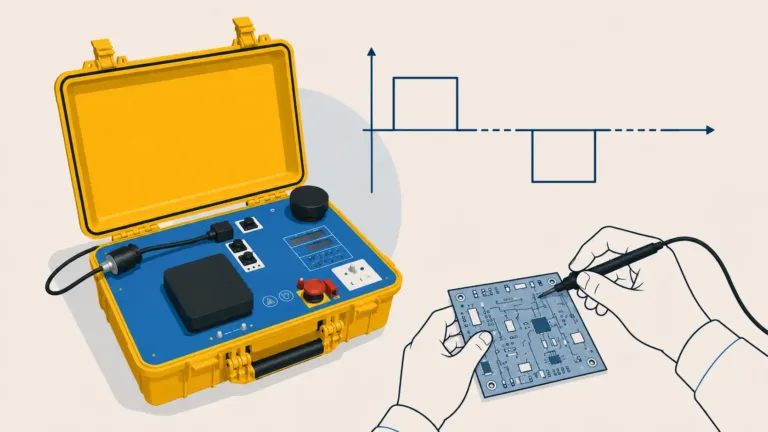
When we imagine people who create geophysical equipment, a fairly clear picture usually appears in our heads: an electronics engineer with a technical background, a programmer, a geophysicist who explains what problem the device should solve in the field. It seems that they all went into this profession from the first year and knew for a long time what they would do. In practice, everything is much more interesting.
After the trip of GeoConversation editor-in-chief Maria Kostina to Quebec, to the Instrumentation GDD production studio, we published material about how geophysical equipment is developing and how it will help look for complex deposits. Now we want to look at this topic from the other side – through people and careers: who generally invents, collects and refines geophysical hardware.
And let’s start with the technical director of Instrumentation GDD, Vladislav Surin, a man who got into geophysics almost by accident, from the position of “Russian clerk Yashka.”
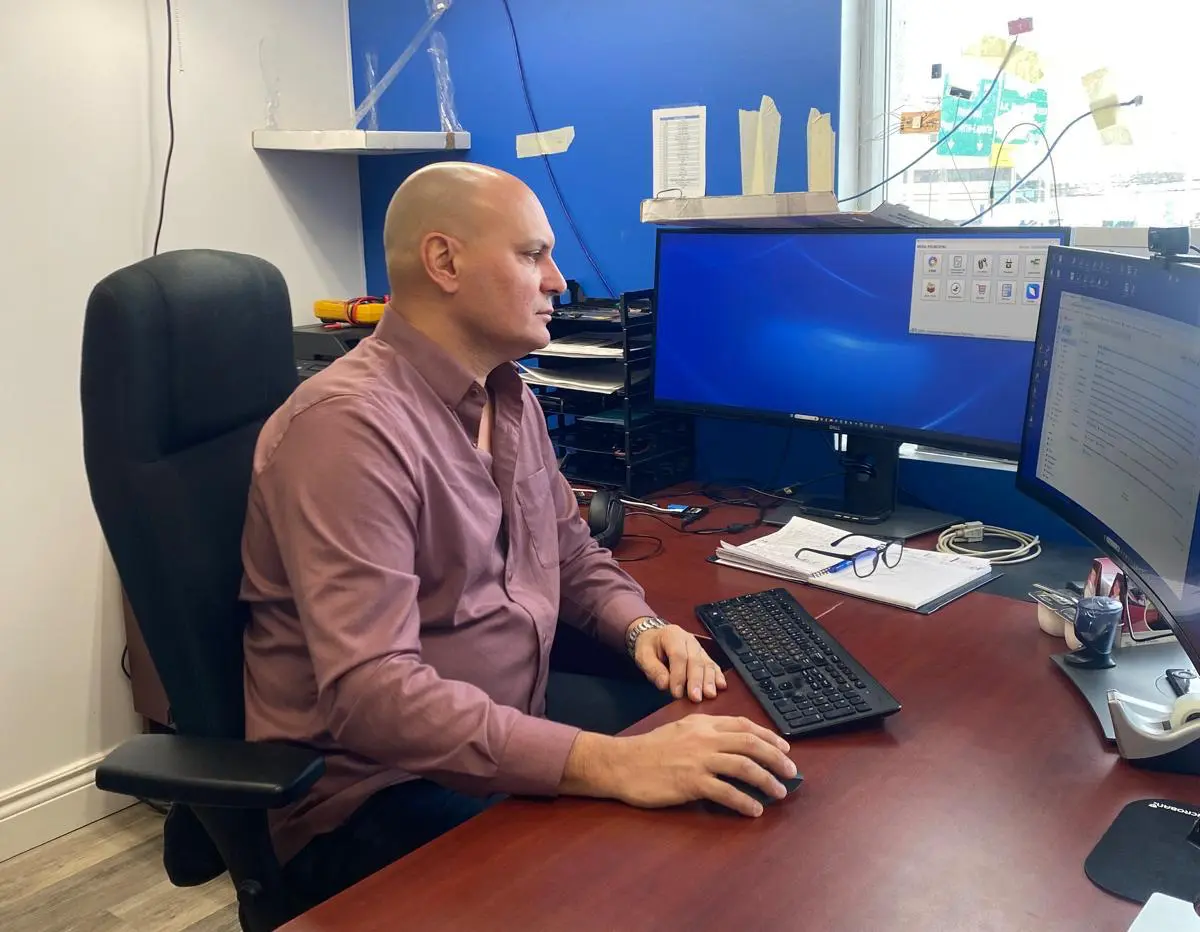
“Russian clerk Yashka”, who became technical director
In the early 90s, Vladislav Surin entered the Faculty of Experimental Physics at MEPhI. By his own admission, he didn’t really understand the choice at that time: it was a time when many people simply entered wherever it turned out, and only then tried to understand whether they got there.
After college, he went to work in a design bureau – he was involved in calculating the fuel circuit for the Iranian Bushehr Nuclear Power Plant. But he quickly realized that nuclear physics was not his story. Eight months later he left and began retraining as a programmer. And programming really hooked him.
Vladislav later admitted: if at the age of 17 he had better understood what he wanted, he most likely would have chosen cybernetics or automation rather than experimental physics. But it was precisely this indirect trajectory that ultimately led him to geophysical equipment.
In 2002, Vladislav left for Canada – and, as often happens with immigration, he almost had to start his professional trajectory all over again. Even if you have a strong education and experience behind you, in a new country you still need to “translate” them to the local market: find your first job, integrate into the system, prove that you can be useful. Therefore, he actually came to the small company Instrumentation GDD in an administrative position. Vladislav himself ironically calls her the position of “Yashka’s clerk”: it was necessary to write letters in Russian. The then president of the company had just visited Norilsk Nickel, trying to arrange supplies of equipment, and he needed a Russian-speaking employee for correspondence.
“I have never worked in geology or geophysics. I like to remember this story as an anecdote. When I came across the word dilution, in Russian – “dilution”, I was afraid to use it. I did not dare to write it in Russian,” recalls Vladislav.
But he did not stay in this role for long. Quite quickly, it became clear to the company that Vladislav could be useful not only as a Russian-speaking employee, but also as a programmer. So he moved to a technical position, and then a long story began within one company: programmer → R&D developer → R&D manager → technical director. Today, Vladislav is responsible for the development of the entire line of GDD instruments: those that geophysicists work with in several dozen countries around the world.
Vladislav has no geophysical education. Programmer, formally, too. He became an electronics engineer on the fly, studying alongside the engineers who today work under him, and this non-core background, by his own admission, sometimes makes itself felt:
“I don’t want to somehow become poor, for 24 years, of course, I have both practical and theoretical experience, but nevertheless, I have some kind of lack of a theoretical basis. To immerse myself in the topic, I walk through the student desk – from some crooked side, bypassing something important that I missed,” shares Vladislav.
And yet, a nuclear physicist has been working in geophysical hardware for more than twenty years and leading the development. His own career has become a good example of the fact that in such a niche, not only the “right” starting specialty is important, but the ability to quickly complete your studies, retrain and collect the missing expertise along the way.
Therefore, already in the role of technical director, Vladislav looks at the people who come to the team in a similar way. For him, the question is not only what a person already knows at the entrance, but whether he can grow along with the tasks – because geophysical equipment is at the intersection of physics, electronics, programming and field practice, and it is almost impossible to find a “ready-made” specialist for all this.
“I don’t care what you know now. What matters is how well you can learn.”
When a new person comes to R&D Instrumentation GDD, Vladislav does not look at the lines in the diploma or even how many years the candidate has worked in electronics or programming.
“When we meet new people, I always say that I don’t care what you know now. It’s important to me how well you can learn,” Vladislav formulates his main principle when hiring.
It sounds almost like a motivational slogan from a HR conference, but it is backed by a concrete observation from the practice of a niche company in which it is impossible to hire a narrow specialist for exactly one task. In an R&D team with several engineers and programmers, each person fills several roles by default. In this kind of work it is impossible to know everything in advance. There is no geophysicist who is equally proficient in all methods. There is no such thing as a programmer who knows all languages, platforms and tools. Therefore, even a strong specialist will still have to constantly continue his studies – for a new task, a new device, a new element base or a new method.
At the same time, the ability to learn does not mean that any person can be taken “off the street” and trained for any technical task. The basis is still needed: physics, mathematics, electronics, programming, understanding of circuits and signals. It is impossible to quickly train a non-technical person to develop induced polarization equipment or electromagnetic methods – there are too many things to understand up front. Therefore, for Vladislav, curiosity and learning ability are important, but they only work when there is a foundation on which new knowledge can be built up.
But this does not mean that there is no place in production for people from other professions. If the task involves assembly, soldering, careful manual work, a person can be trained within the company – provided that he has good hands, attentiveness and a desire to understand.
GDD has this example: one of the company’s strongest shareholders came not from electronics, but from cooking. Today it is she who is trusted with miniature circuit boards and work under a microscope. That is, the career entry into geophysical hardware can be different – it is important to understand where an engineering basis is needed, and where accuracy, motor skills and learning ability are decisive.
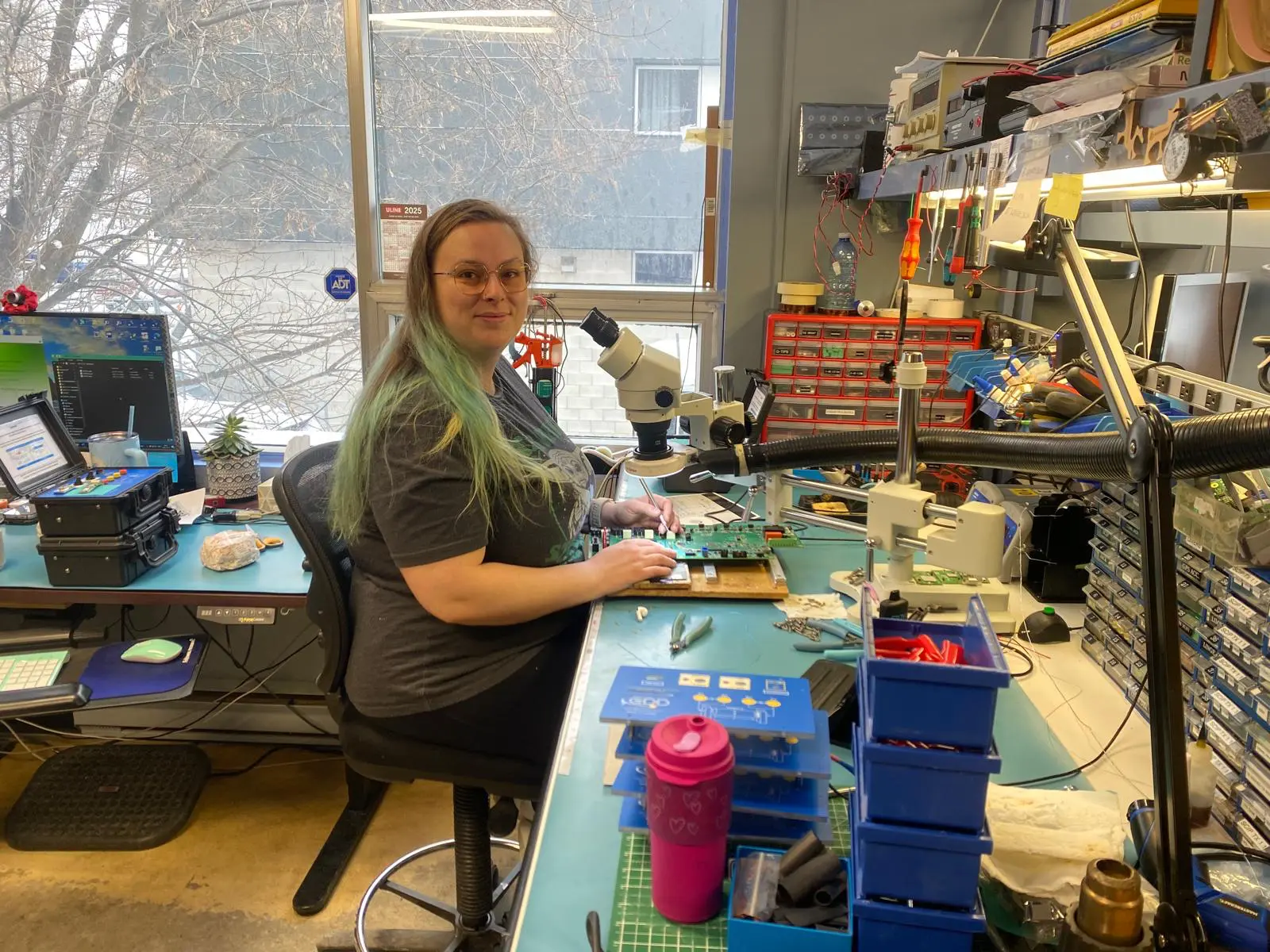
A good example from Vladislav’s team is the young electronics designer Badr. He had a specialized education: he studied circuit design and came with a theoretical basis. But, as often happens in education systems where there is a lot of academic preparation and little work with real hardware, he initially lacked practical skills.
For Vladislav this was not a problem. Another thing was more important: the person quickly grasped it, asked questions, wanted to understand and absorbed new information. In such a situation, the missing practice can be obtained within the company – especially if there is a team nearby that is ready to explain, show and give real tasks.
Therefore, Badr was hired not because he came as a “ready-made ideal specialist,” but because he had a technical base and a desire to grow. For a small R&D team, this is often more important than an impeccable resume.
Technical background: why do you need integrals if you are assembling a device?
We have already stated above: the development of geophysical equipment requires a technical foundation. But a diploma in itself does not mean that a person is ready for real engineering work. Next, another question is important: how this foundation was assembled – through abstract formulas, divorced from practice, or through tasks where mathematics, physics and circuitry immediately become working tools.
And here Vladislav has two observations. The first is about education, in which there is a lot of strong theory, but little connection with practice: the student seems to learn everything he needs, but for a long time he does not understand why it will be needed. The second is about the applied approach, where students are introduced to real tasks earlier: they are given internships, projects, assembly, programming, working with hardware. Next, let’s look at both experiences – through the Russian and Canadian episodes from his career.
All his fellow students, says Vladislav, left in the same state – “all were equally unprepared for the industry.” To start doing something specific, it was necessary to retrain for another year or two from mentors, who finally explained what to do in general.
This situation is best illustrated by a story about integrals.
“When I realized that the integral is to calculate the area under a curve, I thought: damn, maybe I didn’t teach them well? No, in fact, I learned integrals quite well. It’s just that when they hammer at you with differentials and integrals, but don’t explain why they are there, then I felt offended. The teacher did not have the talent to explain at the right time with a simple example: guy, don’t think that this is some kind of stupid cramming, you can do this with this. And everything would change in my head,” shares Vladislav.
Maria Kostina recalls a similar experience. In the first years of the Faculty of Geophysics, students took higher mathematics almost as a separate discipline: they calculated integrals, gradients, divergences, took exams – and often did not understand where this would be useful later. And already in specialized courses it became clear that it is through these concepts that the physical fields with which geophysics works are described: electrical, magnetic, gravitational. What had previously seemed like abstract mathematics suddenly became the language of the profession – but by this time much had already been forgotten.
The problem here is not the theory itself. Without it, there is nothing to do in geophysics and equipment development. The problem is that theory without connection with practice quickly turns into an abstract load: the student does not understand why he is learning it, and then is forced to return to the same formulas through real problems.
In Canada, Vladislav saw a different approach – more applied. For more than twenty years, he has worked with local students and graduates and noticed that they are connected to real projects much earlier.
“After the first year, we were just solving differential equations, and they were already sent to an internship, and they were doing something specific: some kind of robot that runs, searches for something, catches something. I was stunned when I encountered this. I think: wait, are you already able to do this?”
For him, this became an important difference: the student does not just learn the theory “for the future,” but almost immediately tries to apply it with his own hands—assembling a device, programming a controller, solving a small engineering problem.
One example is a college in Sherbrooke, Quebec, where GDD regularly hires summer interns. Formally, these are not yet ready-made engineers, but, according to Vladislav, the latest trainees made a strong impression on him:
“I was very impressed with the techniques. I could totally use them as engineers. These are guys with circuit design in their heads, passionate and involved in all new technologies.”
That is, the point is not that one approach is “good” and the other “bad”. The Russian and Soviet engineering school has traditionally provided a strong theoretical basis. But if the student does not see how this base works in real problems, part of the knowledge simply is not consolidated. An applied system, on the contrary, gives earlier contact with the industry, but may be narrower in outlook.
Maria notes that the situation in Russian geological universities is also changing. There are teachers and programs that try before connect students with industry, give them projects, practice, real tasks. But the system remains very conservative: somewhere there is already a movement, but somewhere lectures are still read “from the textbook”, without explanation of why the student will need this knowledge in the field, in processing or in the development of devices.
That is why the combination of education and practice is so important for geophysical hardware. You cannot replace the teric base with “observation” or enthusiasm alone, but the base without practice does not work to its full potential. A good specialist appears where a person understands physics and mathematics – and early enough gets the opportunity to apply them to a real device, a real signal and a real field problem.
Where to go to study if you want to study geophysical hardware
When the conversation turns to young professionals, a practical question arises: where to go to study a person who wants to work with geophysical equipment? According to Vladislav’s logic, there is no one correct trajectory here. Geophysical hardware is located at the junction of several areas at once, so this niche can be reached in different ways.
First direction – geophysics and geology. Without understanding what exactly we are looking for underground, how different environments behave and what problems the methods solve, it is easy to make a device technically correct, but poorly suited for real searching. Vladislav himself admits that he sometimes lacks an academic geophysical base – especially when it comes to relaxation models, Cole-Cole parameters, frequency characteristics of media and other things that geophysicists study at the university.
Second direction – electronics and embedded systems. This is the development of boards, circuits, sensors, receivers, power, all that “filling”, thanks to which the device is generally capable of measuring a signal. In recent years, entry into this area has become easier: Arduino, Raspberry Pi, ready-made modules, and an accessible element base have appeared. Many geophysicists can already assemble a working prototype without being professional electronics engineers. But it lowered the barrier to entry, not eliminated the profession. A good electronics engineer who can make not a laboratory homemade product, but a reliable field device, is still a rare and valuable specialist.
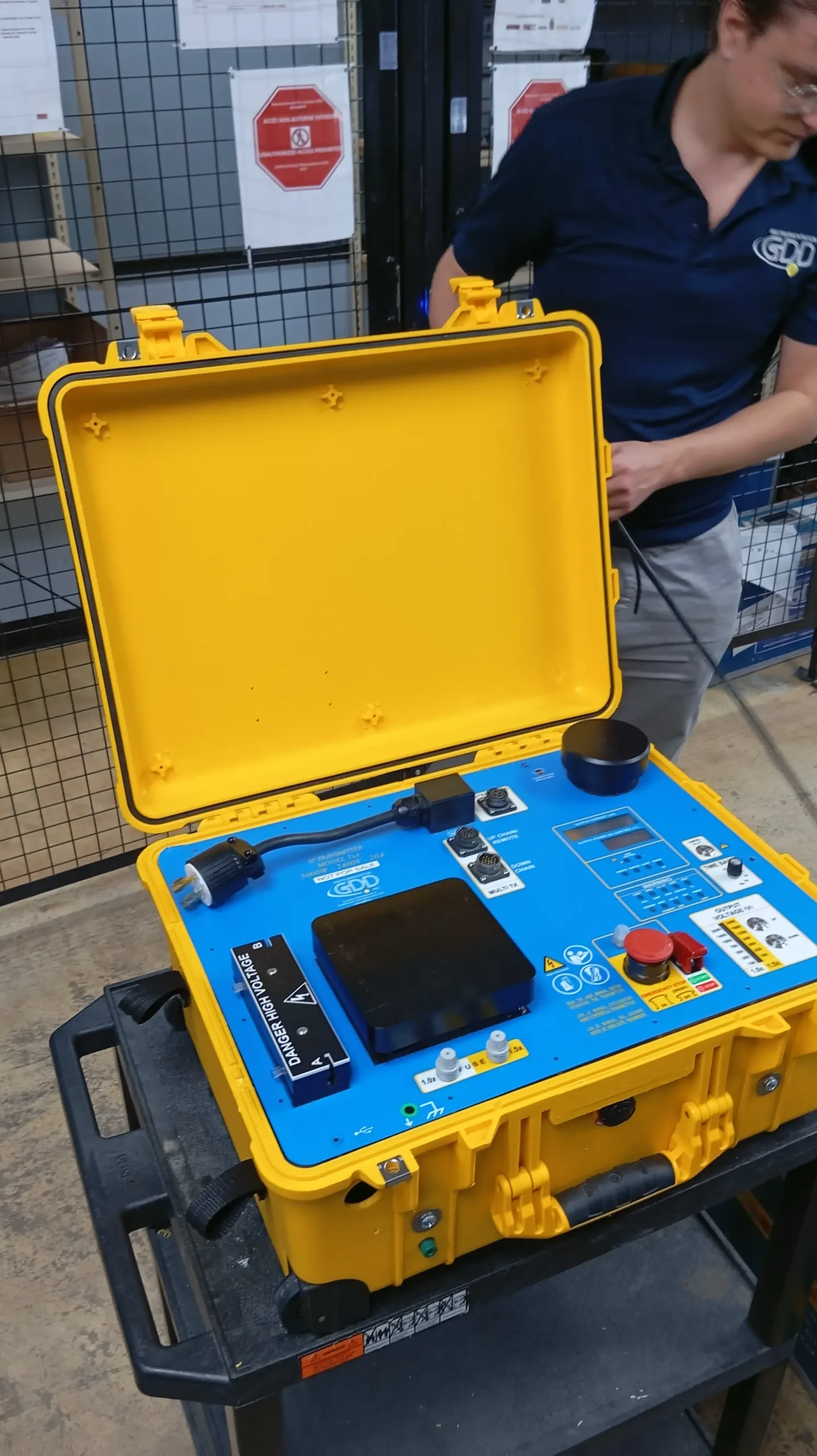
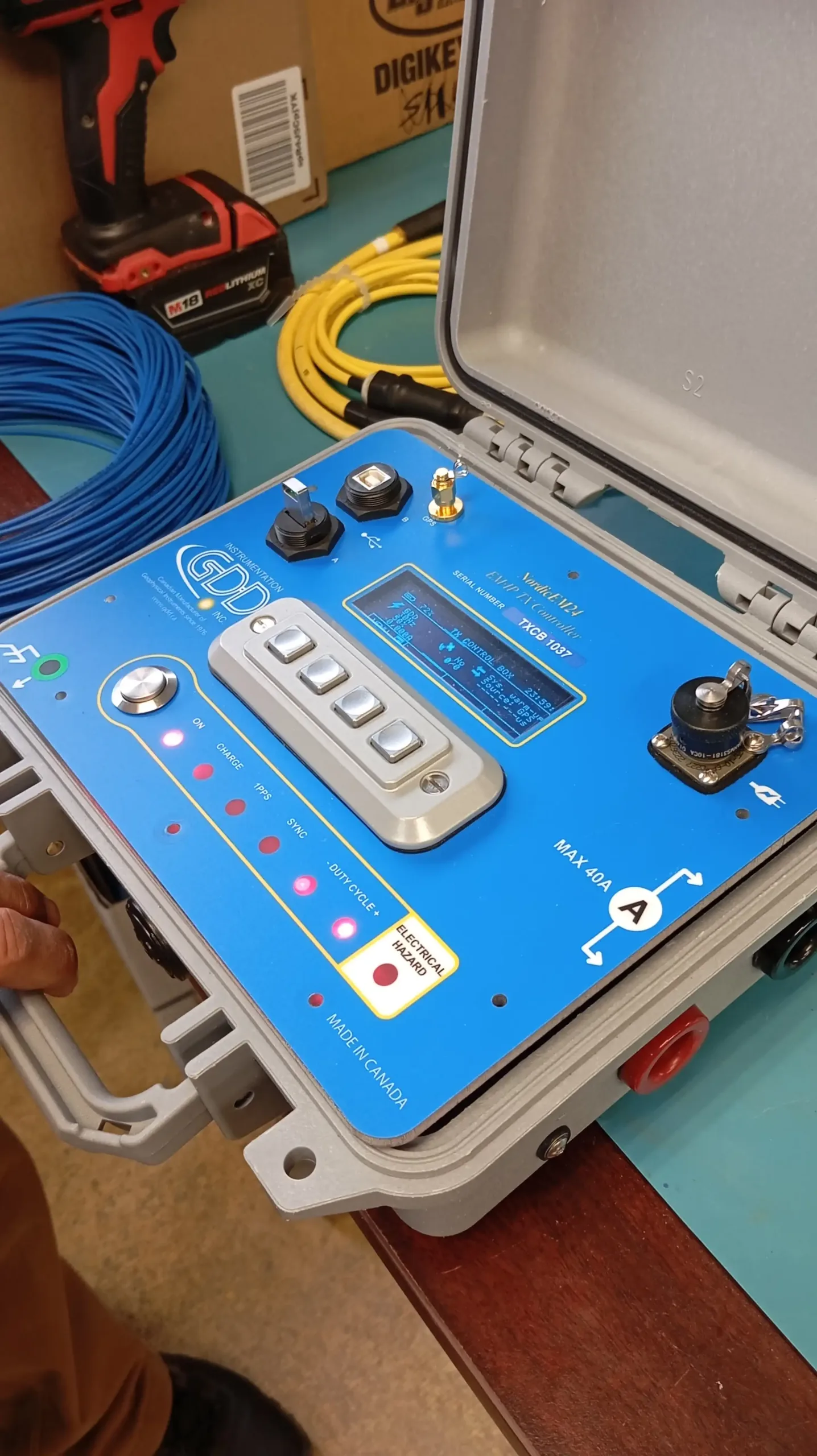
Third direction – programming and working with data. Vladislav knows this trajectory from the inside: he came to it from physics and still writes code. Today, a device is not only a coil, a board and a housing, but also firmware, an interface, signal processing, data transmission, communication with a server, and sometimes interpretation models. Therefore, programmers in geophysical equipment are needed no less than electronic engineers.
It is programming that Vladislav is now pushing his fifteen-year-old daughter towards – with a very understandable fatherly logic.
“I’m now pushing her towards programming. Let’s say, with a mercantile thought, it’s just an easy career. Naturally, you need to have some specific talent, but if you have the urge, it’s a good career with good earnings. You sit remotely, in some Bali, with a laptop – and work for the so-called Microsoft,” he says.
To this, Maria laughs in conversation: “I think this is your dream.” And Vladislav agrees: yes, in many ways he projects onto his daughter his own idea of an ideal career – free, intellectual, mobile.
But there is an important caveat to this story. Vladislav does not advise going into programming, electronics or any other technical field just because it is fashionable, promising or well paid. There must be a thirst for exact sciences, an interest in problems, a desire to understand. Otherwise, instead of an “easy career,” you will end up with constant self-abuse.
As a result, the recommendation is broader than just “go into programming” or “go into geophysics.” If you want to work in geophysical hardware, you need a STEM foundation: physics, mathematics, electronics, programming, working with data. But it’s still worth choosing a trajectory based on your own interest. Because a profession is not a nice line on a resume or a fashion trend, but something that a person will then have to do every day.


Samuel TOTIN
Very interesting and inspiring article! Thank you for sharing these insights into the world of geophysical equipment.