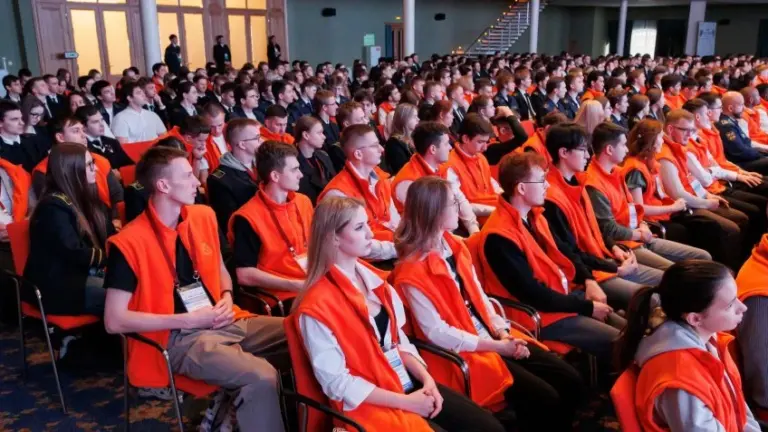
The International Student Olympiad PetroCup has started at the St. Petersburg Mining University. The key theme of the opening ceremony was the location artificial intelligence in the future of the mineral resource complex. Industry leaders discussed how digital technologies are changing the work of engineers.
The PetroCup Olympics has been held since 2020. Students of specialized universities compete by managing a virtual mine on a special simulator. Team members, as in real production, perform the roles of different specialists: from a geologist to an asset manager. Such a simulator is used not only in tournaments, but also in real enterprises for training and minimizing costs.
This year, for the first time, a bot team with artificial intelligence is fighting for victory. The operator only loads the data, and the algorithm makes decisions. Rector of Nafta College Arthur Aslanyan noted that AI is not yet able to independently interpret information. He urged students to develop their own intelligence because digital tools are only effective in smart hands.
Rector of the Mining University Vladimir Litvinenko emphasized that the engineer should play the main role in the tandem of an engineer and an IT specialist. He warned against over-reliance on automating routine tasks, calling this approach the creation of “dangerous digital toys.” The professor is confident that the need for hydrocarbons will grow, and the industry itself requires a creative and research approach from specialists.
Gazprom Neft Science Director Mars Khasanov supported his colleague. He designated the dead-end path of AI development as “MetaExcel” – a focus on working with documents. Instead, technologies need to be applied to solve complex production problems, such as enhanced oil recovery. The engineer must retain the strategic “tops,” handing over the routine to the digital “backs.”
Industrial metaverses—digital twins of enterprises—are becoming a counterbalance to primitive automation. Scientists at the Mining University are actively working on such projects, as confirmed by publications in a specialized journal. The training of modern engineers at the university includes an in-depth study of digital technologies, from 3D modeling to mathematical analysis.
Experts agreed: the future of the oil and gas industry lies in the symbiosis of deep engineering knowledge and advanced digital tools. It is this synthesis that will allow Russia to maintain its leadership position and transform scientific developments into real production achievements.
The material was prepared with the support of the Russian Ministry of Education and Science as part of the Decade of Science and Technology.
Source: forpost-sz.ru