Humanity isn’t yet mining resources on the Moon, but debates over how to tax such activity have already begun. A study led by Petr Zimcik of NEWTON University proposes a ready-made tax architecture for extraterrestrial mining. It would need to account for inflation, currency fluctuations, and commodity price volatility, while directing part of the revenue to countries without their own space programs.
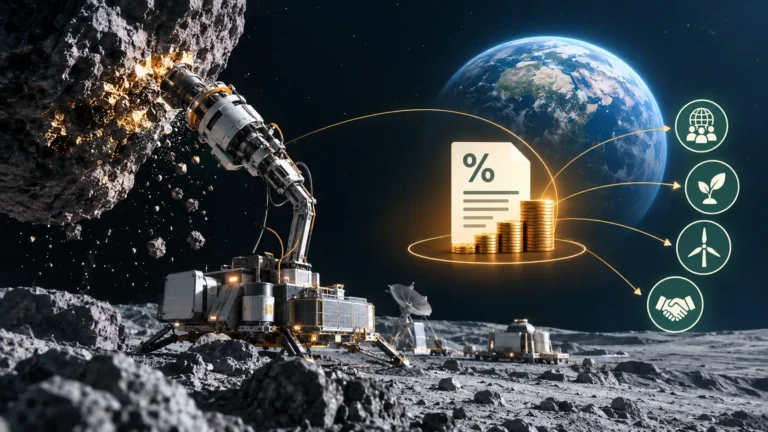
The proposal’s foundation is the idea of splitting collections into two streams. The first would fund a Global Space Resources Dividend, distributed among participating states.
The key questions the study addresses are: who exactly collects the tax, at what point does the obligation to pay arise, how is a resource valued without a market price, and should countries lacking space flight technology receive a share.
Institutional framework. A central fiscal authority is proposed to be established through a multilateral treaty under UN auspices, modeled on the 1960s Outer Space Treaty. The UN Committee on the Peaceful Uses of Outer Space could serve as a starting point, but it has neither taxation nor enforcement powers. A separate body for taxing space resources is therefore needed, with the committee serving as an expert forum. Enforcement would remain with national governments: compliance with the international regime would become a condition for issuing and maintaining a mining license.
When to pay. Collecting money immediately upon extraction of material is administratively convenient, but it would hit companies before they recoup their enormous investments. Zimcik proposes instead taxing economic rent first — what remains after reasonable investment and operating costs are recovered. A failed project wouldn’t face a large bill simply for having extracted material. The tax would only apply to excess profit.
How the model could evolve. Resources mined in space won’t necessarily reach Earth. They could go toward orbital construction, refueling spacecraft, or settlements on the Moon and Mars. In that case, it would make sense to introduce a small administrative fee at extraction, a more substantial tax at sale or consumption, and a final settlement if the material does eventually reach Earth’s market.
Protection against currency swings. Tax thresholds are proposed to be denominated in a stable international unit of account tied to a basket of currencies and commodities. Inflation would be accounted for automatically, and currency swings would only affect conversion into national currencies, not the size of the obligation. Tying the tax to profitability would smooth out downturns: the effective rate would fall during weak prices and rise during favorable conditions.
Who benefits. This is the most politically difficult question, since initially only a handful of wealthy states and corporations possess the technology and capital. Under the plan, a fixed share of revenue would go into the Global Dividend and be distributed according to a formula accounting for population, development gaps, and contribution to the space ecosystem. The population component reflects the idea of humanity’s common heritage, the development component directs more funds to poorer countries, and the third element recognizes the contribution of those providing infrastructure, research, or launch technology. Part of the revenue could also feed a Global Development Fund — for climate adaptation, clean energy, planetary defense, and developing countries’ access to space infrastructure.
Management of the fund is proposed to be kept independent of both mining companies and individual governments. One option is a governing body including states, independent scientists, economists, and legal experts.
A legal nuance. It’s important to prevent fees charged to companies from being interpreted as recognition of property rights over celestial bodies. Zimcik insists that contributions must be explicitly classified as fiscal payments, not payment for the resource itself. This matters because the Outer Space Treaty prohibits national appropriation of outer space, and the legal status of extracted resources remains disputed.
Building a tax framework before space mining becomes widespread would buy valuable time. Otherwise, the rules will have to be improvised on the fly, once valuable extraterrestrial resources are already flowing through this new economy.
Source: MINING.COM