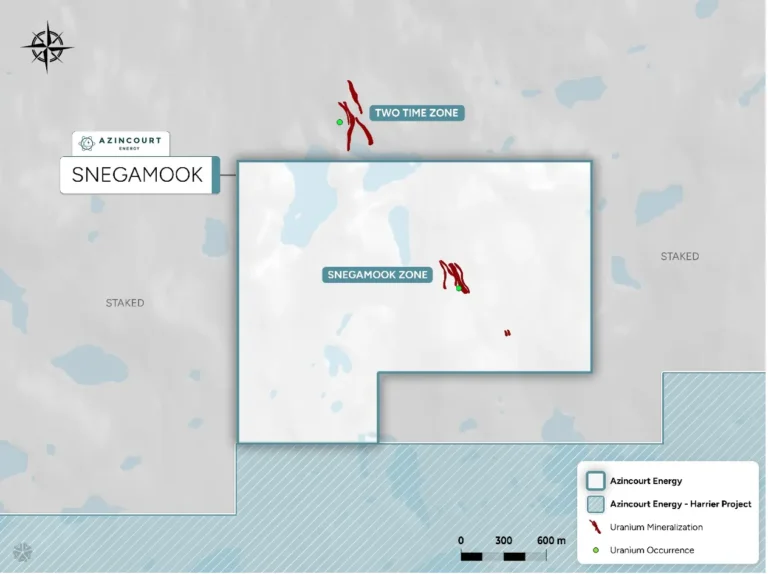
Canada’s Azincourt Energy has reported that the first two holes of its 2026 drilling program at the Snegamook uranium deposit in Labrador intersected zones of elevated radioactivity. The company is verifying historical drilling and assessing the possibility of preparing a first resource estimate. The results were released on October 14, against a backdrop of record nominal long-term contract prices for uranium.
Hole SN0045 was drilled next to historical hole SN-08-06. It intersected several radioactive zones over a 30-meter interval. The best result was 0.07% eU3O8 over 0.6 meters, including 0.14% over 0.2 meters. Hole SN0046, drilled from the same pad at a steeper angle, cut a 25-meter radioactive zone with a peak of 0.05% eU3O8 over 0.5 meters.
Historical samples from SN-08-06 returned 0.97% U3O8 over 0.5 meters. The new radiometric values are lower than that interval.
Vice President of Exploration Trevor Perkins noted that the program confirmed the ore system and the deposit’s geological setting. According to him, the results show the small size and variability of high-grade veins in deposits of this type.
CEO Marc Tommasi added that the holes provide useful data for verifying historical drilling. The company’s priority is to build a reliable geological dataset and assess the potential for a future resource estimate.
The grades cited are preliminary radiometric estimates. Samples have been sent to ACTLabs in Ontario, with assay results expected early next year.
Azincourt plans to drill about 2,000 meters in 6–7 holes. The company previously completed an exploration program at the Harrier project, which includes Snegamook.
Historical drilling in 2007–2008 identified a uranium-bearing rock zone 20 to 50 meters wide. A preliminary resource estimate was prepared in 2008 but was never completed or filed. The deposit currently has neither a current nor a historical resource estimate.
Snegamook is still at an early stage, and confirming the ore system is only a first step. Amid record contract prices for uranium and a supply deficit, even interim results may attract investor attention. But final conclusions will come only after laboratory assays.
Source: GlobeNewswire
Image: Azincourt Energy