What is the salary of a driller in Russia? Websites with vacancies promise up to 350,000 rubles per shift. In the reviews of the drillers themselves, everything is different. We figured out what a driller’s salary is, why incomes can vary three times in different regions, and what needs to be done to earn more.
Who is a driller and what does he do for a salary?
The driller is the person who is responsible for ensuring that the well appears at all. In typical vacancies it responsibilities They sound simpler than they actually look. For example, a specialist:
- conducts the drilling process;
- checks how instruments and equipment operate;
- monitors the drilling fluid;
- prepares the well for geophysical research.
Working drillers where there is oil: in Western Siberia, Yamal-Nenets Autonomous Okrug, Khanty-Mansi Autonomous Okrug, Eastern Siberia, in certain areas in Tatarstan. Sometimes – on offshore platforms. Companies usually immediately offer watch This means that you will be brought to the site, placed in a trailer or dormitory, fed and given everything you need for work.
I wonder what the salary of geological specialists consists of? Read our article about salaries in the fields and mines
What does the salary of a driller in Russia depend on?
When you open vacancies and look at how much a driller gets, you notice that most of the offers are in the range of 80,000–160,000 rubles. On average, according to DreamJob, the salary of a driller in Russia is about 120,000 rubles. Another job aggregator counted 155,000 rubles. Why is there such a difference? Let’s figure it out.
Region
Between regions, income varies almost twice. For example, in different cities the average monthly salary of a driller looks so: Alexandrov Gai – 350,000 rubles, Novy Urengoy – 240,000 rubles, Tomsk – 155,000 rubles. These are not just numbers.
Large companies in the northern and oil and gas centers attract specialists for complex projects and are willing to pay more. In regions of Russia without large fields, the salary of a driller is closer to the lower part of the fork.
Work schedule and shift
The schedule matters. For example, a shift of 30 days, 12 hours a day, away from home can bring more than a five-day shift in your hometown. You work for a month, get 200,000 rubles, and rest at home for a month. In general, a driller’s salary is still higher than that of salespeople in a liquor store or office workers.
Rank and experience
Qualification also greatly influences how much a driller earns. Beginners come for a minimum of 80,000–100,000 rubles; more experienced ones with a confirmed rank can count on amounts from 200,000 rubles.

Company and conditions
Major players in the oil and gas industry offer drillers high salaries, compensation for accommodation, food and travel, northern bonuses, and bonuses for fulfilling the plan.
“Salaries now in the oil industry are generally unworthy, at least for driller’s assistants, mechanics, especially in the overhaul of wells. In the USSR, oil workers’ wages were 7–10 times higher than on earth: for the cold, for working outside, for heavy work. And now, for example, in Samara at a factory, if you work seven days a week for 12 hours, you will receive approximately the same salary as in the north, only at home, in the warmth. Conclusion: the north is a kind of “Guadeloupe” for those who live in the wilderness, where everything has been stolen to its foundations and there are no factories,” Ivan, a subscriber to the profile community on social networks, shares his opinion.
Women come to oil and gas – Do they manage to build a successful career?
How can a driller increase his salary?
How much a driller gets is not luck, but the result of correctly taken steps. What should I do?
Step 1. Plan to increase the level
Qualification decides. Employers directly link a driller’s rank to the size of his salary and the type of work to which he is allowed. Specialists with 6–7 ranks are assigned to more responsible operations and receive from 200,000 rubles per shift. If qualification does not grow for several years, then the income stops.
“When I was getting hired, the first thing I had to do was to do the paperwork. It cost money, but during the first shift everything was done. Now the situation is different: there is a lot of turnover, there are not enough people, so they hire you even without experience – they prepare the documents for free, as long as you go to the site,” says the driller’s assistant (pombur).
Step 2. Gain valuable skills
What is valued on the market is not years in drilling, but specific experience: work on complex projects, participation in well workovers, deep or horizontal drilling, equipment knowledge.
“There’s a lot of work and it’s all different. One assistant works as a “rider” and is responsible for the pumps – the most responsibility. Another deals with the solution, the third deals with the release of sludge. Plus general operations: lowering and raising tools, string assembly, cementing, moving the drilling rig. Depth – up to five kilometers. Those who can do more are valued more,” a driller from the Irkutsk region describes his workday.
In the reviews of drillers, one idea is repeated: salaries increase when a specialist goes beyond standard operations and becomes a generalist.
Step 3. Look for the best vacancies
A typical situation is that a driller has been sitting on a salary of 90,000–120,000 rubles for years, considering this to be the norm in Russia, although there are already offers in vacancies at the level of 180,000–220,000 rubles with the same schedule and responsibilities.
“It’s about 200,000 per shift. On paper it seems decent, but if you consider that you’ve been sitting at home for a month without income, it’s not that much. That’s why some also earn extra money between shifts,” shares the driller.
Step 4. Consciously choose an employer
Salaries grow faster for a driller who chooses complex projects: remote sites, high-pressure wells, directional or horizontal drilling. Yes, at first there are a lot of problems: strict safety requirements, constant inspections, the need to master new equipment. But all this opens up access to better-paid jobs.
“The work is dangerous: technology, altitude, gas emissions, climate. In the Irkutsk region in winter it reached -45. In summer it is hot and rainy. But it is precisely these conditions that then work for you. With this experience, you are already being called to other sites and for other money,” the driller says about his experience.
Where to study to become a geologist — read our article to find out where you can go, what subjects you will have to take, what prospects to expect in general
What is important to understand about the salaries of drillers in Russia
Firstly, the oil industry is no longer the same as it was 20–30 years ago. At that time there were not enough specialists, the industry was growing, and the pay at the rig was noticeably higher than the national average. Now drilling is here to stay, but it is no longer a high-growth market. Money here is paid primarily for the conditions, risk and schedule, and not for the prestige of the profession.
Secondly, competition is intensifying. Migrant workers appear in the brigades, especially in pombour positions. This affects the lower level of the salary scale. If the rank is low, it is easier for the employer to find a replacement and pay less for simple tasks.
Thirdly, in the coming years, drillers will not be replaced by either robots or AI. Competition with people who are ready to work practically for food is much more realistic. Therefore, salaries increase only where there is responsibility, experience and permissions.
In fact, drilling remains one of the highest paid working professions. Those professionals who plan a long-term career, rather than just picking up shifts, end up earning noticeably more – even when it seems that wage growth in the country has stopped.
How much do you earn on the rig? Write in the comments how you manage to earn decent money. Your experience speaks more than any vacancy or position.
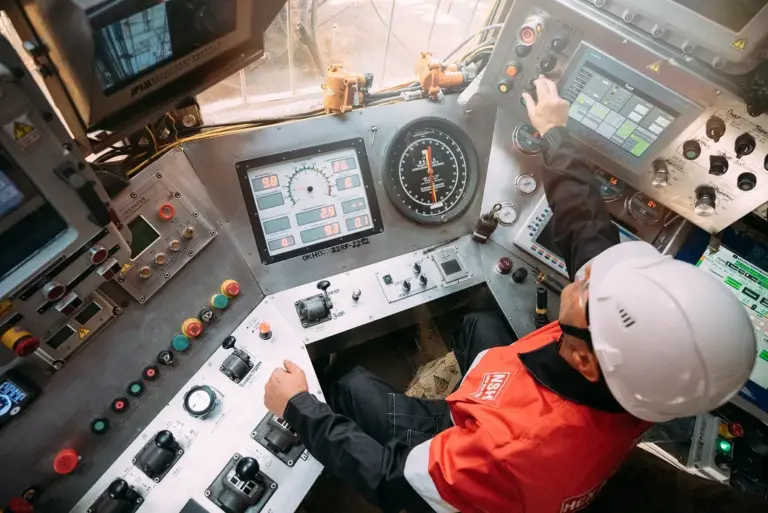
Cover photo taken from the official website of NSH ASIA DRILLING