Scientists from the Kola Science Center of the Russian Academy of Sciences have discovered a new mineral – brunovskite. Its unique crystal structure has no analogues among known minerals and inorganic compounds. The discovery was confirmed by the International Mineralogical Association.
On March 4, the Commission on New Minerals, Nomenclature and Classification of the International Mineralogical Association (IMA) officially approved a new mineral – brunovskite. This was reported in the Telegram channel of the Center for Nanomaterials Science of the KSC RAS.
Brunovskite has the chemical formula NaZrSi₂O₆(OH) and belongs to the class of microporous zirconosilicates. Its main feature is a unique crystal structure, which has not previously been found either in nature or among synthetic materials. This makes brunovskite a new structural type, which is especially important for science, given that just over 6,000 minerals are known today.
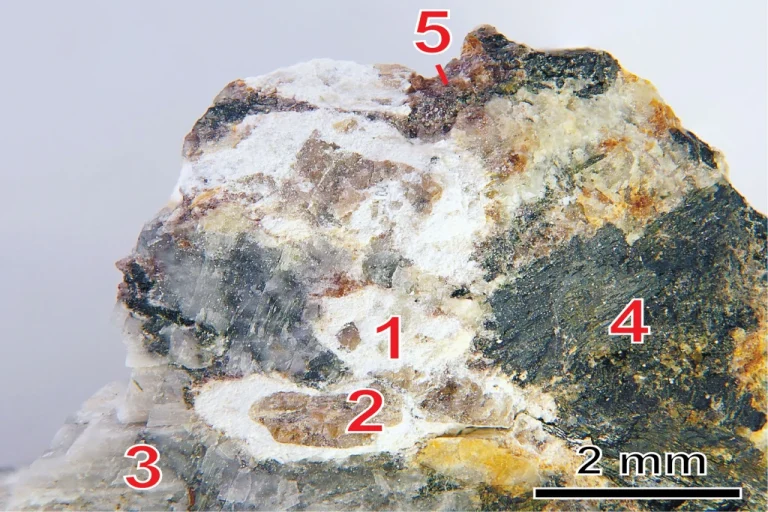
The mineral was discovered in the Khibiny mountain range (Murmansk region) in eudialyte-aegirine-microcline pegmatite. It forms white powdery aggregates that form rims around another mineral, parakeldyshite.
Brunovskite is named after the Soviet scientist Bruno Karlovich Brunovsky, who first deciphered the structure of catapleite, a zirconosilicate also found in the Khibiny Mountains. The discovery continues research into keldyshite group minerals that began in the 1960s.
According to Taras Panikorovsky, first author of the study, Brunovskite is of interest as a potential ionic conductor, molecular sieve and ion exchanger. “The Khibiny massif remains one of the richest mineralogical laboratories on the planet. In the near future, we plan to study the ion-exchange properties of this mineral,” the scientist noted.
Read about how new minerals are discovered and how mineralogists work. interview with Taras Panikorovsky
A type specimen of Brunovskite is kept in the Mineralogical Museum of St. Petersburg State University (catalog No. 19657). A full description of the mineral will be published in Mineralogical Magazine and European Journal of Mineralogy.
The discovery of Brunovskite confirms that the Khibiny massif remains an important source of new minerals. This discovery not only expands scientific knowledge, but also opens up prospects for the use of the mineral in industry.
Source: new.ras.ru
Photo: White powdery aggregates of brunovskite (1), forming rims around parakeldyshite (2) with albite (3), with enigmatite (4), and eudialyte relics (5), in eudialyte-aegirine-microcline pegmatite in the foyer of Mount Takhtarvumchorr