Scientists from MIEM NRU HSE and their Chinese colleagues have developed a new catalyst that effectively converts carbon dioxide into formic acid. The technology works even in an acidic environment and requires a minimal amount of potassium, which makes the process cheaper and more convenient for industrial use.
Researchers have presented an innovative catalyst based on carbon-coated indium oxide. Its key advantage is stability in an acidic environment and low potassium requirement. It was previously thought that a high concentration of this element was required to effectively convert CO₂, but the new method challenges this idea.
The problem with traditional methods of processing carbon dioxide is side reactions that reduce the efficiency of the process. In alkaline solutions, a lot of potassium is used to combat them, but this leads to the formation of precipitation and increased cost of the technology. The new catalyst solves these problems by providing a carbon layer that protects the active sites and traps potassium ions near the surface.
Experiments confirmed the high efficiency of the development: in an acidic environment, the catalyst remained stable for more than 100 hours, and the yield of formic acid reached 98.9%. Without the carbon coating, indium oxide quickly lost activity, proving the importance of this element in catalyst design.
The technology opens up new possibilities for industrial CO₂ recycling. It not only reduces the cost of the process, but also simplifies its scaling. In the future, the method can be used not only for the production of formic acid, but also for other types of environmentally friendly fuels and chemical raw materials.
Source: naked-science.ru
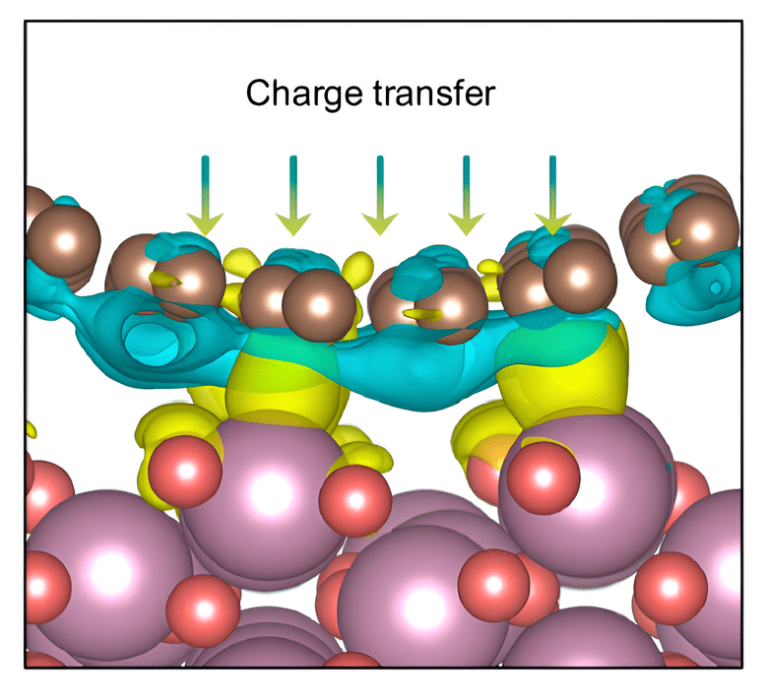
Photo: Schematic illustration of how the carbon layer interacts with indium oxide (In₂O₃) at the electronic level. Indium atoms are shown in purple, oxygen atoms in red, and carbon atoms in brown. Blue and yellow areas indicate decreasing and increasing electron density, respectively / © Wang, Z., Liu, D., Xia, C. et al., Nature Communications