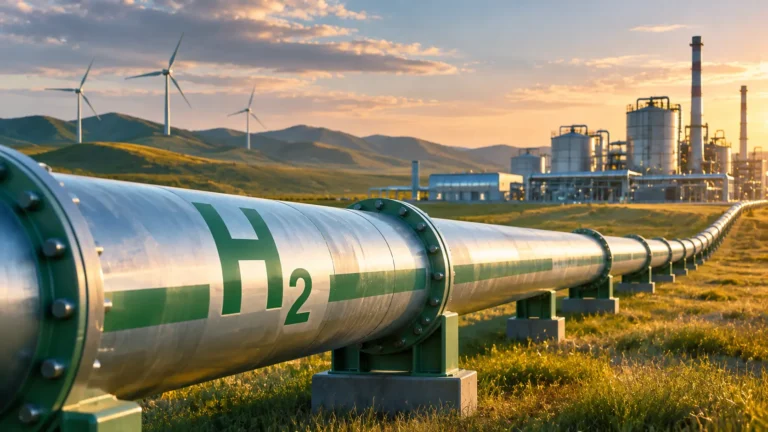
On November 19, China’s first long-distance pipeline for pure hydrogen began operating in Inner Mongolia. The 195-kilometre pipeline connects the Darhan Muminggan Joint Banner with the industrial centre of Baotou. It has a design capacity of 100,000 tonnes of hydrogen a year. Transport costs are expected to fall from 13 yuan to 3 yuan per kilogram.
The project’s main impact lies in the economics of delivery. Until now, hydrogen has mostly been trucked to industrial customers, limiting volumes and adding significantly to the final cost. The pipeline enables continuous delivery of larger quantities, making hydrogen a more competitive industrial feedstock.
The hydrogen will serve several markets. It will be used in the steel and chemical industries, blended into natural gas and supplied as a transport fuel. More than 160 heavy-duty hydrogen fuel-cell trucks are already operating in the region, including in coal transport, and the refuelling network is expanding.
The figures show how much capacity has been built for future growth. The green hydrogen project connected to the pipeline produces about 7,800 tonnes a year, less than 8% of the pipeline’s capacity. The infrastructure therefore has room to connect additional producers. In the future, the pipeline’s capacity is expected to increase to 240,000 tonnes a year.
China is moving from individual hydrogen projects towards a distributed network linking production centres with industrial users. Transport infrastructure will help determine whether hydrogen becomes a widely used industrial feedstock or remains a niche solution.
The pipeline’s launch marks a shift in China’s hydrogen sector from trials to logistics. If transport costs fall as expected, hydrogen could become a viable part of industrial supply chains. The project also highlights the importance of pipeline infrastructure for countries seeking to compete in the hydrogen sector.
Source CDU TEK
Image AI-generated