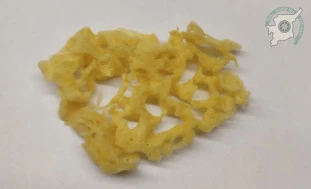
Scientists of the Komi Scientific Center developed innovative composite material based on sea sponges. After heat treatment and copper plating, it acquires unique catalytic properties, superior to traditional carbon analogues.
How the material was created:
1. The starting material is sea sponges, whose 3D structure is rich in the protein spongin.
2. Processing process:
– Carbonation under nitrogen/argon at 400–500°C.
– Loss of 70% volume, but preservation of microarchitecture.
– Formation of heat-resistant turbostatic graphite.
3. Final: coating with a nano-sized layer of copper turns the material into a hybrid with catalytic properties.
Practical benefits:
– Purification of sea water from toxic nitrophenols (conversion into compounds safe for pharmaceuticals).
– An alternative to carbon nanotubes in catalysts.
– Environmentally friendly: non-toxic and uses renewable resources.
Research began in 2017 as part of an international project on “extreme biomimetics,” a field that copies natural structures for materials science.
The development opens up new opportunities for green industry and environmental protection. The next stage is implementation into production.
Source: www.bnkomi.ru