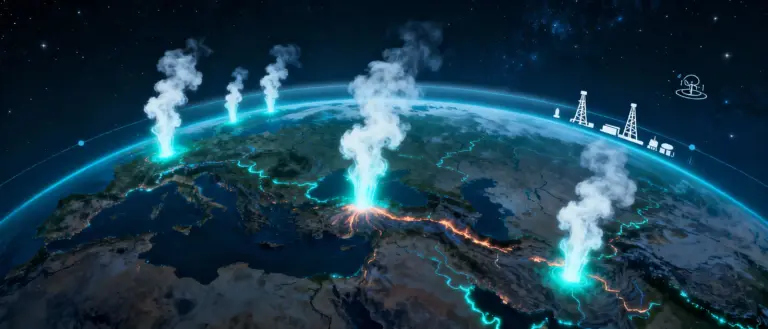
Gazprom moved from individual research to systematic search deposits natural hydrogen, which is considered as a promising environmentally friendly fuel. The company is assessing the possibilities of industrial development of such reserves and proposes to create a network of test sites to study deep degassing of the subsoil.
The researchers explain that the potential of natural hydrogen is underestimated. It was believed that its concentrations in nature were too low. However, new data shows that hydrogen content increases with depth. Gas accumulates under the crust and rises along tectonic faults along with mantle fluids.
Natural or “white” hydrogen is called one of the most environmentally friendly fuels. Unlike gray hydrogen, which is produced from gas with carbon dioxide emissions, white hydrogen forms naturally in the ground. Its industrial production can become profitable if deposits with sufficient reserves and concentrations can be found. In known fields, hydrogen, as a rule, is found in small quantities, often in the lower horizons, so its use there as part of the produced gas is not economically feasible.
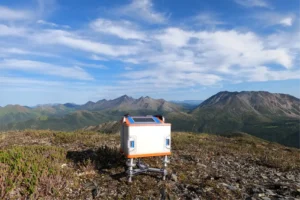
Research at the Kovyktinskoye and Chayandinskoye fields has shown that promising hydrogen accumulations may be located outside of traditional gas structures. Among the search methods, scientists highlight monitoring of the thinning of the ozone layer, which may be associated with deep hydrogen flows over fault zones, volcanic belts of Kamchatka and the Kuril Islands. Gazprom proposes to develop a network of testing sites in different regions of Russia, primarily in tectonically active zones, in order to assess the potential of natural hydrogen.
Global interest in white hydrogen is growing. The US Geological Survey estimates the possible reserves of natural hydrogen in the bowels of the planet at more than 5.6 trillion tons. In recent years, deposits of white hydrogen have been discovered in France, the USA, Australia, Oman, Mali and other countries. Against this background, projects search natural hydrogen in Russia may become part of the global race for a new clean energy resource.
The material was prepared with the support of the Russian Ministry of Education and Science as part of the Decade of Science and Technology.
Source: neftegaz.ru