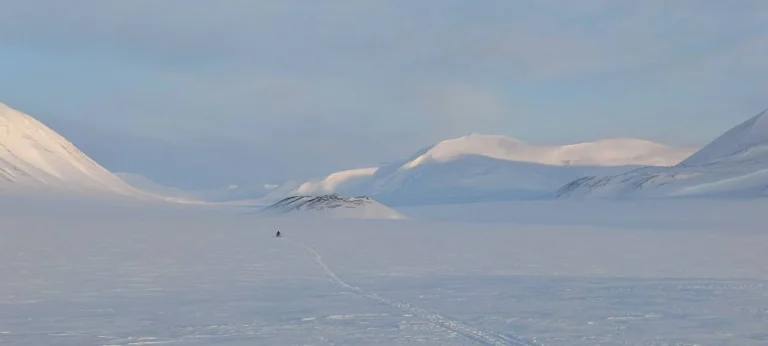
Гидролакколиты Шпицбергена: снежный ландшафт с исследовательским снегоходом на фоне ледяных бугров и горных хребтов в долине Рейндален

Hydrolaccoliths of Spitsbergen: AARI scientists studied giant ice mounds

03.04.2025
Reading time: 2 min
0

Specialists from the Arctic and Antarctic Research Institute (AARI) examined unique permafrost formations on the Spitsbergen archipelago – giant hydrolaccoliths with ice cores. Using ground penetrating radar, scientists studied their structure and found out how they were formed. 

In the Rheindalen Valley, scientists discovered a huge hydrolaccolith about 40 meters high. Its ice core raised a layer of coal from a depth of 75 meters, which indicates powerful geological processes. Scanning showed that such mounds are formed due to the freezing of groundwater that rises along faults. 

Thousands of years ago, cooling began in this region, and groundwater, fed by melting glaciers, began to freeze. Gradually, the ice accumulated, creating pressure that lifted the rocks. In some cases, the ice even ruptured rock layers, bringing coal to the surface. 

A special feature of the Svalbard hydrolaccoliths is the craters on their tops. They were formed due to the summer melting of ice, after which the soil subsided, forming depressions filled with water. Such thermokarst lakes are a rare occurrence. 

“There are only a few tens of thousands of hydrolaccoliths on the planet, but only a few allow us to study the ice core using georadar,” explained AARI researcher Nikita Demidov. “Our research helps to understand permafrost processes, which is important for studying the permafrost zone of Russia.” 

Getting to hydrolaccoliths is not easy – they are located in remote areas. To study the objects in Rheindalen, scientists traveled 80 km on snowmobiles. These studies will help better understand permafrost changes and their impact on climate. 

Source: @aari_official

Photo: Oksana Kochanova, Alexander Novikov, AARI

Prepared by —
Author avatar
Lyubov Cherkasova
TAGS
Did you like this news? Share with friends
RELATED

Leave your comment


Editor-in-Chief
Maria Kostina
Maria Kostina
Geophysicist, founder of the project and editor-in-chief GeoConversation. Salt of the Earth
GO TO THE EDITOR'S COLUMN

GeoConversation. Salt of the Earth is a media platform where top mining-industry specialists share their experience, helping professionals communicate and collaborate more effectively.

Learn more about the project
TOP PROFESSIONALS
Тарас Паникоровский — эксперт в minералогии и кристаллографии, лауреат премии «Хрустальный компас». Исследует природоподобные технологии и техносферную безопасность Арктики.

Taras Panikorovsky

Murmansk Arctic University, Murmansk
Head of Laboratory
Глеб Загорский

Gleb Zagorsky

State Scientific Center of the Russian Federation, Arctic and Antarctic Research Institute
Geophysics Engineer
Евгений Барабошкин

Evgeny Baraboshkin

Digital Petroleum
Product Lead
VIEW ALL EXPERTS
CATEGORIES
SUBSCRIBE
If you would like to receive a monthly selection of fresh articles by email
LIKE THE PROJECT? SUPPORT US
Friends, developing the project takes a lot of effort and financial resources. If you like what we do, you can support us in two ways.
MORAL SUPPORT
Show our website to your friends. Just click on the social media icons below and share our website on your pages.
FINANCIAL SUPPORT
Even a small fee will help us pay for the transcription (audio to text) of an expert interview or the design of drawings, diagrams, and tables.
Send a donation
Got an article idea? Suggest it.
Cool! You have an idea for us. We love that, because only the experience and knowledge of an expert makes our articles useful for the reader. Please answer 5 questions to let us know a little more about you and the article
answer questions