Skoltech specialists, together with French colleagues, have refuted the hypothesis about molecular oxygen as the cause of degradation of new generation lithium-ion batteries. This discovery eases the path to commercialization of a technology capable of storing 30% more energy.
Next-generation lithium-ion batteries with lithium-enriched cathodes (NMC) are considered a promising technology, capable of storing a third more energy than current equivalents. However, their commercialization was hampered by deterioration of performance during operation. Previously, it was believed that the problem was due to the formation of molecular oxygen (O₂) in the cathode, which led to a drop in voltage and capacitance.
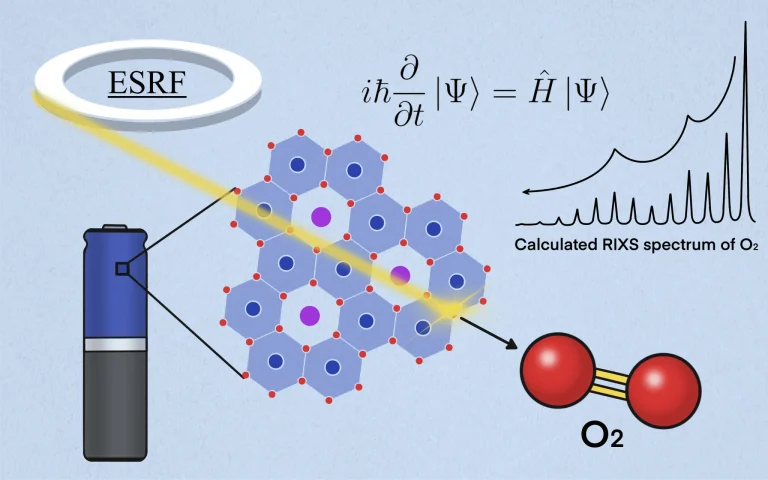
Skoltech scientists, together with colleagues from the University of Montpellier and the Collège de France, conducted a large-scale study using a megascience experimental setup. Analysis of the data showed that the oxygen molecules detected earlier were actually a measurement artifact – they were formed under the influence of the X-ray radiation used for analysis.
“The hypothesis of molecular oxygen in the pores of the cathode remains a thing of the past,” said Dmitry Aksenov, senior lecturer at Skoltech’s Center for Energy Technologies. “Now we can focus on other degradation mechanisms that are easier to eliminate.”
A study published in the journal *Nature Materials* found that the problem is due to the oxidation of structural oxygen – atoms that remain in the crystal lattice but lose electrons. This discovery greatly simplifies the task of stabilizing cathode materials and makes the commercialization of new batteries more realistic.
The research results open up new opportunities for the development of the next generation of lithium-ion batteries. Removing a key barrier to their commercialization will accelerate the transition to sustainable energy and improve the efficiency of energy storage in electric vehicles and power grids.
Source: naked-science.ru
Photo: Analysis of the results of experiments carried out at the European Synchrotron Radiation Facility (ESRF) showed that the diatomic molecule of oxygen gas (O₂), detected in the cathode of a lithium-ion battery in the X-ray scattering spectrum (RIXS), was formed under the influence of X-rays / © Lyubov Savenkova, Skoltech press service