Specialists from Perm Polytechnic University have created a mathematical model that takes into account many parameters when drilling oil wells. This will improve the accuracy of calculations and avoid errors in design and operation.
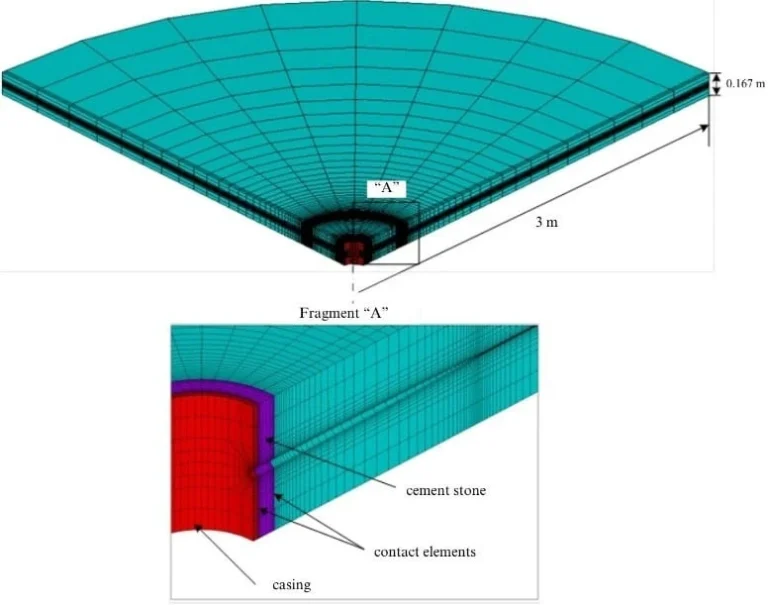
Geomechanical modeling is an important tool in oil production that helps determine optimal conditions for drilling and production. However, existing methods often give inaccurate results because they do not take into account all factors. Perm Polytechnic scientists have proposed a new model, which analyzes the stress state of the casing, cement stone and rock around the well.
The developed model takes into account the geometry of the perforation channels, which makes it more accurate compared to analogues. It allows you to assess the stability of the well, select the optimal materials for cementing and predict production productivity.
A special feature of the model is the use of contact elements to analyze the interaction between the casing, cement and rock. This makes the calculations more realistic. Scientists have already tested the model using a vertical well as an example, and the results showed high accuracy – the discrepancy with classical methods was only 3.8%.
A new model from Perm Polytechnic scientists can significantly improve the accuracy of calculations in the design and operation of oil wells. This will help avoid productivity problems and improve production efficiency.
Source: naked-science.ru
Photo: Press service of PNRPU