Rosneft specialists have created a unique technology for determining the filtration properties of rocks. The development of Tyumen and Tomsk scientists makes it possible to more accurately predict well production and optimize the development of complex deposits.
In the face of depletion of large fields, the oil industry is actively developing hard-to-reach reserves. The key task is to accurately predict production volumes, which directly depends on understanding the filtration processes in the reservoir. Hydrodynamic modeling of development requires accurate data on the phase permeability that determines the movement of fluids through the rocks.
Determining these parameters using traditional methods is quite difficult. Particular difficulties arise when working with carbonate reservoirs in Eastern Siberia, which have a heterogeneous structure of the void space. Standard core studies often do not provide the required measurement accuracy.
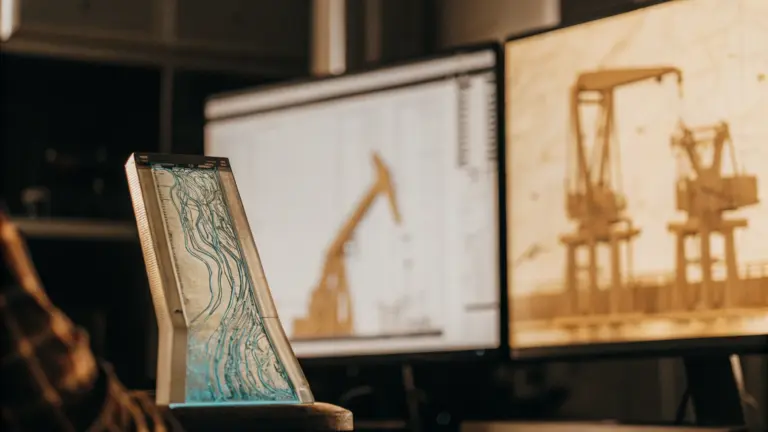
A new method developed by Rosneft scientists fundamentally changes the approach to studying rocks. Researchers analyze the structure of the pore space in detail and create special samples for repeated measurements at different points and planes. This makes it possible to identify the main pathways for hydrocarbon filtration and build a highly accurate digital model.
The implementation of the technology is already demonstrating practical results – the accuracy of hydrodynamic modeling has increased by 5%. This significantly optimizes technological processes and increases efficiency production hard-to-recover reserves. The new method opens up prospects for developing complex deposits while reducing costs.
The material was prepared with the support of the Russian Ministry of Education and Science as part of the Decade of Science and Technology.
Source: geonews.ru
Image generated by a neural network