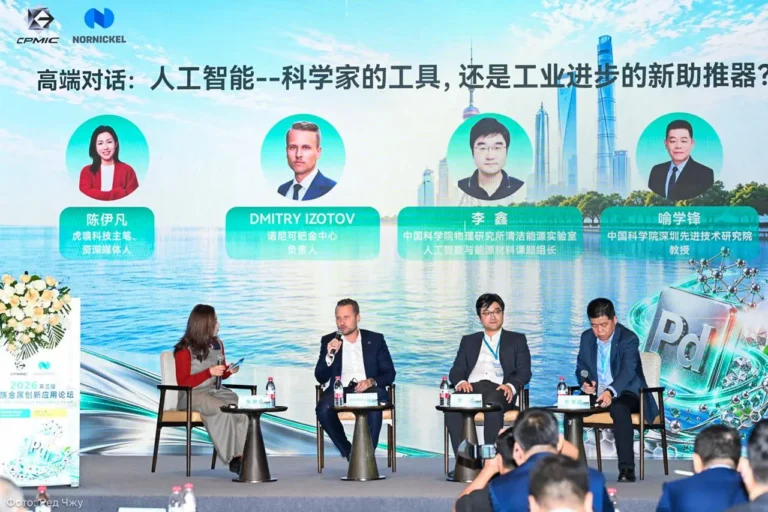
Nornickel has presented developments from its Palladium Technology Center in Shanghai and offered Chinese companies joint testing. Behind the presentation lies a larger task: finding new markets for a metal for which the auto industry accounts for more than 80% of demand today. The bet is on generative artificial intelligence and the world’s first laboratory fully dedicated to palladium.
The Palladium Technology Center was created in 2023 and already manages about 30 active projects. Its budget is estimated at $100 million, and the goal is to create 100 new palladium materials by 2030. In April, a laboratory opened in Moscow’s Lomonosov cluster, providing a full cycle: from hypothesis and synthesis to analytics and testing.
The previous approach to finding materials was slow and expensive. Researchers worked through about 50 candidates a year, and a single discovery could take decades. Now generative AI creates and evaluates up to 10,000 structures in a one-month cycle, weeding out weak options before synthesis. That is 200 times more than the team could test manually in a year, and twelve times faster in terms of time.
Three directions have already moved beyond the calculation stage. For fiberglass production, palladium alloys have been found that are not inferior to platinum benchmarks but cost less. They are now undergoing large-scale industrial trials at Chinese manufacturers. In solar energy, a palladium additive to perovskite cells raises efficiency by two percentage points, and those tests in China have already been completed. In microelectronics, AI has identified palladium structures for ultra-thin conductive layers, including 6G equipment, but this work is still at the pilot development stage.
The economic significance of microelectronics for Nornickel is especially great. The global industry consumes about 250 tonnes of gold a year for contact pads and conductors, while palladium is three times cheaper and almost half as heavy. However, replacement requires coatings that retain their properties at ultra-small thicknesses, and this is exactly the problem being addressed by the AI platform being created jointly with the Kurnakov Institute.
Center head Dmitry Izotov noted that generative AI has already changed drug discovery, and inorganic materials are next in line. According to him, partners get fewer refinement cycles and materials that do exactly what their product requires.
The next step is an automated laboratory where AI and robots will work around the clock. The goal is to go from idea to first industrial application in two years.
For Nornickel, this is not just a scientific presentation but an attempt to reduce dependence on automotive demand for palladium. Success depends on how quickly the new materials turn into repeat orders and real consumption volumes. For now, the laboratory offers a tool that makes the search faster but does not guarantee a commercial result.
Source: Nornickel
Image: Nornickel