Scientists from Russia and Canada have identified a hidden volcanic center on Venus, changing ideas about the planet’s geology. The study is based on data from the Magellan probe, which studied the planet back in the 1990s.
Despite their similar size and mass, conditions on Venus are radically different. The temperature here reaches 467 °C, and the pressure is 93 times higher than on Earth. The surface is covered with giant lava fields formed by powerful eruptions.
Theia Mons volcano, located in the Beta region, is comparable in area to France. While studying its structure, geologists discovered a second eruption center hidden under young lava flows. This center is displaced 200 km from the main one, which may be associated with the movement of the mantle plume.
The discovery will help better understand the geological evolution of Venus and help select sites for future missions such as Venera-D. However, the exact age of the volcano is still unknown; soil samples are needed for this.
“Volcanic activity on Venus may continue, but we are unlikely to see a new eruption in the next millions of years,” noted Arina Shimolina, co-author of the study.
Source: naked-science.ru
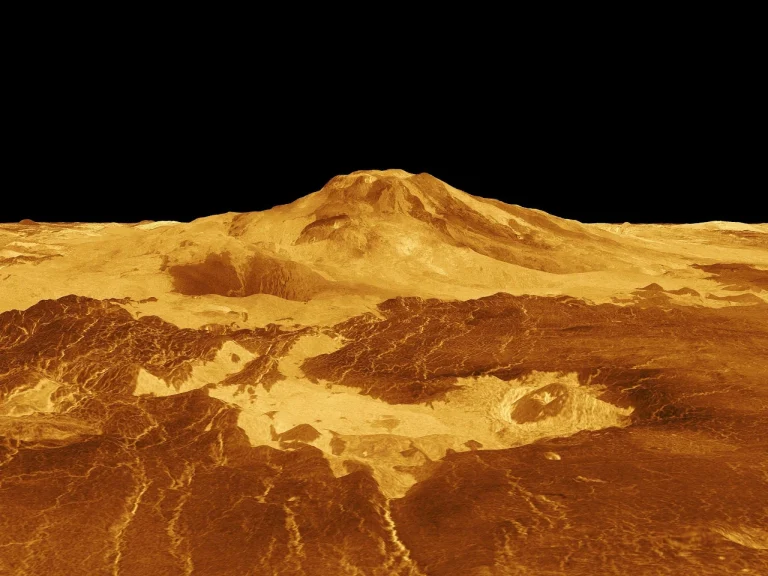
Photo: Three-dimensional perspective of the Maat Mons volcano on Venus. The viewpoint is located 634 kilometers north of Maat Mons at an altitude of three kilometers above the area. Lava flows extend hundreds of kilometers to the base of the volcano. As the researchers note, the history of Theia Mons is comparable to other shield volcanoes, including Maat Mons / © Wikimedia Commons, NASA