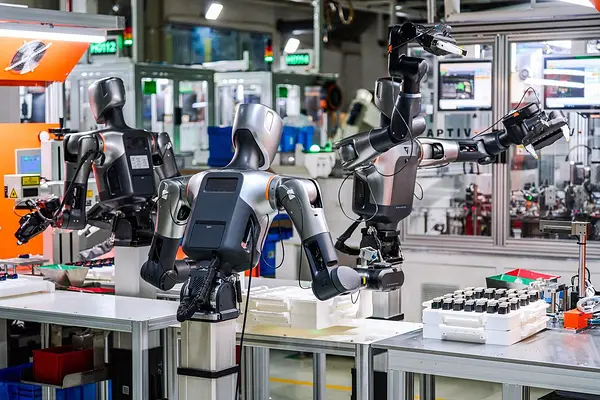
TARSBOT and Aptiv have signed an agreement to expand cooperation in embodied AI, artificial intelligence built into physical machines. By the end of the year, Aptiv plans to put 100 TARSBOT A-series industrial robots into operation. They will cover eight categories of production processes and 33 application scenarios, including flexible assembly, coordinated inspection, and production management. The first batch is already working on real lines at Aptiv’s smart factory.
The agreement was signed at the ninth China International Import Expo in Shanghai. Besides supplying the robots, the parties agreed to integrate Aptiv’s high-performance computing platforms into TARSBOT machines. This is meant to ensure reliable operation in real industrial conditions, with mass production planned for 2026.
The second part of the cooperation is joint validation of applications in a real environment. Data obtained on the production floor will be used to develop AWE, TARSBOT’s universal foundation model for embodied AI.
The project is being carried out with the support of the Jiading District government in Shanghai. The companies are already working on creating China’s first fleet of industrial embodied AI robots, with a target scale of 1,000 units. The first phase is under way at Aptiv’s production site, where the robots are being adapted to real processes and requirements. The signing at CIIE marks a transition to a more systematic and large-scale stage.
Aptiv’s computing platforms provide a flexible and reliable foundation for perception, decision-making, and motion control. Combined with TARSBOT’s end-to-end capabilities and its experience on real lines, this should enable effective deployment at industrial scale.
The project is meant to prove that large-scale adoption of embodied AI is tested not in the lab but on real shop floors. If the model works, it could become a benchmark for replication worldwide, from flexible assembly to production management.
Source: TARS
Image: TARS