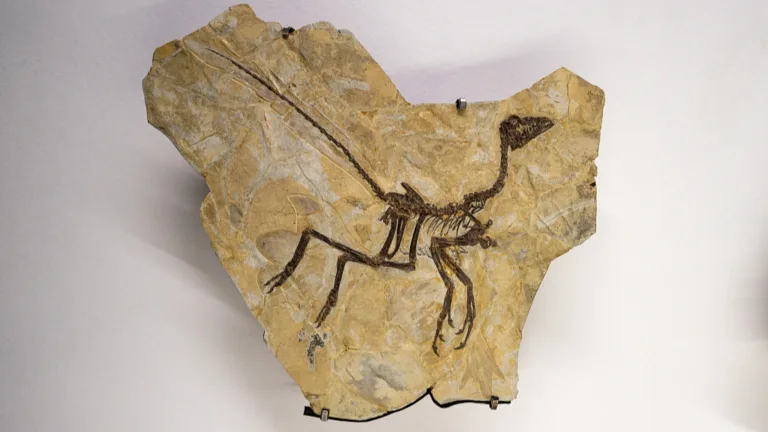
In Patagonia, where the remains of giant lizards were previously found, paleontologists discovered something else. The nearly complete skeleton of the crow-sized dinosaur lay buried in sandstone for about 95 million years. Scientists named it Alnashetri cerropoliciensis and gave it the affectionate nickname Alna. This is one of the tiniest dinosaurs known to science.
Alna weighed only 700 grams – less than a chicken. She was shorter than the average person’s knee. Despite its miniature size, it was a predator. Sharp teeth, like those of a small velociraptor, helped her hunt lizards, snakes and insects. The long tail made up most of the body length – about 70 centimeters.
The amazing preservation of the bones is explained by the fact that after death the carcass was quickly covered with a sand dune. This happened in the desert, which the local Mapuche Indians called Cocorque – “desert of bones.” Despite the harsh conditions, Alna lived for more than four years and almost reached adult size.
The find was made in the province of Rio Negro. The remains of snakes with legs, saber-toothed mammals and other small dinosaurs, but Alna is special. It belongs to the family Alvarezsauria, an unusual group of theropods from which birds evolved. They had short powerful front legs, long hind legs and a light skull. Scientists suspect that Alna was covered with feathers, like her relatives, but could not fly – her limbs were too short.
Late alvarezsaurs ate termites and had tiny teeth. Alna had strong teeth and no signs of an insectivorous diet. This means that miniature sizes developed in this line independently and long before the transition to ants.
Paleontologists first found the remains of Alnashetri cerropoliciensis in 2004 – these were two incomplete legs. The current specimen was discovered in 2014, but it took 12 years to extract the bones from the rock and study them. Thin sections made it possible to examine the cellular structure; experts called the level of preservation exquisite.
The discovery changes the understanding of the Cretaceous period of Patagonia. This era was previously called the “time of the southern giants” because of Argentinosaurus and Giganotosaurus. But Alna shows: here was not just a land of giants, but a world with a huge variety of creatures. Large animals coexisted with small ones, and without them the ecosystem would have been incomplete.
Source: Reuters
Image: VCG