New research points to the possibility of a solid inner core on Mars. Scientists have conducted experiments with iron sulfide, which can crystallize in the Martian interior.
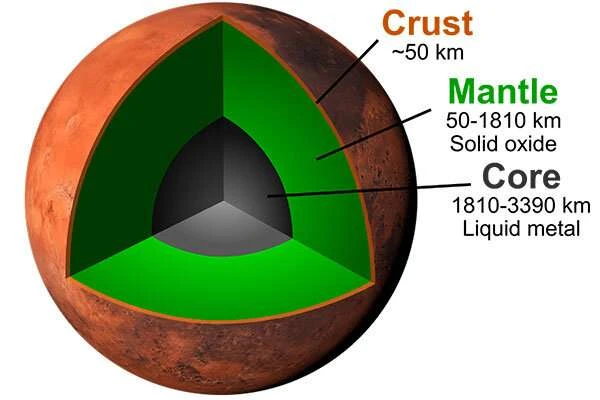
Mars, like Earth, has a liquid core consisting primarily of molten iron mixed with sulfur. This is confirmed by data obtained by the NASA InSight probe. However, scientists suggest that there may be a solid inner core at the center of the planet.
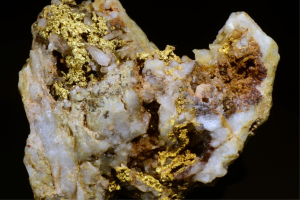
According to a new study published in the journal *Nature Communications*, the Martian core may contain an unusual iron sulfide (Fe4+xS3) that can crystallize under certain conditions. Experiments carried out by an international team of scientists from Germany, France and Belgium showed that the material is stable at pressures of up to 40 gigapascals and temperatures of about 1970 kelvins – conditions similar to those found in the center of Mars.
“If the temperature in the core drops below 1960 kelvin, iron sulfide will begin to crystallize, which can lead to the formation of a solid inner core,” the researchers explain.
So far, there is no direct evidence of the existence of a solid core on Mars. Seismic data from the InSight probe has revealed the boundary between the mantle and the liquid core, but what lies beneath remains a mystery. If a solid core exists, its radius does not exceed 750 kilometers.
The study opens new horizons for understanding the evolution of Mars. If the hypothesis is confirmed, it will help explain how the planets of the solar system formed and cooled. Scientists plan to continue experiments to clarify the data.
Source: naked-science.ru
Photo: Internal structure of Mars / © 2020 Takashi Yoshizaki