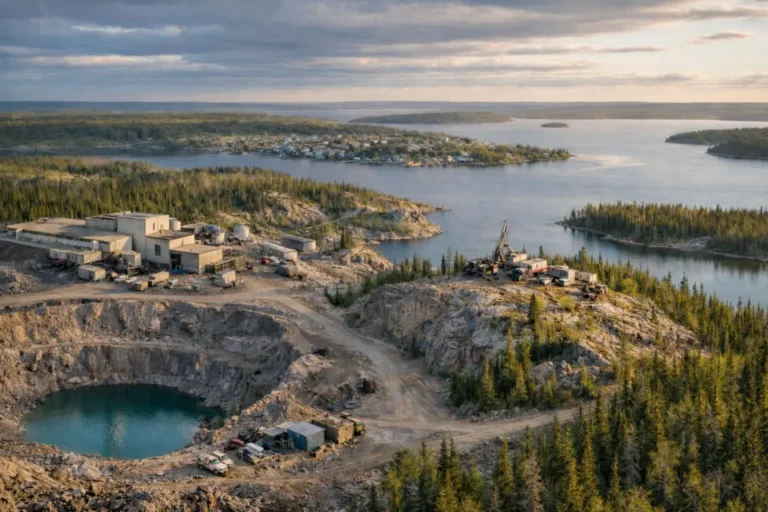
Canadian company Triton Uranium has completed four technical reports on its Atlas project in Saskatchewan. The project is a large, low-grade deposit amenable to open-pit mining. Total potential is estimated at nearly 46.5 million pounds of uranium oxide (U₃O₈), including resources from the Red Rock deposit and neighboring occurrences.
Two resource categories have been calculated for Red Rock. Indicated resources total 276,702 tonnes of ore at an average grade of 0.087% U₃O₈, yielding roughly 531,000 pounds of metal. Inferred resources stand at 20,946 tonnes at a grade of 0.060%, or nearly 28,000 pounds.
The Atlas project is located in the historic Beaverlodge uranium district, which has produced approximately 77.8 million pounds of U₃O₈ over its mining history. The company’s roughly 46,000-acre land package borders former production centers, including the Ace-Fay-Verna complex with its 50.4 million pounds. The Uranium City area, home to the project, has sat idle for 44 years — Triton intends to bring it back to life and provide North America with a large-scale source of raw material.
The initiative coincides with accelerating efforts by Canada and the United States to build a continental critical minerals supply chain under a bilateral action plan. Canada, the world’s second-largest uranium producer after Kazakhstan, aims to double exports by 2035 while developing reactor programs and small modular reactor projects. This is fueling demand for a reliable domestic fuel source.
Exploration is ongoing. A recent airborne gamma-ray survey identified about 11 kilometers of new, near-surface exploration targets. These are being tested as part of a current 10,000-meter drilling program, with additional work planned for winter 2026–2027. According to the company, a significant portion of the land package remains underexplored.
Triton is betting on the combination of the district’s historical legacy and modern mining technology. Existing infrastructure, the company calculates, should allow for faster permitting and shorter construction timelines compared to remote greenfield projects. Looking ahead, Atlas could become the continent’s only low-cost, open-pit uranium mine.
Triton Uranium President Scott Evans emphasized that demand for nuclear energy is growing, and that Saskatchewan is positioned to play a key role as a reliable, allied source of uranium for Canada and the US. The technical reports, he said, are an important step toward realizing that opportunity.
Atlas is evolving from a historic district into a modern project with well-defined resources and drilling plans. If exploration confirms the new targets, Saskatchewan could gain another major uranium asset supporting continental energy security.
Source: MINING.COM
Image: Triton Uranium